
By early August, a garden can feel both abundant and vulnerable. Tomatoes are colouring, seed heads are forming and insects crowd the flowers, yet heat, drought and sudden storms can quickly expose weaknesses in soil, planting and water management.
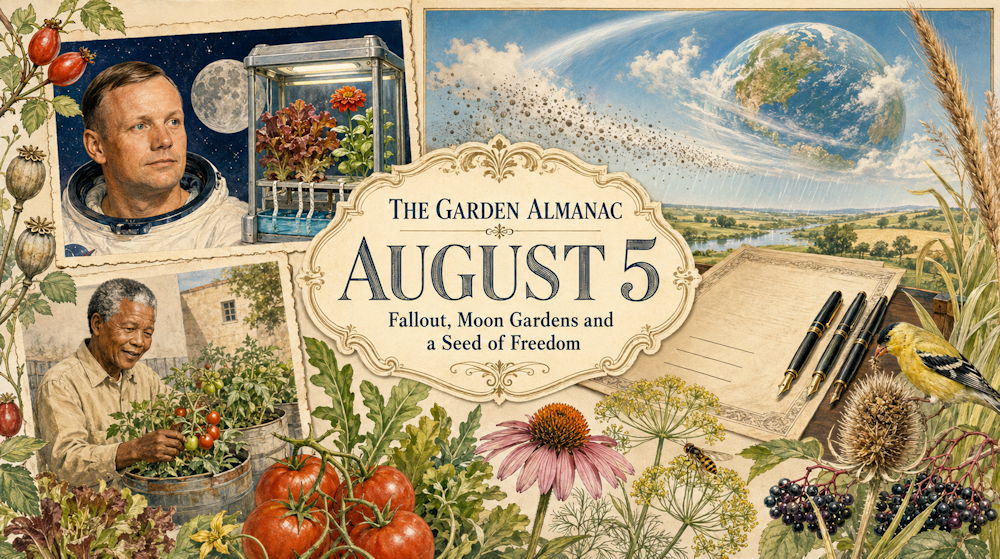
August 5 opens three unusually wide windows onto our relationship with the living world. One leads into an atmosphere once burdened by radioactive fallout, another towards the challenge of growing plants beyond Earth, and the third into a prison garden where tending vegetables became a quiet expression of freedom.
August 5, 1963 – The Treaty That Helped Clear the Sky
On August 5, 1963, representatives of the United States, the Soviet Union and the United Kingdom signed the Partial Nuclear Test Ban Treaty in Moscow. The agreement prohibited nuclear test explosions in the atmosphere, underwater and in outer space, although underground testing remained permitted under certain conditions. It was an arms-control milestone, but it was also an important act of environmental protection.
Atmospheric nuclear tests had dispersed radioactive particles far beyond the places where explosions occurred. Fallout could be carried by winds, returned to Earth in rain and deposited on fields, pastures, forests and water. Two of the most concerning long-lived products were strontium-90 and caesium-137. Strontium behaves chemically rather like calcium, allowing it to enter plants and food chains, while caesium can move through soil and be absorbed by vegetation.
The treaty did not remove contamination already present, nor did it end every form of nuclear testing. It did, however, greatly reduce a source of pollution that ignored national borders and demonstrated something gardeners understand instinctively: nothing in the environment exists in isolation. Air becomes rain, rain enters soil, roots take up what the soil contains, and plants become food for animals and people.
That lesson remains relevant wherever land may have been contaminated by industry, flooding, fire debris, old paint, treated timber or heavy traffic. Home gardeners cannot identify pollutants by looking at the soil. If contamination is suspected, laboratory testing is more reliable than assumptions, and edible crops can be grown in clean imported soil in raised beds while the original ground remains covered with mulch or perennial vegetation.
Garden Science – Can plants remove pollution from soil?
Some plants can absorb or stabilise particular contaminants, a process known as phytoremediation. Its effectiveness depends on the pollutant, soil chemistry, plant species and the depth of contamination. It is rarely a quick home-garden remedy, and contaminated plant material may require controlled disposal rather than composting.
August 5, 1930 – From an Ohio Farm to the First Moon Gardeners
Neil Armstrong was born in rural Ohio on August 5, 1930. Thirty-nine years later, as commander of Apollo 11, he became the first person to walk on the Moon. His famous journey appears far removed from vegetable beds and flower borders, yet human exploration beyond Earth has created an entirely new branch of horticulture.
Plants offer more than fresh food on a long space mission. They can recycle carbon dioxide, release oxygen and return water to a closed life-support system through transpiration. Living foliage may also provide psychological comfort in an environment dominated by machinery. Modern space gardens have already produced crops including lettuce, radishes, Chinese cabbage and chilli peppers, while compact growth chambers allow researchers to control light, moisture, nutrients and airflow.
The greatest difficulty is often found below the leaves. On Earth, gravity helps water drain through soil and allows air to return to the spaces around roots. In microgravity, water can cling to surfaces and gather around roots, depriving them of oxygen. Space-growing systems therefore deliver moisture very precisely through porous substrates, wicks or hydroponic equipment – a sophisticated version of a familiar terrestrial rule: roots need air as well as water.
For gardeners on Earth, the practical lesson is simple. A plant that wilts is not necessarily thirsty, and adding more water can make matters worse if its roots are already sitting in saturated compost. Before watering a container, check below the surface, confirm that its drainage holes are open and notice whether the pot feels unusually heavy.
Seasonal Tips – How can container plants cope with August heat?
- Water thoroughly when the upper few centimetres of compost feel dry, rather than giving frequent shallow sprinkles.
- Water in the morning where possible, allowing foliage to dry and roots to replenish moisture before the hottest part of the day.
- Group pots together to reduce exposure, but leave enough space for air to circulate.
- Shade dark containers from fierce afternoon sun because overheated root zones can damage plants even when the compost is moist.
- Place saucers beneath plants that enjoy steady moisture, but do not leave drought-tolerant species permanently waterlogged.
August 5, 1962 – The Prison Garden That Offered a Taste of Freedom
On August 5, 1962, Nelson Mandela was captured near Howick in South Africa. His arrest led first to a five-year sentence and later, following the Rivonia Trial, to life imprisonment. He would spend 27 years in prison, including 18 years on Robben Island.
Gardening became one of the few areas of prison life over which Mandela could exercise some control. He cultivated vegetables in improvised containers and later created a roof garden at Pollsmoor Prison. The harvest improved meals, but the garden’s importance extended beyond food. Seeds responded to patience rather than prison authority, and each new leaf offered visible evidence that careful work could still produce change.
His experience reveals why gardens matter in schools, hospitals, refugee settlements, prisons and crowded cities as well as in private homes. Cultivation restores a small measure of agency: a person can prepare soil, choose a seed, observe its needs and help it reach maturity. The most useful garden is therefore not always the largest or most beautiful. A bucket with drainage holes, a sunny windowsill or a narrow communal bed can be enough to begin.
For anyone working with little space, fast and forgiving crops provide the strongest start. Loose-leaf lettuce can be harvested one leaf at a time, radishes mature quickly, and herbs such as chives, parsley and mint tolerate repeated picking. Where summer heat makes sowing difficult, gardeners can prepare containers now and wait for slightly cooler conditions before starting autumn leaves.
Garden Reminder – What can be sown in early August?
In many temperate Northern Hemisphere gardens, early August is suitable for sowing quick autumn crops such as rocket, spinach, Asian leaves, radishes and winter lettuces. Timing depends on local climate: in very hot regions, use light shade and keep the seedbed evenly moist, while gardeners in cooler areas should sow promptly so plants establish before days shorten sharply.
Wildlife Note – Leave a Little Water at Ground Level
Hot, dry weather affects far more than cultivated plants. Birds need safe drinking and bathing water, while bees, hoverflies and other insects may visit damp soil or shallow dishes.
A wildlife water station should be shallow, stable and easy to escape from. Add pebbles or partly submerged stones as landing places, keep the water in light shade, and replace it frequently to prevent fouling and mosquito development. Avoid deep, smooth-sided containers in which small animals could become trapped.
What to Observe Right Now – The Garden’s Shift Towards Seed
Early August often marks a subtle turning point. Growth continues, but many plants are beginning to invest more energy in fruit and seed than in fresh leaves.
Look closely for swelling rose hips, darkening elderberries, drying poppy capsules and the first mature seeds on annual flowers. Watch which seed heads attract finches and which late blooms still draw bees. These observations can guide autumn decisions: what to collect, what to leave for wildlife and which self-seeding plants deserve room to return next year.
Looking Ahead
The stories of August 5 move from a contaminated atmosphere to gardens in orbit and finally to vegetables cultivated behind prison walls. Each reminds us that growing plants depends on clean soil, breathable roots, patient observation and the freedom to care for a living place. Protecting those conditions – in a window box, a community garden or across an entire landscape – is practical work with consequences far beyond the garden gate. The future begins in such modest acts: testing before planting, watering with understanding, saving a seed and making room for life to continue.