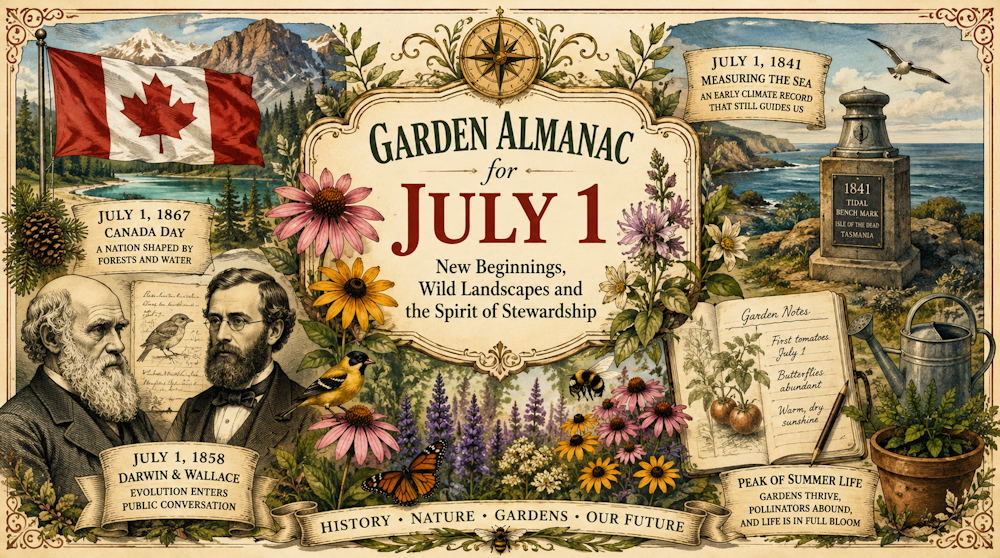

The first day of July feels like the true gateway to high summer. Gardens have settled into their rhythm, vegetable beds promise generous harvests, pollinators work from sunrise to sunset, and many of us finally find time to slow down and enjoy the green spaces we’ve nurtured throughout spring.
Yet July 1 is more than simply the start of another summer month. Throughout history, this date has marked moments of new beginnings – the birth of nations, breakthroughs in scientific understanding, and reminders of our evolving relationship with landscapes. Together, they tell a story that gardeners know well: healthy ecosystems and thriving communities are built patiently, one season at a time.
From Canada’s forests to groundbreaking ideas about evolution, July 1 offers a surprisingly rich collection of stories that continue to inspire anyone who loves nature.
Canada Day – A Nation Shaped by Forests and Water
On July 1, 1867, the British North America Act came into effect, uniting several colonies into the Dominion of Canada – an event now celebrated each year as Canada Day.
For gardeners, Canada represents far more than a political milestone. It is home to some of the world’s largest intact forests, immense freshwater reserves, and remarkable plant diversity stretching from temperate rainforests on the Pacific coast to Arctic tundra.
Canadian horticulture has also influenced gardens around the globe. Native species such as serviceberry, coneflowers, wild bergamot, black-eyed Susan and countless hardy shrubs have become favourites for wildlife-friendly planting. These resilient plants remind us that beautiful gardens often begin by working with nature rather than against it.
Canada Day is therefore also a celebration of landscapes that continue to teach valuable lessons about biodiversity, ecological restoration and sustainable gardening.
Garden Inspiration
If you’re looking to make your garden more pollinator-friendly, keep an eye out for North American favourites such as purple coneflower (Echinacea purpurea), wild bergamot (Monarda fistulosa) and black-eyed Susan (Rudbeckia hirta). These popular perennials provide weeks of colourful blooms, attract bees and butterflies in abundance, and remain impressively resilient during hot, dry summers.
Darwin and Wallace – The Day Evolution Entered Public Conversation
One of the most influential scientific moments connected with July 1 occurred in 1858, when the joint papers of Charles Darwin and Alfred Russel Wallace introducing the theory of natural selection were presented to the Linnean Society of London.
Neither scientist could have imagined how profoundly their ideas would transform biology, ecology and eventually gardening itself.
Modern gardeners rely on evolutionary thinking every day, often without realising it. Understanding why flowers attract particular pollinators, how plants adapt to different soils, why certain pests evolve resistance, or how wild species became today’s vegetables all stems from the principles first publicly shared on this date.
Even selective breeding – whether producing sweeter tomatoes, disease-resistant roses or compact ornamental trees – is built upon the understanding that living organisms continuously adapt over generations.
Looking around a flourishing garden today means seeing evolution in action: bees choosing flowers, birds selecting nesting sites and plants competing, cooperating and responding to changing conditions.
Nature Watch
Take a closer look at different flowers growing nearby.
- Which insects visit open daisy-like blooms?
- Which flowers attract bees with tubular shapes?
- Which plants seem to receive the greatest diversity of visitors?
These observations reveal countless small examples of evolutionary partnerships that have developed over millions of years.
Measuring the Sea – An Early Climate Record
Another lesser-known July 1 event took place in 1841, when explorers James Clark Ross and Thomas Lempriere established a permanent tidal benchmark on Tasmania’s Isle of the Dead. It became one of the earliest long-term sea-level reference points still used by modern scientists.
What began as a practical navigation exercise has become unexpectedly valuable in today’s climate research. By comparing modern measurements with this historic marker, scientists can better understand how sea levels have changed over nearly two centuries.
Although gardeners may live far from the coast, climate trends increasingly influence every growing season. Longer heatwaves, shifting rainfall patterns and changing flowering times have become familiar observations across much of the world.
Historical records like these remind us that careful observation matters. Garden journals, flowering calendars and notes about first harvests may seem personal, but together they contribute to our broader understanding of environmental change.
Seasonal Tip
Start a simple garden diary this month. Record rainfall, flowering dates, first ripe vegetables and visiting wildlife. Even a few minutes each week can build an invaluable record for future seasons.
July’s Peak of Summer Life
By the beginning of July, gardens in much of the Northern Hemisphere reach one of their busiest periods.
Tomatoes begin swelling rapidly, beans climb vigorously, herbs produce fragrant new growth, and berry harvests gather pace. Butterflies, hoverflies, bees and countless other beneficial insects are now at their seasonal peak.
This abundance is also a reminder that healthy gardens are ecosystems rather than collections of individual plants. Every flowering border supports pollinators, every compost heap shelters decomposers, and every mature tree offers food or refuge to birds and insects.
Rather than striving for perfection, many gardeners now embrace a more natural balance – allowing some seed heads to mature, leaving small wild corners untouched and recognising that a little untidiness often means greater biodiversity.
Garden Reminder
Early July is an excellent time to:
- Water deeply rather than frequently during dry weather.
- Harvest vegetables regularly to encourage continued production.
- Deadhead repeat-flowering annuals and perennials.
- Watch for signs of drought stress before leaves begin to wilt.
- Leave shallow water sources available for birds, bees and other wildlife during hot spells.
Looking Ahead
July 1 reminds us that every landscape has a story. Some begin with historic moments like the founding of a nation, others with scientific discoveries that changed how we understand life itself, while still others emerge quietly through decades of careful observation.
Our own gardens become part of that continuing story. Every tree we plant, every pollinator we welcome and every sustainable choice we make contributes to landscapes that future generations will inherit.
As summer unfolds, this is an ideal moment not only to enjoy the season’s beauty but also to notice the connections that make gardens thrive – between plants and insects, people and nature, history and the living world growing just beyond our doorstep.