


By the last day of September, a garden often feels as if it is holding two seasons at once. The soil may still remember summer warmth, but the light has changed; seedheads dry, leaves loosen, and every watering can or rain shower suddenly seems more important than it did in July.
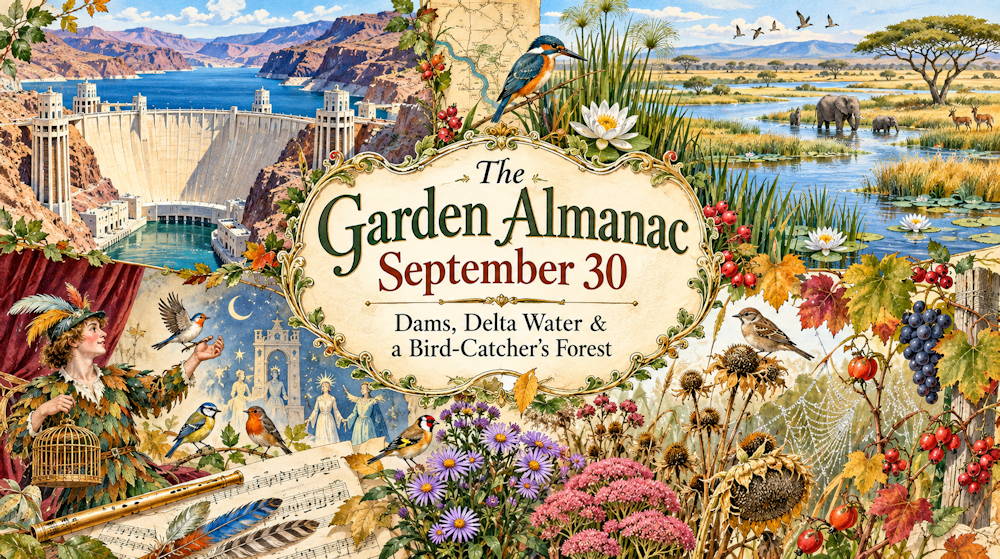
September 30 opens three very different doors into that same seasonal question: how do people live with water, landscape, wildlife and imagination? From a giant dam in the American desert to Botswana’s dryland wisdom and Mozart’s bird-haunted stage, today’s almanac is not a list of anniversaries. It is a reminder that gardens are always shaped by bigger stories.
September 30, 1935 – The Dam That Made a Desert Bloom, and Pay the Price
On September 30, 1935, Franklin D. Roosevelt dedicated Boulder Dam, later officially known as Hoover Dam. It was presented as a triumph of engineering: a concrete wall rising from the Colorado River, holding back floodwater, generating electricity and promising security to farms and cities across the American Southwest.
For gardeners, the striking detail is not only the scale of the structure, but the idea behind it. Water, once wild and seasonal, was being turned into something measured, stored and delivered. In practical terms, this helped make modern irrigated agriculture possible in places where rainfall alone could never support such abundance. Orchards, vegetable fields, lawns and cities all grew from the belief that water could be commanded.
But September gardens also know the other side of that story. A river is not just a pipe with scenery around it. Dams alter silt movement, fish migration, floodplain renewal and the rhythm by which plants and wildlife have adapted for centuries. The Colorado River became a lesson in both human ingenuity and ecological accounting: every controlled flow has consequences somewhere downstream.
Today’s gardener does not need a canyon-sized project to meet the same question. A rain barrel, a dry creek bed, a pond, a swale or a mulched border all ask us to think about water before it becomes a crisis. The most resilient gardens do not simply “use” water; they slow it, store it, share it with roots and soil life, and let excess move away without damage.
Garden Reminder – Water Smarter as Autumn Begins
Late September is a good moment to adjust watering habits before colder weather arrives.
- Water deeply but less often, especially around trees, shrubs and newly planted perennials.
- Check soil moisture before watering containers; cool nights slow evaporation.
- Keep mulch 5–8 cm deep, but pull it back from stems and trunks.
- Empty saucers under pots after rain to prevent root rot.
- Prioritise evergreens before winter, because they continue losing moisture through their leaves.
- A garden that enters autumn evenly hydrated is better prepared for wind, frost and sudden dry spells.
September 30, 1966 – Botswana and the Wisdom of Dryland Landscapes
On September 30, 1966, Botswana became an independent republic. At first glance, this may seem far from the concerns of an autumn garden, but Botswana offers one of the world’s most powerful lessons in reading land carefully. Much of the country lies within the Kalahari, where water is precious, seasonal and unevenly distributed.
The surprise is that scarcity does not mean emptiness. Botswana contains extraordinary ecological contrasts, from dry savanna and thornveld to the Okavango Delta, where floodwater travels inland and spreads into a vast wetland instead of flowing to the sea. The result is a landscape where timing matters as much as quantity: a pulse of water can feed grasses, attract wildlife, recharge soils and transform the visible world.
For gardeners in temperate climates, this changes how we think about “dry” spaces. A dry garden should not be treated as a failed version of a lush one. It can be designed as a living system in its own right, using plants with deep roots, small or waxy leaves, silver foliage, seasonal dormancy and strong relationships with soil fungi. Drought resilience is not a single trick; it is a whole pattern of growth.
September 30 therefore becomes a useful day to look honestly at the dry corners of a garden. Instead of forcing every bed into the same style, we can match planting to reality: Mediterranean herbs where the soil drains fast, prairie plants where summer heat lingers, tough ornamental grasses where wind and sun dominate, and moisture-loving plants only where water naturally gathers.
Garden Science – Why Mulch Helps More Than It Looks
Mulch is often described as a weed suppressant, but its deeper value is water regulation. A loose organic layer shades the soil surface, reduces evaporation, softens the impact of rain and slowly feeds soil organisms as it breaks down.
In autumn, this matters because roots can continue growing after top growth slows. If the soil remains moist but not waterlogged, newly planted shrubs and perennials can establish fine roots before winter. That quiet underground work often decides how strongly plants return in spring.
September 30, 1791 – The Magic Flute and the Garden of Birdsong
On September 30, 1791, Mozart’s The Magic Flute premiered in Vienna. It is full of temples, trials, enchanted instruments and symbolic landscapes, but one of its most memorable figures is Papageno, the bird-catcher. He arrives not as a grand hero, but as someone who lives by noticing birds.
That detail is easy to pass over, yet it opens a surprisingly garden-minded way into the opera. Before birdsong became a background sound on relaxation playlists, it was part of everyday knowledge. People knew birds by season, call, movement and habit. A bird-catcher’s world was not abstract “nature”; it was a landscape of specific species, behaviours and opportunities.
Modern gardeners are beginning to recover that kind of attention, though with a different purpose. Instead of trapping birds, we now try to support them: berries left on shrubs, seedheads standing through winter, hedges planted for shelter, insects tolerated because they feed nestlings. A garden with birds is not merely prettier. It is usually more layered, more connected and more alive.
The late September garden is an excellent listening post. Migrants may be passing through, resident birds begin to change their feeding patterns, and seed-eaters become more visible as annuals and perennials dry. The lesson from Papageno’s feathered world is not nostalgia; it is observation. Once you learn who visits your garden, you begin to garden for more than yourself.
Wildlife Note – What Birds Need Now
Autumn bird support is mostly about food, cover and restraint.
- Leave some seedheads on coneflowers, teasels, sunflowers and ornamental grasses.
- Delay heavy hedge cutting where birds use dense cover for shelter.
- Plant berrying shrubs such as hawthorn, elder, cotoneaster or native roses where appropriate.
- Avoid over-tidying every border; leaf litter shelters insects that birds may later feed on.
- Keep birdbaths clean and filled, especially during dry autumn weather.
- A slightly less polished garden can be a much better winter pantry.
What to Observe Right Now
The end of September rewards slow looking. Instead of rushing into the full autumn clean-up, spend a few minutes noticing what is already changing.
Look for the first leaves colouring unevenly on stressed trees; this can reveal dry soil, compacted roots or heat damage from summer. Watch which flowers still attract bees on mild afternoons. Notice where dew lingers longest in the morning, because those cooler pockets may also be the first places frost appears later.
Seedheads are worth attention too. Some plants collapse into mush after rain, while others hold strong architectural shapes for months. Those sturdy stems are useful for winter structure, wildlife and self-seeding. The garden is quietly showing you what to leave standing.
Seasonal Tip – Plant With Next Summer in Mind
September 30 is a good planning point for climate-wise planting. If a bed struggled through summer, do not simply replace dead plants with the same choices.
Choose plants according to the stress pattern you actually observed:
- Hot, dry and sunny – try lavender, thyme, salvias, sedums, yarrow or drought-tolerant grasses.
- Damp in winter, dry in summer – improve soil structure before planting, and avoid plants that hate wet crowns.
- Shady and dry – use tough groundcovers, leaf mulch and small plants that can establish gradually.
- Exposed and windy – plant in groups, use temporary wind protection, and water well before cold weather.
- The best garden design often begins with admitting what the site is already telling you.
Looking Ahead
September 30 brings together three very different forms of attention: controlling water, respecting dryland systems and listening for life in the trees. None gives a complete answer on its own, but each helps sharpen the gardener’s eye. The future garden will need more than beauty; it will need water wisdom, habitat value and a willingness to work with local conditions. As autumn deepens, the most useful thing we can do is not hurry past these signals, but let them guide what we plant, save, leave and change next.