

By early August, the garden has begun to reveal what it can endure. Leaves carry the marks of heat and wind, fruit trees bend under their developing crop, and plants that seemed exhausted in July may surprise us with fresh growth from hidden buds.
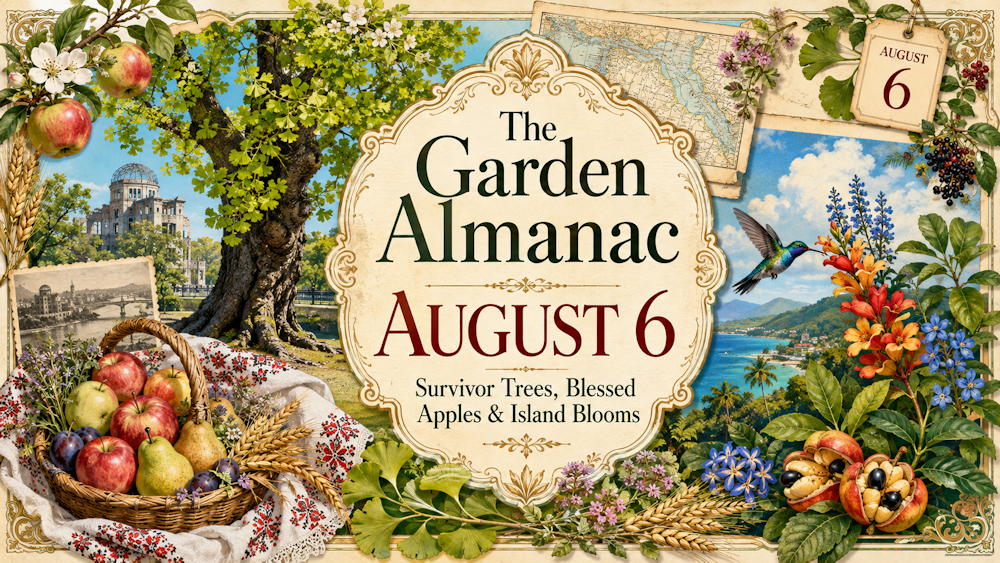
August 6 brings together three very different stories of endurance and renewal: the trees that lived through the destruction of Hiroshima, a Ukrainian feast that welcomes the apple harvest, and Jamaica’s choice of native plants as symbols of a newly independent nation. Each reminds us that landscapes preserve history – but also that thoughtful care can influence what grows next.
August 6, 1945 – The Trees That Survived Hiroshima
At 8.15 on the morning of August 6, 1945, an atomic bomb exploded above Hiroshima. Human loss stands at the centre of every remembrance of that day, yet the city’s plants also became witnesses to the devastation. Trees were scorched, stripped of branches and surrounded by ruins, and many people believed that nothing would grow in the city for decades.
Then, in the months that followed, shoots appeared. Some came from roots protected beneath the soil, while others emerged from surviving sections of trunks and branches. These trees became known as hibakujumoku – a Japanese term meaning trees exposed to the atomic bombing. Among them were ginkgos, camphor trees, willows, black locusts, Japanese hackberries, hollies and cycads.
Their survival was not a sign that radiation or extreme heat caused no harm. Plants growing above ground were gravely damaged, but soil offered a degree of insulation to roots, underground stems and dormant buds. Where enough living tissue remained, stored carbohydrates could support new shoots before a damaged crown was able to photosynthesise effectively again. The same biological capacity can be seen on a smaller scale when a fire-damaged shrub, storm-broken tree or apparently dead perennial begins growing from its base.
Many of Hiroshima’s survivor trees are now carefully recorded and protected, while their seeds have been shared with communities around the world. For gardeners, their lesson is both practical and profound: do not declare a damaged plant dead too quickly. After fire, frost, drought or severe pruning, wait for the appropriate growing season, examine the bark and buds, and look for basal growth before removing the root system. Recovery may begin in places that are not immediately visible.
Garden Science – How can a badly damaged tree grow again?
Trees store carbohydrates in their roots, trunks and larger branches. If part of the cambium – the living layer beneath the bark – survives, dormant buds may produce replacement shoots. Species differ greatly in this ability: ginkgo, willow and many broadleaved trees can recover from severe crown damage, while some conifers cannot regrow once all green growth has been lost.
August 6 – Apple Spas and the First Fruit of the Orchard
In Ukraine, August 6 is now associated with the Feast of the Transfiguration and the folk tradition known as Apple Spas, or the Apple Feast of the Saviour. The celebration combines Christian observance with much older harvest customs. Baskets of apples and other seasonal produce are brought for blessing, marking the moment when the year’s fruit can be welcomed, shared and eaten.
Apples became central to the custom because they were among the most important ripening fruits in much of Eastern Europe. Pears, plums, grapes, honey, grains and herbs may also appear, reflecting what a particular garden or farm is ready to give. The feast therefore acts as a local harvest calendar rather than a fixed botanical deadline – a reminder that ripeness is determined by variety, weather and place.
Modern gardeners should follow the fruit rather than the date. An apple may be ready when it develops its characteristic colour, separates with a gentle lift and twist, and contains seeds that are turning brown. Summer cultivars are usually eaten soon after picking, while later apples intended for storage should be harvested mature but still firm. Bruised fruit, windfalls and apples showing rot should be kept away from sound fruit in storage.
Garden Reminder – What should you do in the orchard in early August?
- Collect fallen fruit regularly to reduce opportunities for brown rot, codling moth and wasps.
- Support heavily laden branches before they split, using broad, padded ties or a forked wooden prop.
- Water young fruit trees deeply during dry weather rather than sprinkling the soil surface each day.
- Do not remove too many leaves around developing apples – some shade helps prevent sunscald during intense heat.
- Store only clean, unbruised fruit, with individual apples arranged so that decay can be spotted quickly.
August 6, 1962 – Jamaica Chooses a Living National Identity
On August 6, 1962, Jamaica became an independent nation after more than three centuries of British colonial rule. The new black, green and gold flag was raised, with green representing hope and the island’s agricultural resources. Independence also brought a search for national symbols capable of expressing Jamaica’s own landscape and identity.
Plants played an unusually visible role in that process. A committee that included representatives of the Jamaica Horticultural Society, a botanist and the superintendent of public gardens helped select the national flower, tree and fruit. The choices were the lignum vitae, the blue mahoe and ackee – three plants carrying very different stories of ecology, cultivation and cultural use.
The blue mahoe is indigenous to Jamaica and can grow into a tall, rapidly developing tree in wetter districts. Its hibiscus-like flowers change from yellow to orange-red and finally crimson as they age. Lignum vitae, the national flower, belongs to the dry coastal woodland and forms a compact crown with blue flowers and orange-yellow fruit. Together, they demonstrate an important gardening principle: plants associated with one island are not interchangeable simply because they share a tropical origin. Each belongs to particular soils, moisture levels and plant communities.
A garden expresses its own place most convincingly when locally adapted species form its structure. Native and regionally appropriate trees are more likely to fit existing rainfall patterns, soils and wildlife relationships than plants selected only for appearance. Before choosing a tree, gardeners should consider its mature size, natural habitat and water needs – the right plant is not merely one that survives, but one that can belong to the landscape without constant intervention.
Wildlife Note – Should fallen fruit be left for animals?
A little sound, overripe fruit can feed butterflies, beetles, birds and small mammals, but a heap of decaying fruit beneath a tree may also shelter pests and spread fungal disease. Leave a small amount in a designated wildlife corner, away from stored crops and productive fruit trees, and compost or dispose of diseased fruit separately.
What to Observe Right Now – Signs That Summer Is Turning
August still feels unmistakably like summer, but gardens in the Northern Hemisphere are beginning to show the first quiet signs of seasonal change.
- Look for ripening elderberries, blackberries and early apples along hedges and woodland edges.
- Notice whether drought-stressed trees are dropping a few leaves early to reduce water loss.
- Watch late-summer flowers such as oregano, mint, echinacea and helenium for bees, hoverflies and butterflies.
- Listen for changes in the morning soundscape as some birds become less territorial and more discreet after breeding.
- Examine damaged shrubs for small basal shoots before deciding whether autumn removal is necessary.
Observation is particularly valuable after a difficult summer. A plant that wilts at midday but recovers overnight may be responding normally to temporary water stress, while one that remains limp in cool morning conditions needs closer investigation. Seasonal change is read most accurately through repeated small observations, not a single glance.
Looking Ahead
The stories of August 6 show that renewal is never separate from memory. Hiroshima’s survivor trees teach patience with damaged plants, Apple Spas turns ripeness into a shared seasonal occasion, and Jamaica’s national flora demonstrates how plants can express the character of a place. Gardeners can carry these lessons forward by allowing time for recovery, harvesting according to what the plant reveals and choosing species that genuinely suit their landscape. In doing so, every garden can become more resilient, more locally rooted and more generous to the life around it.