

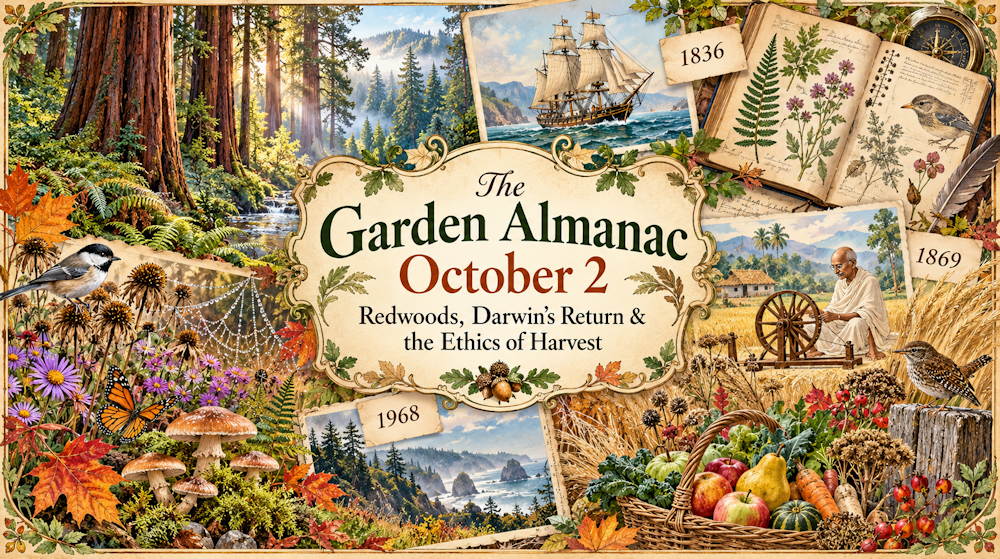

October 2 arrives with gardens in a state of useful in-between. Summer has not quite vanished from the soil, but autumn is already writing its instructions in seedheads, fungi, fallen leaves and the cooler rhythm of morning light.
It is a date that opens several doors at once: into an ancient forest saved in the 20th century, a ship returning with observations that changed natural history, and a birthday that still asks how gently human beings can live with the rest of life.
October 2, 1968 – The Day Redwood National Park Protected a Living Cathedral
On October 2, 1968, Redwood National Park was created in northern California. The act protected part of the remaining coast redwood landscape at a time when logging had already removed much of the ancient forest that once stood there.
The striking thing about redwoods is not only their height, but their timescale. A mature coast redwood is not just a large tree. It is a vertical habitat, a climate archive, a water collector and a community of mosses, lichens, insects, birds and soil organisms. To protect such a forest is to admit that some forms of value cannot be replaced quickly, however efficient people become at planting saplings.
For gardeners, this changes the way we look at trees. A young tree is never merely decoration for a lawn or shade for a bench. If well chosen and well placed, it is a long-term structure for the garden’s future climate: cooling air, slowing rainwater, feeding fungi, sheltering birds and shaping the soil beneath it.
The redwood story also reminds us that conservation is often late, imperfect and still necessary. Many old-growth forests were protected only after enormous losses had already happened. In a garden, the same principle appears on a smaller scale: an old hedge, a veteran fruit tree or a neglected corner full of leaf litter may hold more life than a newly designed border. Before clearing, cutting or “tidying,” it is worth asking what has quietly gathered there over time.
Garden Science: Why Fog Can Feed a Forest
Coast redwoods are famous for their relationship with fog. In dry summer periods, fog condenses on needles and branches, then drips down to the soil below. This “fog drip” helps support the forest when rainfall is scarce.
The garden version is simpler, but useful:
- Dense planting reduces evaporation from the soil.
- Mulch helps keep root zones cooler and more evenly moist.
- Trees and shrubs create small pockets of shade and humidity.
- Wind protection can matter as much as watering in exposed gardens.
A garden does not need to imitate a redwood forest to learn from it. The lesson is that plants do not live on water alone. They live in microclimates.
October 2, 1836 – Darwin Comes Home With a Different Kind of Garden in Mind
On October 2, 1836, HMS Beagle returned to England after nearly five years at sea, carrying Charles Darwin home from the voyage that would reshape biology. The famous theory came later, but the raw material was already there: notes, specimens, comparisons and a mind trained by patient observation.
What makes this date so interesting for gardeners is that Darwin did not return with one grand answer. He returned with patterns. Why did related species differ from island to island? Why did fossils resemble living animals in the same region? Why did small variations seem to matter so much in survival?
A garden is full of the same kind of evidence, though on a quieter scale. One tomato variety resists a damp summer better than another. One patch of lawn grows moss because the soil is compacted and shaded. Self-sown seedlings choose places the gardener did not plan. Pest damage is heavier on stressed plants than on vigorous ones. The garden keeps explaining itself, but only if we notice the details.
Darwin’s later work also turned ordinary places into scientific territory. Earthworms, climbing plants, orchids and domestic varieties all became subjects worthy of close attention. That is still a liberating thought: a garden does not have to be rare, exotic or perfect to be worth studying. The compost heap, the bean row, the old apple tree and the weeds at the path edge can all teach something real about adaptation.
What to Observe Right Now
Early October is an excellent time to look at the garden as a record of the growing season.
Notice:
- which plants stayed healthy through heat, rain or drought;
- where fallen leaves collect naturally;
- which flowers still attract bees, hoverflies or butterflies;
- where fungi appear after damp nights;
- which seedheads are being visited by birds.
These observations are more useful than memory alone. A few notes now can help you choose better plants, improve soil cover and design more resilient planting next year.
October 2, 1869 – Gandhi’s Birthday and the Garden Ethics of Enough
Mohandas K. Gandhi was born on October 2, 1869. The date is now observed in India as Gandhi Jayanti and internationally as the International Day of Non-Violence. It has also become connected with World Farmed Animals Day, which brings questions of food, farming and animal welfare into the same calendar space.
For a gardening magazine, Gandhi’s birthday is not an invitation to turn the garden into a political symbol. Its more useful connection is practical and ethical: how much do we take, how much do we waste, and what kind of abundance are we trying to grow?
Kitchen gardens make these questions very concrete. A good harvest is not only measured in baskets filled. It is also measured in soil left fertile, water used wisely, pollinators protected, scraps composted and surplus shared or preserved before it spoils. The old idea of “enough” can be surprisingly modern in a time of overproduction and waste.
This date also invites a gentler look at the animals around food systems. Even in a small garden, choices matter: growing some herbs, fruit or vegetables at home, reducing waste, composting plant remains, avoiding unnecessary chemicals and supporting wildlife all shift the garden toward a less extractive way of living. It is not purity. It is practice.
Garden Reminder: Useful Jobs for Early October
Early October is a good moment for practical, unshowy work that pays off later.
- Plant spring bulbs while the soil is still workable.
- Lift and store tender summer bulbs before hard frost.
- Collect dry seeds from healthy plants for next year.
- Add fallen leaves to a leaf-mould pile or use them as mulch.
- Clear diseased plant material, but leave some hollow stems and seedheads for wildlife.
- Plant trees, shrubs and perennials while the soil still holds warmth.
The best autumn gardening often looks modest. It is mostly preparation, protection and patience.
Wildlife Note: Leave Some Autumn Standing
Not every fading stem is garden waste. Hollow stems can shelter insects, seedheads can feed birds, and leaf litter protects overwintering invertebrates. A completely cleared garden may look orderly, but it often removes the small winter refuges that wildlife needs.
A good compromise is selective tidying. Clear paths, remove diseased foliage and cut back plants that collapse into crowns, but leave strong stems, seedheads and quiet corners where they do no harm. Autumn structure can be beautiful, and it can be useful at the same time.
Looking Ahead
October 2 gives us three different ways of thinking about care: saving what cannot quickly be replaced, observing closely before deciding, and asking what kind of harvest is truly enough. These are not abstract ideas for gardeners. They show up in tree planting, composting, seed saving, pruning, watering and the decision to leave part of the garden a little less tidy.