
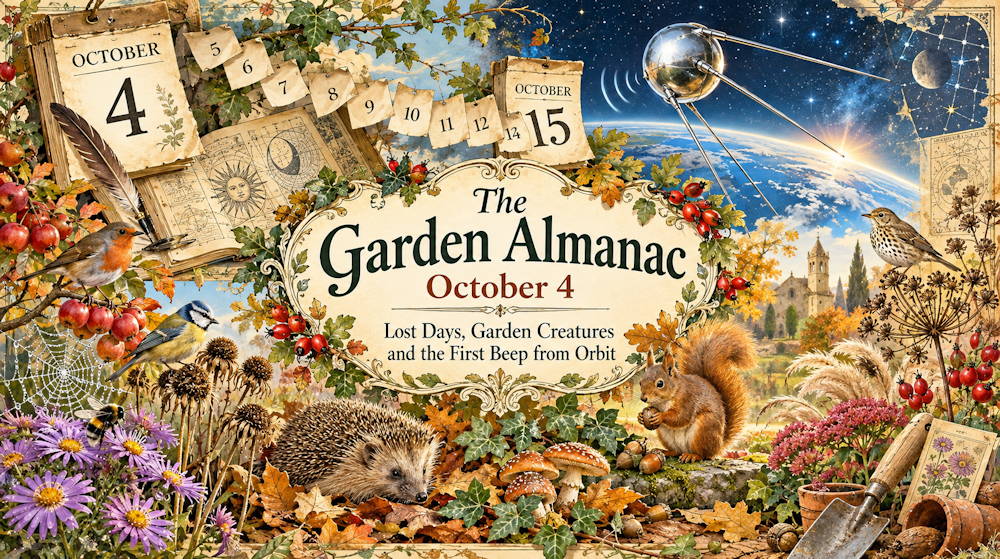

In early October, the garden begins to teach patience in a different language. Growth slows, shadows lengthen, seedheads dry into architecture, and even a small rustle in the hedge can feel more noticeable than it did in high summer.
October 4 is an almanac date with an unusually wide view. It leads from a vanished stretch of calendar time to the moral imagination of animal care, and then far beyond the atmosphere, where one small metal sphere changed how humanity learned to watch Earth.
October 4, 1582 – The Night the Calendar Jumped Over the Garden Fence
In several Catholic countries, Thursday, October 4, 1582, was followed not by October 5, but by Friday, October 15. Ten dates simply disappeared from the civil calendar. The reason was not superstition or royal whim, but a slow, practical problem: the old Julian calendar had drifted out of step with the solar year.
For gardeners, that detail is more than a curiosity. Calendars are not abstract inventions when sowing, pruning, harvest, flowering and frost are involved. A date printed on paper is only useful if it keeps faith with the Sun. By the sixteenth century, the mismatch had grown large enough to disturb the timing of Christian movable feasts, but beneath the religious concern lay a broader truth: human systems had to be corrected because nature had never agreed to follow our arithmetic.
The Gregorian reform adjusted leap-year rules so the calendar would stay more closely aligned with the seasons. It did not make time perfect, but it made civil time more honest. Every garden still reminds us of the same principle. A seed packet may say “sow in October,” but soil temperature, day length, rainfall and the first real cold night tell the fuller story.
For today’s gardener, October 4 is a good day to think in two calendars at once: the one on the wall and the one underfoot. The most reliable autumn decisions often come from combining both – written dates for planning, living signs for timing.
Garden Science: Why Calendar Dates Are Only Half the Story
Plants respond less to calendar names than to environmental signals.
- Day length helps many plants sense the season and prepare for dormancy, flowering or seed formation.
- Soil temperature affects root growth, germination and microbial activity more directly than air temperature alone.
- Accumulated cold can trigger dormancy processes in many woody plants and bulbs.
- Local exposure matters: a sheltered courtyard and an open allotment can be several days apart in autumn development.
In early October, use the calendar as a guide, but check the garden itself before acting. Soil that is still warm can welcome planting; soil that is waterlogged or compacted asks for restraint.
October 4 – World Animal Day and the Small Lives That Hold a Garden Together
October 4 is also widely observed as World Animal Day, chosen because it coincides with the feast day of Francis of Assisi, long associated with animals, humility and care for living creation. The modern observance grew from twentieth-century animal protection movements, but the date gives it an older cultural resonance: the idea that animals are not decorative extras in the human world, but fellow participants in it.
A garden makes that idea wonderfully concrete. The visible animals are easy to notice: birds at the seedheads, bees on late asters, butterflies taking the last warmth from stone, a hedgehog moving through leaf litter at dusk. But the less visible ones matter just as much. Earthworms loosen and enrich soil. Ground beetles hunt pests. Spiders reduce flying insects. Solitary bees, hoverflies and moths continue small acts of pollination long after the showier summer border has faded.
The useful shift is not to think of a garden as a stage where animals occasionally appear, but as habitat. That does not mean letting everything become chaotic. It means designing with life in mind: leaving some hollow stems, keeping a corner of leaves, avoiding unnecessary pesticide use, offering water safely, and choosing flowers that still provide nectar and pollen when the year is thinning out.
Wildlife Note: What Helps Garden Animals in Early October?
Small autumn choices can make a real difference.
- Leave some seedheads standing for finches and other seed-eating birds.
- Keep a shallow water source available, especially during dry autumn spells.
- Let a modest pile of leaves remain under shrubs or in a quiet corner.
- Avoid cutting every hollow stem, as many insects overwinter inside plant material.
- Delay heavy tidying where late flowers are still feeding bees, hoverflies and moths.
- A wildlife-friendly autumn garden is not an abandoned garden. It is a garden edited with a lighter hand.
October 4, 1957 – Sputnik and the Moment Earth Became Observable from Above
On October 4, 1957, the Soviet Union launched Sputnik 1, the first artificial satellite to orbit Earth. It was small – a polished sphere with radio transmitters and long antennae – yet its signal travelled around the world. The famous beeping did more than announce a technological achievement. It changed the scale at which humans imagined their own planet.
At first, the drama was political and scientific. Sputnik sharpened Cold War competition and opened the Space Age. But in the decades that followed, satellites became something quieter and, for gardeners and environmental thinkers, profoundly useful: instruments for observing Earth’s systems. Weather forecasting, climate monitoring, forest mapping, drought assessment, storm tracking and crop observation all grew from the larger ability to look back at the planet from above.
That changed how landscapes could be understood. A gardener sees curled leaves, dry soil and a struggling shrub. A satellite sees heat, vegetation stress, rainfall patterns, snow cover, wildfire scars and the spread of urban surfaces. Neither view replaces the other. The surprising lesson of the Space Age is that close observation and distant observation need one another.
In the garden, this has a practical echo. Local knowledge still begins with kneeling down, touching the soil and noticing which plants are thriving. But wider patterns now matter more than ever: warmer autumns, irregular rainfall, later frosts, sudden heat, new pest pressures. October 4 reminds us that the garden is intimate, but never isolated.
What to Observe Right Now: Early October Signals in the Garden
Look closely over the next few days and the garden will reveal its autumn priorities.
- Which plants are still flowering, and which insects visit them?
- Where does dew linger longest in the morning?
- Are leaves colouring evenly, or are some plants showing drought stress?
- Which seedheads are being used by birds?
- Is the soil still warm enough for planting, or already heavy and cold?
- Where do fallen leaves naturally collect, and could some stay there as shelter?
These observations are more useful than they may seem. They help you decide where to plant, what to leave standing, and which parts of the garden need protection before winter.
Garden Reminder: Practical Jobs for October 4
Early October is a good moment for calm, useful work rather than frantic tidying.
- Plant spring bulbs while the soil is workable, especially daffodils, crocuses and ornamental alliums.
- Move or divide hardy perennials if the weather is mild and the soil is moist.
- Collect healthy fallen leaves for leaf mould.
- Remove diseased foliage from roses, peonies or fruit plants to reduce overwintering problems.
- Mulch bare soil after rain, leaving space around plant crowns and woody stems.
- Check young trees and shrubs for secure staking before autumn winds strengthen.
The guiding rule is simple: protect the soil, keep useful habitat, and do only the tidying that prevents disease or real disorder.
Looking Ahead
October 4 offers three different ways of becoming a better observer. The calendar reform reminds us that human schedules must be tested against the seasons. World Animal Day asks us to notice the living community that makes a garden resilient. Sputnik adds the widest frame of all: every small plot belongs to a changing planet.
For the gardener, that is not a burden, but an invitation. Watch closely, act carefully, and let autumn show which parts of the garden need help – and which parts simply need to be left alive.