


In early October, the garden often feels as if it is keeping two calendars at once. The light is softer, the soil is still holding summer’s warmth, and yet every yellowing leaf seems to be counting down toward dormancy.
October 5 is a curious date for an almanac because, in one famous moment of history, it vanished altogether. From there, the day leads us to an Enlightenment editor who tried to gather the world’s practical knowledge, and to a modern celebration of teachers – including those who teach with soil under their fingernails.
October 5, 1582 – The Garden Day That Never Happened
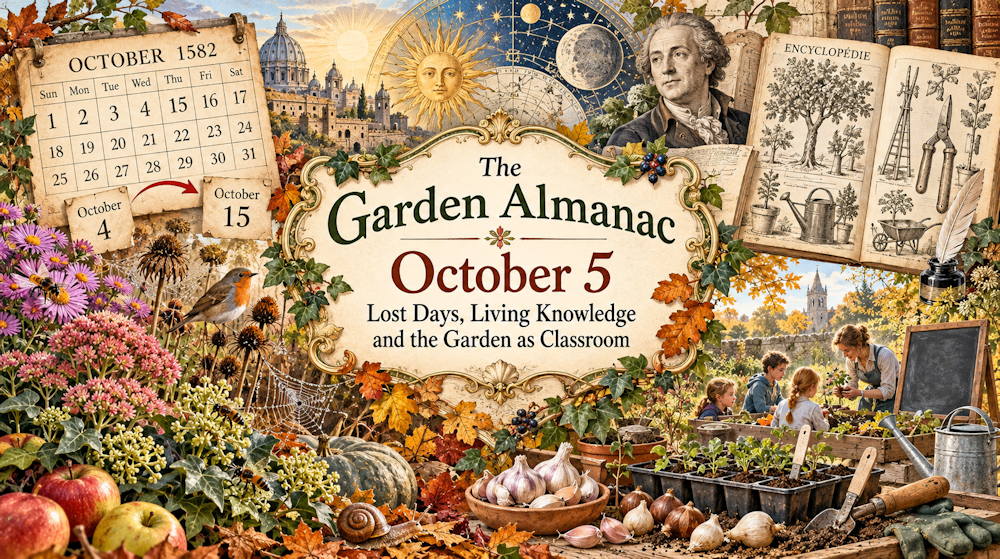
In several Catholic countries in 1582, October 5 did not arrive. The calendar moved straight from October 4 to October 15 as part of the Gregorian reform, an extraordinary adjustment designed to bring human timekeeping back into line with the solar year. The old Julian calendar had drifted by about ten days, which meant that religious dates tied to the seasons were slowly slipping away from the skies and fields they were meant to follow.
For gardeners, this is more than a historical oddity. Every sowing date, pruning tradition, harvest festival and moon calendar rests on a quiet assumption: that the date on the page still matches what the sun, soil and plants are doing outside. When that match fails, the garden notices before the paperwork does.
The reform reminds us that calendars are tools, not masters. A printed date can say “autumn,” but a gardener still has to read the ground: whether the soil is workable, whether nights are cold enough to check growth, whether leaves are falling because the season has turned or because drought has pushed a tree into stress.
In October, that lesson is especially useful. Garlic, spring bulbs, bare-root plants and late cover crops all depend less on a fixed date than on local conditions. The lost October 5 is a neat historical shock, but its modern message is calm and practical: garden by the calendar, then confirm everything with your hands, eyes and weather.
Garden Science – Why Planting Dates Are Only a Starting Point
Plants respond to temperature, light and moisture more directly than to calendar dates. Day length helps trigger flowering, leaf fall and dormancy in many species, while soil temperature strongly affects root growth and seed germination.
For autumn planting, soil that remains mildly warm can help roots establish before winter. Cold, waterlogged soil, however, slows growth and increases the risk of rot. That is why the same October date can be perfect in one region and too early, too late or too wet in another.
A simple rule helps: if soil crumbles when squeezed, it is usually workable; if it forms a sticky lump, wait.
October 5, 1713 – Diderot and the Radical Idea of Useful Knowledge
Denis Diderot was born on October 5, 1713, in Langres, France. He became one of the central figures behind the Encyclopédie, a vast Enlightenment project that did something more daring than simply collect facts. It treated practical knowledge – crafts, tools, trades, techniques and observation – as worthy of serious attention.
That matters in a garden. For much of history, horticultural skill was passed hand to hand: how to graft a branch, save seed, sharpen a blade, layer a shrub, read a compost heap or judge when fruit was ready. The Encyclopédie’s great plates and articles helped give such applied knowledge cultural weight. It suggested that knowing how something is made, grown or maintained is not lesser knowledge. It is civilization at work.
Today’s gardeners live in a world Diderot would have recognized in spirit, even if not in technology. We still learn from books, diagrams, neighbors, videos, labels, seed packets and mistakes. A garden is one of the few places where information becomes visible almost immediately: a mulched bed holds moisture, a badly placed shrub sulks, a correctly pruned fruit tree answers with light and air.
The useful recognition here is that gardening knowledge is cumulative. No one learns it all at once, and no single authority replaces observation. The best garden education still combines the printed page with the trial bed, the old method with the new climate, and expert advice with the stubborn evidence of one’s own patch of earth.
Garden Reminder – Practical Jobs for Early October
- Plant spring-flowering bulbs while the soil is still workable, but avoid waterlogged ground.
- Collect fallen leaves separately if possible; leaf mould makes an excellent soil conditioner.
- Check stored onions, apples and squash, removing any damaged fruit before rot spreads.
- Sow hardy green manures where vegetable beds will remain empty through winter.
- Leave some seedheads standing for birds and insects instead of cutting every border clean.
October 5 – World Teachers’ Day and the Garden That Teaches Back
October 5 is also World Teachers’ Day, linked to the 1966 international recommendation on the status of teachers and celebrated globally since 1994. At first glance, this may seem more like a school story than a garden story. But few places teach as quietly and thoroughly as a garden.
A school garden can turn abstract lessons into living evidence. Children can measure growth, compare soils, watch decomposition, count pollinators, harvest food and see that failure is not the end of an experiment. A tray of seedlings teaches patience more convincingly than a lecture about patience. A compost bin explains cycles without needing a diagram first.
The deeper point is that environmental understanding is not built only from warnings about crisis. It is also built from familiarity. A child who has watered beans, watched a sunflower turn, noticed worms after rain or tasted a radish pulled from soil has a different relationship with the living world. Care becomes less theoretical.
For adult gardeners, the same idea still applies. Every garden is a small continuing education course: climate adaptation in a dry summer, biodiversity in a messy corner, soil science under a mulch layer, design in the way shade moves across a path. The teacher may be a person, but just as often it is the plant that refuses to thrive until we understand what it has been telling us.
Wildlife Note – What the Autumn Garden Is Teaching Now
Early October is a good time to notice which parts of the garden are still feeding wildlife. Ivy flowers, late asters, sedums and single dahlias can provide valuable nectar when many summer flowers have faded. Seedheads of teasel, sunflower, coneflower and ornamental grasses may also support birds later in the season.
A too-tidy autumn garden can become a hungry garden. Leaving hollow stems, leaf litter in quiet corners and a few fading plants in place gives insects shelter and birds more reasons to visit through winter.
What to Observe Right Now
- Which plants are still attracting bees, hoverflies or butterflies on mild afternoons?
- Are trees colouring evenly, or are some showing drought stress, scorch or early leaf drop?
- Where does dew linger longest in the morning, and what does that reveal about shade and airflow?
- Which areas of soil stay wet after rain, and which drain quickly?
- Are birds already investigating berries, seedheads or sheltered shrubs?
These observations are small, but they sharpen a gardener’s timing. They also make next year’s decisions easier: where to add spring bulbs, where to improve drainage, where to plant for late nectar, and where the garden already has a useful microclimate.
Looking Ahead
October 5 offers no single neat lesson, and that is part of its charm. One story shows that even calendars must answer to the sun; another reminds us that practical knowledge deserves respect; a third brings learning back into the living world. For gardeners, all three point toward a more attentive way of working. The future garden will need dates, books and teachers – but it will also need people willing to look closely, test patiently and let the season correct the plan.