

By October 3, the garden has begun to speak in a lower voice. The bright urgency of summer has faded, but the season is far from over: seedheads are ripening, late apples are coloring, fungi appear after rain, and every warm afternoon feels slightly borrowed.
This date opens three very different doors into the relationship between people and the living world. One leads to a former border strip that became a refuge for wildlife, one to a wartime harvest proclamation, and one to a medieval saint whose language of kinship with animals and plants still feels unexpectedly modern.
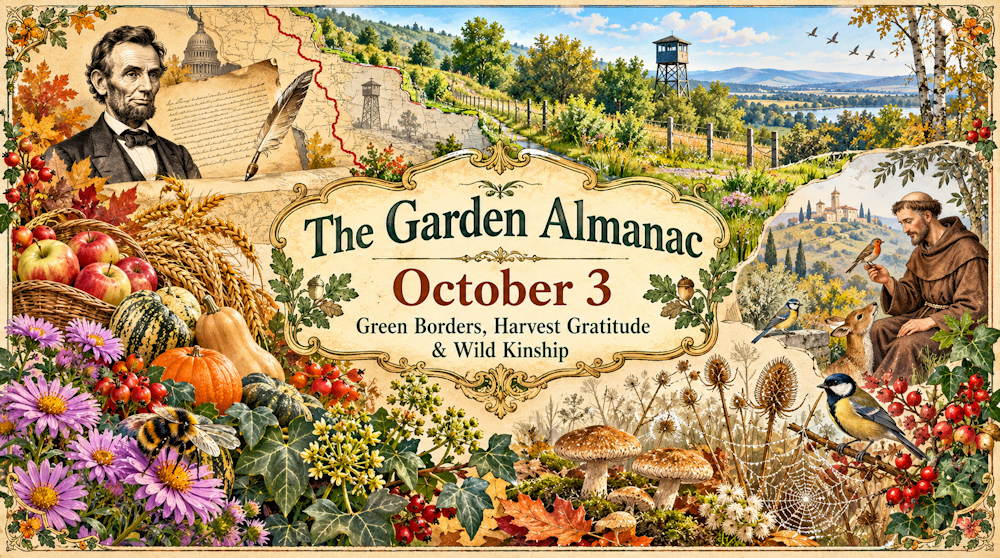
October 3, 1990 – When a Border Became a Green Corridor
On October 3, 1990, Germany was formally reunified. For most people, the date belongs to political history: the end of division, the joining of East and West, the redrawing of daily life after decades of separation. Yet one of the strangest legacies of that divided landscape was not found in parliaments or city squares, but along the old inner-German border.
For decades, the border zone was heavily controlled, dangerous and largely inaccessible. Human movement was restricted, villages were cut off, and ordinary land use was interrupted. But precisely because people were kept out, many stretches of grassland, wetland, woodland edge and scrub were left relatively undisturbed. What had been designed as a line of separation quietly became, for plants and animals, a chain of shelter.
After reunification, conservationists recognized that this former strip could become something rare: a long, connected habitat corridor running through intensively used landscapes. The German Green Belt now reminds us that nature often needs continuity more than perfection. A narrow strip of connected habitat can matter enormously if it allows insects, birds, small mammals and wild plants to move, feed, breed and recover.
For gardeners, the idea is wonderfully practical. A garden does not have to be wild from fence to fence to support life. A hedge, unmown edge, berrying shrub line, pond margin, log pile or strip of native perennials can become part of a living corridor. The lesson is not that neglect automatically creates richness, but that connected, lightly disturbed spaces often become more valuable than we expect.
Garden Science – Why Habitat Corridors Matter
Small habitats become much stronger when they are connected. A single flower bed may feed insects for a few weeks, but linked spaces help wildlife move safely through a larger landscape.
Good garden corridors can include:
- mixed native hedges with flowers, berries and shelter;
- long-flowering borders that offer nectar from spring to autumn;
- leaf litter and log piles for beetles, fungi and overwintering insects;
- small gaps under fences for hedgehogs and other ground-moving wildlife;
- pond edges, damp corners or rain gardens for amphibians and insects.
The useful question is not only “How wildlife-friendly is this garden?” but also “Can wildlife pass through it?”
October 3, 1863 – Lincoln’s Harvest Proclamation in a Broken Year
On October 3, 1863, Abraham Lincoln issued the proclamation that helped establish Thanksgiving as a national holiday in the United States. The timing is striking. The country was in the middle of the Civil War, and yet the proclamation spoke of harvests, fields, orchards, mines, workshops and the continued abundance of the land.
That contrast gives the document its force. It was not a simple celebration of plenty in a peaceful year. It was an attempt to notice food, fertility and seasonal rhythm while society was under extreme strain. In that sense, the harvest was more than produce: it was proof that ordinary life, field work and household provisioning still mattered when public life had been shaken.
For gardeners, this is a useful way to think about autumn abundance. A harvest is never only the final basket of apples, squash or beans. It is also a record of timing, weather, soil, pollination, storage and care. October is the moment to ask what actually worked: which tomato resisted disease, which bed dried out too fast, which herbs kept going, which flowers still fed pollinators after the main show had ended.
Garden Reminder – What to Do in Early October
Early October is a good time to turn observation into next year’s success.
- Save seeds only from healthy, vigorous plants.
- Label stored bulbs, tubers and seed packets clearly before memory becomes guesswork.
- Remove diseased foliage from vegetable beds, but leave clean seedheads where birds can feed.
- Mulch bare soil after clearing crops to reduce erosion and feed soil life.
- Note which plants still provide flowers, berries or structure after summer has passed.
A gardener’s autumn notes are often more valuable than spring enthusiasm. They are written while the evidence is still visible.
October 3, 1226 – St Francis and the Garden of Kinship
St Francis of Assisi died on October 3, 1226. His feast is usually marked the next day, but the evening of October 3 belongs to the end of his life, and to a way of seeing the natural world that still travels far beyond religious history.
Francis is remembered for addressing the sun, moon, animals, water, fire and earth as kin. To modern ears, that may sound poetic or symbolic, but its deeper significance is more practical than sentimental. He placed humans inside the living world rather than above it. The bird, the wolf, the field and the body were not decorative background; they were part of a shared creation.
That view has a surprisingly sharp edge for gardeners. A garden is not simply a designed space that nature occasionally visits. It is already a community: soil organisms breaking down leaves, fungi linking roots, bees reading flowers, birds reading seedheads, worms opening the ground, and humans editing the scene with tools and choices. The question is not whether a garden is natural or human-made. It is what kind of relationship our making creates.
Francis’s legacy also invites restraint. Not every fallen leaf needs to vanish, not every seedhead needs to be cut, not every insect needs a verdict. Early October is a good time to let parts of the garden become less tidy and more intelligible. The more we observe, the more we see that many “messy” corners are actually winter housing, food storage and shelter.
Wildlife Note – The Garden Is Preparing for Night and Cold
In early October, many garden creatures are already responding to shorter days.
Queen bumblebees may search for sheltered places to overwinter. Ladybirds gather in dry cracks and crevices. Birds test seedheads and berrying shrubs. Amphibians may move through damp grass after rain, especially near ponds or shaded borders.
A few simple choices help:
- avoid cutting every perennial stem at once;
- leave some dry leaves under shrubs;
- keep berrying plants such as hawthorn, rose, cotoneaster or elder where appropriate;
- check long grass before mowing;
- avoid disturbing log piles once cold weather begins.
Autumn wildlife gardening often means doing slightly less, but doing it deliberately.
What to Observe Right Now – Early October Signs in the Garden
October 3 sits at a beautiful turning point. The garden is still active, but much of its energy is moving inward, downward or into storage.
Look closely for:
- late pollinators visiting ivy, asters, sedum and other autumn flowers;
- spider webs made visible by dew in the morning;
- leaves changing first on stressed, exposed or shallow-rooted plants;
- fruits softening for birds and mammals;
- fungi appearing after damp nights;
- perennial stems hardening as plants prepare for winter.
These signs are not only seasonal decoration. They show how the garden redistributes energy: from flower to seed, from leaf to root, from growth to survival.
Looking Ahead
October 3 offers no single neat message, and that is part of its richness. A former border can become a wildlife corridor, a harvest proclamation can remind us to read abundance carefully, and a medieval saint can make the garden feel less like property and more like relationship.
For the modern gardener, all three stories point toward attention. Notice what connects, what feeds, what shelters and what lasts after the showier season is over. The future of a garden is often shaped now, in the quiet decisions of autumn: what we leave standing, what we record, what we protect, and what we allow to keep living beside us.