
By September 18, the garden has begun to speak in two voices. There is still summer in the late flowers and ripening fruit, but autumn is already visible in cooler mornings, lengthening shadows and the first leaves loosening from the canopy.
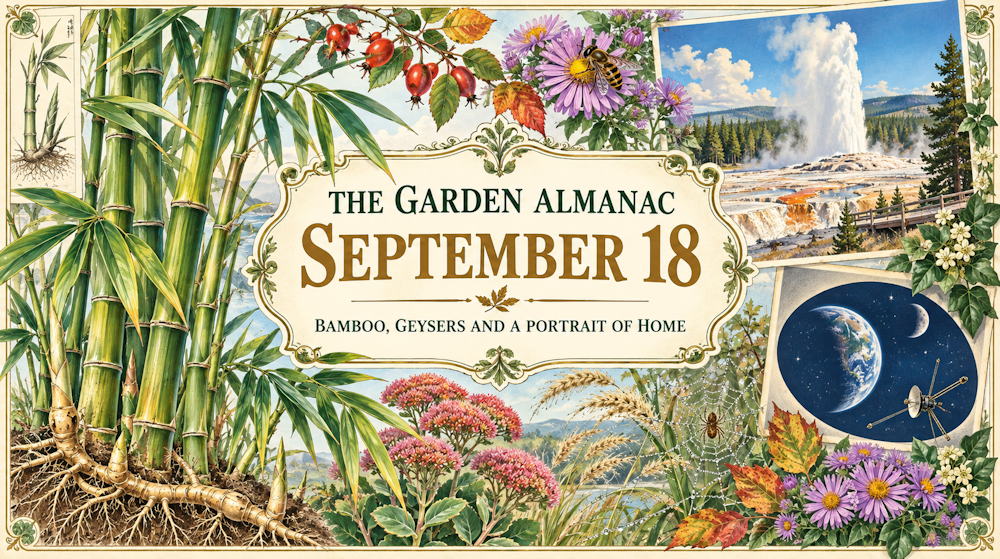
This date opens three unusually wide windows onto the living world. It celebrates a grass that can become a forest, recalls the naming of a geyser that helped define a protected landscape, and marks the day a spacecraft photographed Earth and the Moon together from deep space. Each story asks the same practical question in a different way: how do we live well within systems that are larger, older and more connected than they first appear?
World Bamboo Day – The Grass That Builds Above and Below Ground
World Bamboo Day has been observed on September 18 since 2009, when the World Bamboo Organization created the initiative in Bangkok. Its purpose is broader than celebrating an attractive garden plant. Across Asia, Africa and Latin America, bamboo has long supplied food, tools, baskets, musical instruments, paper, scaffolding and building material, while modern research continues to explore its value in land restoration and lower-impact manufacturing.
Bamboo’s botanical identity is part of its fascination: it is not a tree, but a woody grass. Its upright canes, called culms, arise from rhizomes beneath the soil. Some species form slowly widening clumps, while others send long running rhizomes well beyond the original planting. That hidden difference determines whether bamboo becomes an elegant screen or an expensive dispute across a boundary fence.
Its reputation as a sustainable wonder also deserves care. Fast regrowth can make well-managed bamboo a useful renewable crop, and dense rhizome systems can help hold soil on suitable sites. Yet no plant is automatically ecological wherever it is planted. A poorly chosen running bamboo can escape cultivation, crowd out other plants and reduce the variety of habitats in a small garden. Responsible growing begins with the species name, the local climate and a realistic plan for containment.
For gardeners, September is a good time to inspect established bamboo while the soil is still workable. Trace the edge of the clump, cut unwanted rhizomes cleanly and remove shoots that have appeared outside their allotted space. If planting a running type, install a purpose-made barrier at least 60 centimetres deep and leave its upper edge visible so escaping rhizomes can be spotted. In compact gardens, a clump-forming Fargesia or a large, sturdy container is usually the more manageable choice.
Garden Science – Why Can Bamboo Grow So Quickly?
A new bamboo shoot contains many of the cells needed for the mature culm before it emerges. Growth then comes largely from rapid cell expansion at several points along the stem, rather than only at one growing tip. The energy is supplied by the established underground rhizome network, which is why a mature grove can produce astonishingly fast spring growth – and why cutting one cane does not remove a running plant.
- New culms emerge at close to their final diameter and do not thicken annually like tree trunks.
- A cut culm will not regrow from the cut tip, although the rhizome may send up replacement shoots.
- Regular inspection of the planting perimeter is more effective than repeatedly trimming the foliage.
September 18, 1870 – The Geyser That Made a Landscape Unforgettable
On September 18, 1870, members of the Washburn–Langford–Doane expedition encountered a Yellowstone geyser whose repeated eruptions impressed them with their regularity. They called it Old Faithful. Indigenous peoples had known the Yellowstone region for thousands of years, but the expedition’s written accounts and the surveys that followed helped bring its geothermal landscape to wider public attention. In 1872, Yellowstone became the world’s first national park.
Old Faithful is only one of nearly 500 geysers in Yellowstone. Its eruptions depend on a hidden arrangement of groundwater, heat and constricted underground passages – a reminder that the visible landscape is governed by processes below the surface. The same is true in a garden on a quieter scale. Drainage, soil structure, buried roots and pockets of warmth often explain why two plants only a few metres apart behave differently.
The geyser basin also offers a lesson in access. Thin mineral crusts and heat-loving microbial communities can be damaged by a single careless footstep, so visitors are kept to boardwalks. Garden soil is less dramatic but similarly vulnerable: repeated walking compresses pore spaces, reduces oxygen around roots and slows the movement of water. Permanent paths, stepping stones and clearly defined bed edges protect cultivated soil, especially during wet autumn weather.
What to Observe Right Now – Where Does Warmth Linger?
- Compare the soil beside a south-facing wall with an exposed bed early in the morning.
- Notice where dew remains longest and where the first cold air settles in low ground.
- Watch which paving stones release stored warmth after sunset.
- Mark these small microclimates now – they can guide the future placement of tender herbs, early bulbs and frost-sensitive fruit blossom.
September 18, 1977 – When Earth and Moon Shared a Single Frame
On this date in 1977, Voyager 1 looked back from 11.66 million kilometres away and recorded the first spacecraft image to show the complete Earth and the complete Moon together in a single frame. Both appeared as crescents against darkness. Voyager had left Earth less than two weeks earlier on a journey towards Jupiter and Saturn, yet one of its earliest historic images was not of a distant planet but of home.
The photograph belongs to a sequence of space-age views that changed how people imagined Earth. From far away, borders, roads and gardens disappear, while the planet’s thin atmosphere, shared water and limited land become the essential facts. For a gardener, that distant view turns familiar materials into parts of a closed cycle: fallen leaves become soil organic matter, rain becomes stored water, and insects link flowers to future seed and fruit.
The useful lesson is not that one garden must solve planetary problems. It is that every garden can waste fewer of the resources already passing through it. Compost plant remains that are healthy, cover bare soil with leaf mould or other organic mulch, collect rainwater where regulations and conditions allow, and grow several kinds of flowering plants rather than relying on one short season of bloom. Diversity and circular use make a garden more resilient when weather becomes less predictable.
Wildlife Note – Which Flowers Still Feed Pollinators in September?
Late-flying bees, hoverflies and butterflies still need nectar and pollen, especially on mild days. Ivy flowers can be exceptionally valuable where ivy is native, while asters, sedums, single-flowered dahlias and late herbs such as mint may also keep the garden open for business.
Do not cut every faded stem at once. Hollow or pithy stems can later provide shelter for insects, seed heads feed birds, and standing growth gives spiders places to build webs. Remove diseased material, but leave a varied patch of healthy stems and seed heads until spring if space allows.
Garden Reminder – What Should You Do in the Garden in Mid-September?
- Divide congested spring- and early-summer-flowering perennials while the soil is warm, provided it is moist enough for re-establishment.
- Plant spring bulbs such as daffodils and crocuses; wait until later in autumn for tulips where fungal disease is a concern.
- Sow a green manure on empty vegetable beds, or cover the soil with compost or leaf mould instead of leaving it bare.
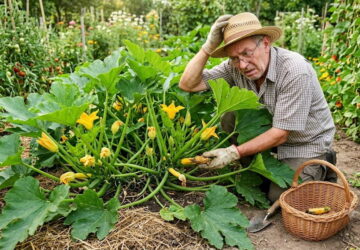
- Keep harvesting courgettes, beans and tomatoes, and remove damaged or diseased fruit promptly.
- Water newly planted trees, shrubs and perennials deeply during dry spells – cooler air does not always mean the root zone is moist.
- Start a leaf-mould area for clean fallen leaves, but keep evergreen leaves and tough needles in a separate, slower-decaying batch.
Looking Ahead
September 18 reminds us that what happens below the surface can matter as much as what catches the eye, whether it is a bamboo rhizome, a geyser’s plumbing or the living structure of garden soil. It also invites us to step back far enough to see the garden as part of a larger landscape, yet close enough to notice one late bee or one cold corner. Choose plants with their future growth in mind, protect soil from needless disturbance and keep useful materials circulating. Small acts of observation are where long-term stewardship begins.