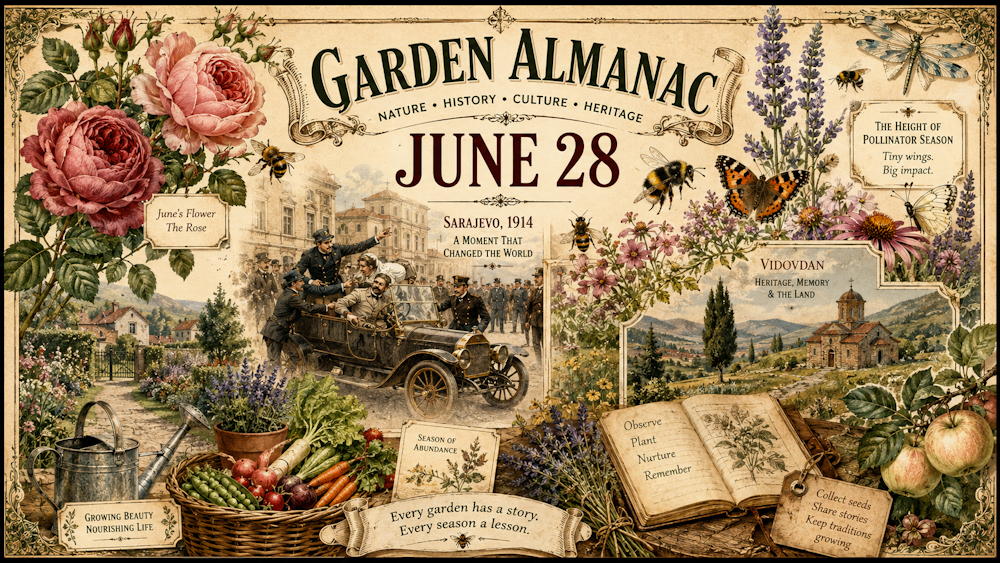

Late June is a season of abundance. Roses are often at their peak, pollinating insects are busy from dawn until dusk, vegetable beds promise the first generous harvests, and long summer evenings invite us to spend more time outdoors. June 28 falls at this vibrant moment of the gardening year – a date that reminds us how closely human history and the natural world have always been connected.
Some dates become memorable because of dramatic historical events, while others quietly reflect seasonal rhythms that have shaped farming and gardening for centuries. June 28 offers both. From one of history’s most consequential political moments to celebrations of biodiversity, roses and pollinators, the day encourages us to appreciate how landscapes influence our lives – and how our choices continue to shape the landscapes around us.
Whether tending a cottage garden, a productive vegetable patch or a few pots on a balcony, today’s stories remind us that every garden is part of a much larger living world.
The Rose – June’s Timeless Emblem
Few flowers capture the spirit of late June better than the rose. As the traditional birth flower of the month, it reaches its most spectacular display just as June draws to a close, filling gardens with fragrance, colour and countless visiting bees.
For centuries, roses have symbolised love, remembrance, celebration and resilience. Historic monastery gardens, royal estates and humble village cottages all cultivated them, selecting varieties that thrived in local climates and soils. Today, modern gardeners continue that tradition by growing everything from old-fashioned shrub roses to repeat-flowering climbers and disease-resistant hybrids.
The rose also reminds us that beauty and biodiversity often go hand in hand. Single-flowered varieties provide valuable nectar and pollen for insects, while their autumn hips later become an important food source for birds.
Garden Inspiration
Plant companion flowers such as lavender, catmint and salvia near roses. They attract pollinators, improve visual contrast and can help create healthier, more diverse planting schemes.
Sarajevo, 1914 – When History Changed in a Single Morning
June 28 is forever associated with the assassination of Archduke Franz Ferdinand in Sarajevo in 1914, an event that triggered the chain of diplomatic crises leading to the First World War.
Although it was a political event, its consequences reached far beyond governments and battlefields. Across Europe, countless parks, orchards, estates and agricultural landscapes were transformed by war. Gardeners became farmers, ornamental gardens became vegetable plots, and many traditional horticultural skills were preserved by ordinary families growing food close to home.
Today, this history offers a valuable reminder that gardens provide more than beauty. They offer resilience during uncertain times, support local food production and preserve knowledge that can be passed from one generation to the next.
A productive kitchen garden remains one of the most sustainable investments any household can make.
Garden Reminder
If you have harvested early peas, lettuce or spinach, don’t leave empty spaces. Sow quick-growing crops such as dwarf beans, beetroot, carrots or salad leaves to keep the garden productive well into autumn.
The Height of Pollinator Season
Although National Pollinator Week changes dates each year, it frequently falls in the final weeks of June, making June 28 an excellent moment to celebrate the insects that keep both gardens and agriculture thriving. Pollinators are responsible for helping produce roughly one out of every three bites of food we eat.
At this time of year, gardens become living ecosystems. Bumblebees work through flowering herbs, hoverflies patrol vegetable beds, butterflies drift among nectar-rich borders, and solitary bees continue raising the next generation.
Supporting these species often requires surprisingly little effort. A patch of unmown grass, flowering herbs allowed to bloom, shallow water dishes and avoiding unnecessary pesticide use all contribute to healthier local biodiversity.
The most successful gardens are rarely the neatest. They are the ones alive with movement.
Nature Watch
Spend ten quiet minutes observing a flowering border today.
How many different pollinators can you identify?
You may be surprised to discover that bees are only part of the story. Hoverflies, beetles, butterflies, moths and even some wasps all play valuable roles in pollination.
Vidovdan – A Day Rooted in Memory and Landscape
Across Serbia and neighbouring regions, June 28 is observed as Vidovdan, one of the country’s most culturally significant commemorative days. Over centuries it has become closely associated with national memory, rural traditions and the enduring relationship between people and their landscapes.
Many traditional European midsummer customs revolve around gathering herbs, walking fields, blessing crops or visiting places of natural beauty. While individual traditions vary, they all reflect an understanding that the health of communities depends on the health of the land.
Modern gardeners can draw inspiration from these customs by seeing their own gardens not merely as collections of plants, but as living places that connect family, heritage and nature.
Even small seasonal rituals – harvesting herbs, collecting seeds or sharing flowers with neighbours – help strengthen that connection.
Seasonal Tip
Late June is an ideal time to begin collecting seeds from early-flowering annuals while making notes about which varieties performed best this season. These observations become invaluable when planning next year’s garden.
What to Observe Right Now
As June turns toward July, subtle seasonal changes begin to appear.
- Early apples and pears start swelling rapidly.
- Tomatoes begin setting heavier fruit.
- Lavender attracts increasing numbers of bees.
- Swallows continue feeding their young over open meadows and gardens.
- Young hedgehogs may begin exploring independently during warm evenings.
These small observations help gardeners stay connected with the changing rhythm of the season far more than any calendar can.
Looking Ahead
June 28 reminds us that every landscape carries stories. Some tell of remarkable historical events, while others unfold quietly each summer as roses bloom, pollinators gather nectar and vegetable gardens reward careful tending.
The healthiest gardens are those that combine beauty with purpose – providing food, supporting wildlife and creating spaces where people reconnect with the rhythms of nature. By planting for biodiversity, observing seasonal changes and caring for the living world around us, today’s gardeners become part of a much longer story.
As June gives way to July, let your garden be more than a collection of plants. Let it become a place where history, nature and hope continue to grow together.