
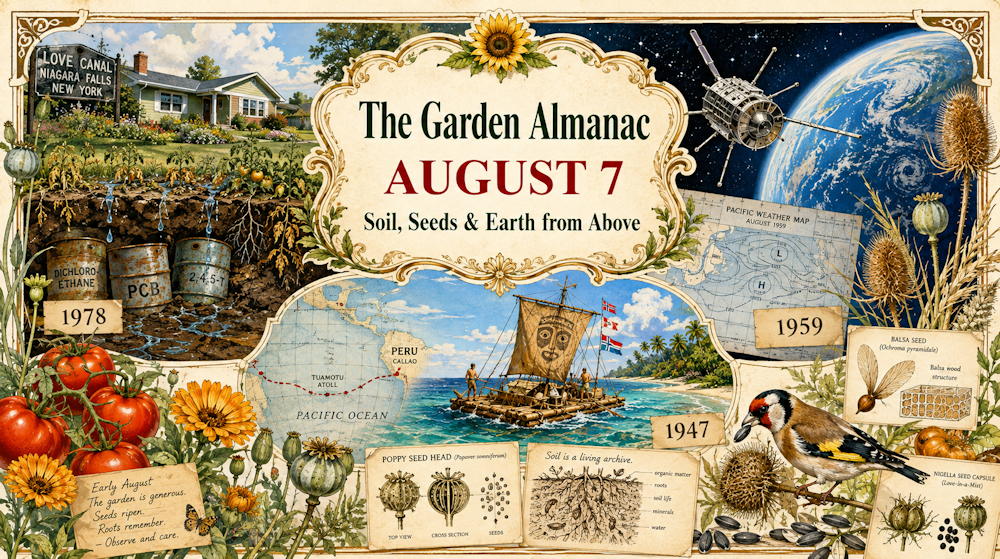

By early August, a garden can look settled into abundance. Tomatoes are colouring, seed heads are forming, and the hottest hours seem to slow even the insects. Yet August 7 carries stories that ask us to look beneath that calm surface – into the soil under our feet, across the currents that move life between shores, and finally down from space at the weather systems shaping every harvest.
This date links a neighbourhood poisoned by its buried past, a balsa raft completing an extraordinary Pacific crossing, and a small satellite beginning a new age of Earth observation. Together, they remind gardeners that no plot is isolated. Soil remembers, seeds travel, and clouds connect landscapes far beyond the garden gate.
August 7, 1978 – When Love Canal Made the Ground Speak
On August 7, 1978, the United States government declared a federal environmental emergency at Love Canal in Niagara Falls, New York. Homes and a school had been built beside a former industrial dumping ground, where thousands of tonnes of chemical waste had been buried. After unusually heavy rain raised groundwater levels, contaminated liquid seeped into basements, yards and school grounds. Residents reported chemical odours, strange residues, sick vegetation and serious health concerns.
Love Canal became a defining environmental story because it overturned a dangerously simple idea: that buried waste had disappeared. Soil is not an inert lid. It contains air spaces, water, minerals, fungi, bacteria, roots and countless small animals, while rainfall can move dissolved substances through it. A site may look green at the surface yet still carry the consequences of decisions made decades earlier. The disaster helped strengthen public demands for systematic investigation and cleanup of hazardous sites.
For gardeners, the lasting lesson is neither panic nor suspicion of every urban plot. It is the value of knowing a site’s history. Before growing food on former industrial land, beside old workshops, near heavily trafficked roads or on imported fill of uncertain origin, obtain a proper soil assessment from an accredited laboratory. A standard fertility test measures nutrients and pH, but it does not automatically test for contaminants such as lead, arsenic or petroleum residues – these must usually be requested specifically.
If contamination is confirmed, adding compost does not make the pollutant disappear. Depending on the substance and concentration, safer options may include professional remediation, capping exposed soil, maintaining dense groundcover to reduce dust, or using raised beds filled with verified clean soil over a protective barrier. Wash produce, peel root crops when appropriate, keep contaminated soil out of the home, and seek advice from local environmental or public-health authorities. The most important crop in any garden is trust in the ground that supports it.
Garden Reminder – When should garden soil be tested?
- Test nutrient levels and pH every few years, or when plants repeatedly struggle without an obvious cause.
- Request contaminant testing separately if the land has an industrial past, unknown fill, peeling old paint nearby or a history of waste disposal.
- Take several small samples from the area in question and combine them as the laboratory instructs – one scoop rarely represents an entire bed.
- Do not rely on appearance, smell or vigorous weed growth to prove that soil is safe for food production.
August 7, 1947 – Kon-Tiki Reaches a Living Reef
On August 7, 1947, after 101 days and roughly 6,900 kilometres across the Pacific, the Kon-Tiki raft struck the reef at Raroia Atoll in the Tuamotu Archipelago. Thor Heyerdahl and his five companions had left Peru on a craft built mainly from balsa logs to demonstrate that such an ocean crossing was physically possible with pre-modern materials. His broader theory about the settlement of Polynesia did not withstand later archaeological, linguistic and genetic evidence, which points primarily to skilled Austronesian voyagers arriving from the west. The voyage nevertheless became a vivid experiment in currents, wind and endurance.
Its plant connection begins with balsa itself. Balsa is a fast-growing tropical American tree whose remarkably light wood contains large air-filled cells. But the wider Pacific story is richer than one raft. People deliberately carried useful plants in canoes, while seeds and fruits also travelled by current, wind and birds. The pre-European presence of the South American sweet potato in Polynesia is evidence of human contact across the ocean, even though it does not validate Heyerdahl’s proposed migration story.
Modern gardeners can see the same dispersal principles on a smaller scale. Some seeds float because corky tissues or fibrous husks trap air; others cling to fur and clothing, pass through birds, or ride gusts into neighbouring beds. Observe how plants arrive before deciding whether they are weeds. Remove invasive species before they set seed, but allow well-behaved annuals such as calendula, poppies or nigella to self-sow where a looser garden style is welcome. Movement is natural – stewardship lies in judging which arrivals a local ecosystem can safely absorb.
Garden Science – How can a seed survive a journey?
A dormant seed has very low metabolic activity, while its coat protects the embryo from drying and damage. Species adapted to water dispersal may add buoyant tissues or waterproof layers, but floating alone is not enough – a seed must remain viable and reach suitable soil at the right season. This is why an ocean can be both a pathway and an immense ecological filter.
August 7, 1959 – The Small Satellite That Changed the Garden Forecast
Explorer 6 was launched from Cape Canaveral on August 7, 1959. The small, paddlewheel-shaped satellite studied radiation, magnetic fields and radio propagation, and carried an experimental scanner for viewing Earth’s cloud cover. A week after launch it transmitted a crude image of a sunlit crescent of Earth and clouds over the Pacific – the first photograph of Earth taken by a satellite in orbit.
That grainy view foreshadowed a profound change in how we understand growing conditions. Today’s satellites monitor cloud systems, rainfall, drought, wildfire, snow cover, vegetation and surface temperature across whole regions. Farmers use Earth-observation data to assess crop stress and manage water; weather services turn repeated measurements into forecasts that help gardeners decide when to sow, protect plants, irrigate or postpone work. The view from above has become practical information at ground level.
Yet a forecast is not a measurement of your particular bed. Walls store heat, slopes drain cold air, trees cast moving shade, and sandy soil dries faster than clay. Use regional forecasts as an early warning, then check the garden itself: feel the soil below the surface, note which leaves wilt first, and keep a simple record of rainfall and frost pockets. Satellite vision is most useful when paired with close observation.
Wildlife Note – Why leave some seed heads standing?
By August, finches and other seed-eating birds begin visiting ripening heads, while hollow or pithy stems will later provide shelter for invertebrates. Leave a selection of sunflowers, teasels and native perennials standing where they will not spread invasively. Their structure feeds wildlife now and adds winter habitat long after the flowers fade.
What to Observe Right Now
- Which parts of the garden remain moist longest after watering or rain?
- Are self-sown seedlings appearing close to the parent plant, along paths or beneath bird perches?
- Do plants beside paving wilt sooner because of reflected and stored heat?
- Which seed heads attract birds, and which are being ignored?
Looking Ahead
August 7 shows that better gardening begins with three kinds of attention: learning what lies beneath a site, noticing how life moves through it, and reading the larger weather patterns around it. We now have laboratory tests and satellite maps that earlier generations could scarcely imagine, but neither replaces an observant gardener. Know the history of your soil, welcome movement without ignoring ecological risk, and compare every forecast with what your own plants reveal. A resilient garden grows from evidence, curiosity and care practiced together.