


By early August, the garden has entered its season of consequences. Months of sowing, watering and patient observation are now visible in swelling tomatoes, ripening beans, seed-heavy flowers and every patch of soil that either held moisture or surrendered it to the heat.
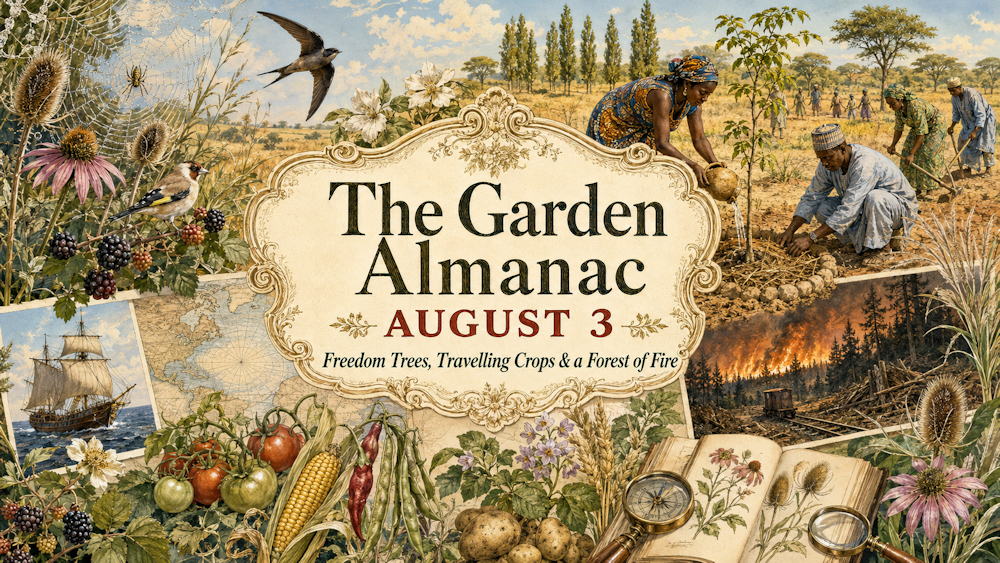
August 3 also carries three stories in which plants are far more than scenery. In Niger, trees became symbols of national renewal and protection against desertification. A voyage from Spain began a vast and often devastating biological exchange between continents. And in a Russian forest settlement, one of history’s deadliest wildfires revealed what can happen when heat, dry vegetation and human decisions combine.
August 3 in Niger – When Independence Day Became a Day for Trees
Niger gained independence from France on August 3, 1960. Fifteen years later, the country began marking the same date as Arbor Day, connecting national freedom with the planting and care of trees. In a nation stretching across the Sahara and the Sahel, this was not simply a commemorative gesture. It expressed a practical idea – that a country’s future depends partly on the condition of its soil, vegetation and water.
Trees in dry landscapes provide benefits far beyond their own shade. Their roots help hold vulnerable soil, while trunks, branches and foliage slow wind near ground level. Leaf litter adds organic matter, improves the soil’s ability to absorb water and provides habitat for decomposers. On farmland, carefully retained trees can protect crops, support livestock and create cooler, more biologically active pockets within an exposed landscape.
Niger’s Arbor Day also challenges the familiar assumption that planting a tree is automatically an environmental success. A tree must suit the climate, soil and available water, and it must survive long enough to perform its intended role. Locally adapted species, protection from grazing and several seasons of follow-up care may matter more than the number of seedlings planted on a single ceremonial day.
The same principle applies in domestic gardens. Before adding a tree, consider its mature spread, root space, water needs and ability to cope with the site’s future climate. Where summers are becoming hotter and drier, a well-chosen tree can shade walls and paving, shelter smaller plants and reduce evaporation. The most useful tree is rarely the fastest-growing impulse purchase – it is the one that can establish successfully and remain an asset for decades.
Garden Science – How do trees protect soil from heat and drought?
A tree canopy intercepts sunlight before it reaches the ground, reducing surface temperatures and slowing the loss of soil moisture. Roots create channels through which water and air can enter the soil, while fallen leaves feed fungi, earthworms and other organisms. Even modest areas of shade can make the upper soil less hostile to roots and soil life during extreme summer heat.
August 3, 1492 – The Voyage That Rearranged the World’s Gardens
On August 3, 1492, Christopher Columbus sailed from Palos de la Frontera in Spain on the voyage that reached the Caribbean. What followed was not merely an age of navigation. European conquest brought dispossession, forced labour, slavery and devastating epidemics to Indigenous societies, while sustained contact between the Americas, Europe, Africa and Asia also set plants, animals and microorganisms moving across oceans on an unprecedented scale.
The resulting Columbian Exchange transformed farms, kitchens and gardens. Tomatoes, potatoes, maize, beans, pumpkins, cacao and chilli peppers travelled from the Americas into other continents. Wheat, sugar cane, bananas, citrus fruits and many domesticated animals moved in the opposite direction. Some crops improved food security far from their places of origin, but introduced weeds, pests, pathogens and plantation systems also caused lasting ecological and human harm.
A modern vegetable plot is often a living map of these journeys. Tomatoes and courgettes may grow beside Mediterranean herbs, Asian cucumbers and African marigolds, yet geographical origin still influences how each plant behaves. Tomatoes and peppers need warmth; potatoes prefer cooler root conditions; climbing beans require reliable moisture when flowering. Learning where a crop evolved helps explain the temperatures, day length, soil and watering pattern under which it performs best.
Garden Inspiration – Read your vegetable bed like a world map
Notice which crops tolerate the hottest part of the garden and which wilt first.
Group plants by water need rather than by culinary use.
Record successful varieties, especially those that crop well during heat or irregular rainfall.
Save seed only from open-pollinated plants, and keep different varieties sufficiently isolated if purity matters.
August 3, 1936 – The Firestorm That Destroyed Kursha-2
On August 3, 1936, fire overwhelmed Kursha-2, a forestry settlement in Russia’s Meshchera Lowlands. Built among pine woods and linked to timber operations by a narrow-gauge railway, the settlement was surrounded by combustible vegetation during a period of intense fire danger. The blaze developed into a fast-moving firestorm and killed more than a thousand people, making it one of the deadliest wildfires on record.
The tragedy demonstrates that wildfire is shaped not only by weather, but by the arrangement and condition of fuel. Dry grasses ignite quickly, resinous plants burn fiercely, accumulated dead wood increases intensity and continuous vegetation allows flames to travel. Peaty ground introduces another danger: once sufficiently dry, organic soil can smoulder below the surface and remain hot long after visible flames have disappeared.
Gardeners cannot control a regional wildfire, but they can reduce hazards close to buildings. Dead vegetation should not accumulate beneath hedges, timber should be stored away from walls and gutters should be cleared of dry leaves. Plants need not be removed indiscriminately – green, well-spaced and appropriately watered vegetation is very different from a continuous belt of drought-stressed shrubs, tall dry grass and fallen branches.
Garden Reminder – How can you make a garden safer in dry weather?
- Remove dead stems, fallen twigs and dry leaves from beside buildings and fences.
- Cut back dry grass before it forms a continuous route through the garden.
- Keep compost heaps moist enough to function and position them away from vulnerable structures.
- Avoid bonfires, flame weeders and spark-producing tools during hot, windy conditions.
- Check local restrictions before lighting any outdoor fire.
- Leave clear access to water and keep hoses ready for ordinary garden emergencies.
Wildlife Note – Should Every Dry Seed Head Be Removed?
No. A completely stripped garden offers less food and shelter to wildlife, so fire awareness should not become an excuse for removing every standing stem. Seed heads of plants such as teasel, sunflower and coneflower can feed birds, while hollow stems and dense ground-level cover shelter invertebrates.
Use location to decide what stays. Remove brittle material beside the house, shed, paths and cooking areas, but retain selected seed heads in more open parts of the garden where they do not create a continuous line of dry fuel. This creates a sensible mosaic – tidier and safer near structures, looser and more wildlife-friendly farther away.
What to Observe Right Now – Signs That the Garden Is Entering Late Summer
Early August often brings subtle changes before autumn is visible. Look closely rather than relying only on the calendar:
- Spiders may build larger, more noticeable webs between tall stems.
- Swifts and swallows gather where flying insects are abundant.
- Berries begin to colour, although they may not yet be ripe.
- Some perennials slow their flowering and divert energy into seeds.
- Trees under drought stress may curl, scorch or shed leaves early.
- Morning dew can briefly return moisture to leaves even after a dry day.
Premature leaf fall does not always mean that autumn has arrived. During drought, some trees reduce their leaf area to limit water loss. Check the soil below the canopy before assuming disease, and water slowly over a broad area rather than pouring a small amount beside the trunk.
Seasonal Tips – What Needs Attention in the Early-August Garden?
Harvest courgettes, beans and cucumbers frequently so that plants continue producing. Remove damaged fruit promptly, but leave healthy tomato foliage in place unless airflow is poor or disease is present – excessive leaf removal can expose fruit to sunscald.
Water less often but more thoroughly, directing moisture towards the root zone in the morning. Containers may still need daily checks, especially against warm walls, while established border plants usually benefit more from deep watering than from a light daily sprinkling. A layer of organic mulch helps slow evaporation, but keep it slightly away from woody stems and plant crowns.
August 3 is also a useful moment to assess shade. Observe where afternoon sun strikes seating areas, walls and vulnerable plants. A future tree, pergola or deciduous climber can be planned from what the garden reveals now, when heat patterns are easiest to see.
Looking Ahead
The stories of August 3 show that planting, moving and managing vegetation can reshape entire landscapes. Niger’s freedom trees remind us to choose for long-term resilience, travelling crops encourage us to understand the origins and needs of what we grow, and Kursha-2 warns us to notice how dry material connects across a landscape. A garden cannot solve every environmental challenge, but it can hold cooler soil, safer spaces and richer habitats. The best place to begin is with careful observation – followed by the right plant, in the right place, with a plan for its future.