
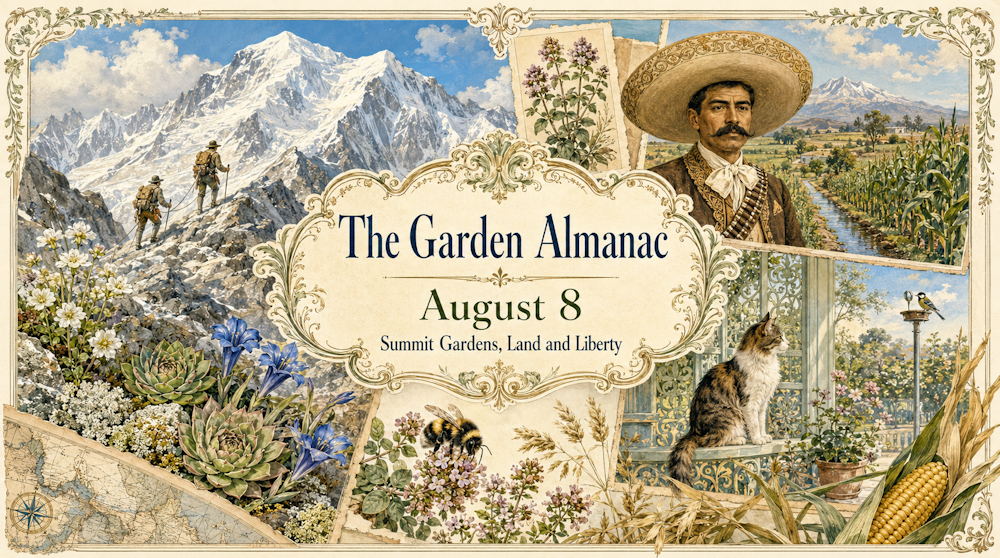

By early August, the garden has begun to reveal what kind of summer it has endured. Lawns may be pale, borders are leaning into their second act, and seed heads are replacing some of the brightest flowers. Yet this is no quiet interval. August 8 opens windows onto the highest slopes of the Alps, the cultivated valleys of Mexico and the miniature hunting grounds just beyond the back door.
The day’s stories are linked by territory: who reaches it, who controls it and who else depends upon it. From alpine plants surviving where soil is scarcely more than a crack in the rock to village farmers defending access to land and water, each story asks us to look more closely at the ground beneath our feet.
August 8, 1786 – The Climb That Revealed a Garden Above the Clouds
On August 8, 1786, physician Michel-Gabriel Paccard and crystal hunter Jacques Balmat became the first recorded people to reach the summit of Mont Blanc. Their ascent from the Chamonix valley is often treated as the symbolic beginning of modern mountaineering. Paccard also carried scientific ambitions, making observations of temperature and air pressure in a place that had previously been seen largely from below.
The summit itself is an expanse of ice rather than a garden, but the journey towards it crosses one of Europe’s most dramatic sequences of plant communities. As altitude increases, forests give way to dwarf shrubs, alpine grassland and, finally, scattered specialists rooted in scree and rock fissures. Low temperatures, strong winds, intense sunlight and a very short growing season select for compact plants with deep or spreading roots, small leaves and flowers held close to the warmer ground.
These high landscapes helped inspire the rock garden, but their real lesson is more subtle than arranging stones around a few small plants. Many alpines need sharp drainage around the crown while their roots remain cool and able to reach moisture below. In a lowland garden, a raised bed, trough or crevice garden filled with a gritty, free-draining mix can imitate those conditions more successfully than a flat bed of rich, damp soil. Stones are functional as well as decorative: they shelter roots, moderate temperature and guide water away from vulnerable crowns.
Alpine habitats are also unusually sensitive to trampling, collecting and a warming climate that pushes suitable conditions higher up the mountain. Gardeners should buy propagated plants from reputable nurseries rather than remove them from the wild. Even a tiny rock garden can then become a respectful study of adaptation – saxifrages gripping a crevice, houseleeks storing water in fleshy rosettes and gentians timing their flowers to a compressed season.
Garden Science – Why do alpine plants stay so low?
Air immediately above the ground is often warmer and less turbulent than air higher up. A cushion-shaped plant traps a thin layer of still air, reduces exposure to drying wind and keeps its leaves and flowers close to heat absorbed by rock and soil. The same compact form that looks ornamental in a trough is a survival strategy on a mountain.
August 8, 1879 – Emiliano Zapata and the Living Meaning of Land
Emiliano Zapata was born on August 8, 1879, in Anenecuilco in the Mexican state of Morelos. He grew up amid a long dispute between village communities and expanding haciendas, particularly sugar estates that concentrated control of fertile land and water. During the Mexican Revolution, he became the best-known leader of the southern agrarian movement, and the 1911 Plan of Ayala demanded the return of lands taken from villages and wider redistribution.
Zapata’s story belongs to political history, but its landscape was agricultural: sugar cane, maize, pasture, irrigation and the boundaries that determined who could grow food. It reminds us that productive soil is never merely a surface. Its fertility rests on access to water, accumulated organic matter, local knowledge and the security needed to care for it beyond a single harvest. Gardens are smaller territories, yet they rely on the same long view.
For today’s gardener, stewardship begins by treating soil and water as resources to renew rather than inputs to consume. Keep soil covered with plants or organic mulch, return disease-free plant matter through compost, collect rainwater where regulations allow and choose crops suited to the water actually available. Seed swaps, community gardens and shared composting schemes add another lesson from agrarian history: resilience grows when knowledge and useful resources circulate through a community.
Garden Reminder – Help an August garden through dry weather
- Water early in the morning and soak the root zone deeply rather than sprinkling the surface every day.
- Check moisture a few centimetres below the soil before watering – a dry crust can hide damp soil underneath.
- Mulch after watering, leaving a small gap around stems to discourage rot and pests.
- Prioritise containers, young trees, recent plantings and fruiting vegetables; established drought-tolerant plants can usually wait longer.
August 8 – International Cat Day and the Garden’s Hidden Border
International Cat Day has been observed on August 8 since 2002, when it was created to promote awareness of cat welfare and responsible care. The date brings affection for a familiar companion into conversation with a less comfortable truth: a garden may be a pet’s territory, but it is also habitat for nesting birds, fledglings, small mammals, reptiles and amphibians.
This does not require gardeners to choose between cats and wildlife. It does require thoughtful design and management. A secure outdoor enclosure or enclosed garden gives a cat air, sunlight and stimulation without allowing it to hunt. Supervised outdoor time is another option, while keeping cats indoors from dusk through the night reduces encounters during hours when many small animals are active. Neutering and identification remain essential for cat welfare, but a well-fed cat may still hunt because hunting is not driven by hunger alone.
Garden layout can reduce risk, too. Position bird feeders away from dense shrubs or structures from which a cat can spring, and use a tall, smooth pole with feeders high above the ground. Avoid placing food directly beside nest boxes, ponds or low cover used by fledglings. At the same time, check plant choices carefully: true lilies and daylilies can cause severe poisoning in cats, including through pollen or vase water, so cat-owning households are safest avoiding them altogether.
Wildlife Note – Where should a bird feeder go in a garden with cats?
Choose an open site that gives birds a clear view of approaching danger, but keep safe cover within a short flight rather than immediately beneath the feeder. Clean up spilled seed, which can draw ground-feeding birds and rodents into ambush range, and pause feeding if a cat repeatedly waits nearby.
What to Observe Right Now – Signs That Summer Is Turning
- Watch bumblebees working late-flowering herbs such as oregano, mint and thyme, especially when other nectar sources are fading.
- Look for seeds ripening in dry pods and heads – collect only when they are fully mature and dry, and leave some for birds and natural reseeding.
- Notice which plants recover quickly after evening temperatures ease; temporary midday wilting does not always mean the soil is dry.
- Listen at dusk for the changing rhythm of the garden as daytime pollinators give way to moths, bats and other nocturnal visitors.
Looking Ahead
The landscapes behind August 8 range from glacial heights to irrigated fields and a single suburban border, yet all depend on careful boundaries and shared resources. A gardener can respond in practical ways: build conditions that suit the plant, protect soil and water, and make room for wildlife without neglecting domestic animals. The future of gardening will be shaped not only by what we grow, but by how attentively we manage the living territory around it. That work can begin today, with one crevice, one layer of mulch or one safer corner for birds.