
Late June has a special rhythm in the garden. The first flush of summer flowers is giving way to ripening fruit, vegetables are growing almost visibly from one day to the next, and every morning reveals something new among the borders. June 27 sits at this turning point of the season – a day rich in old weather lore, remarkable journeys and inspiring reminders that our relationship with nature is shaped not only by what we see, but also by how we observe.
Across Europe, generations of gardeners watched the skies on this date, believing today’s weather could offer clues about the weeks ahead. Elsewhere in history, explorers completed extraordinary voyages that changed how people understood the world, while one of history’s most inspiring advocates reminded us that nature can be experienced through every sense.
Together, these stories invite us to slow down, look more carefully and appreciate the remarkable connections between gardens, landscapes and human curiosity.
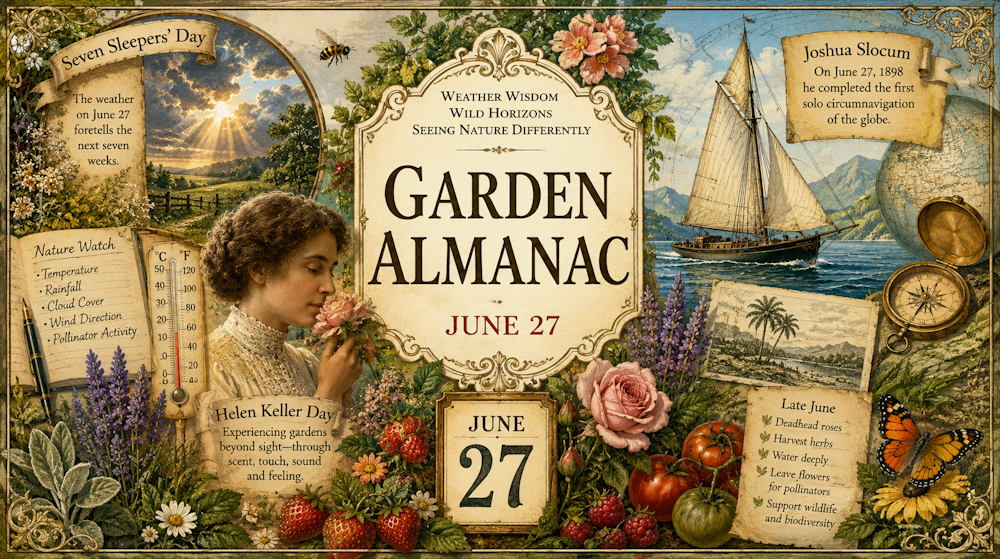
Seven Sleepers’ Day – Can One Day Predict the Summer?
One of Europe’s best-known weather traditions falls on June 27 – Seven Sleepers’ Day, or Siebenschläfertag in Germany. Although rooted in a Christian legend dating back many centuries, the day became famous for something entirely different: weather forecasting.
According to long-standing folklore, the weather on June 27 is said to influence the following seven weeks. While the saying is not literally accurate everywhere, meteorologists have found that in parts of Central Europe, stable atmospheric patterns established around the end of June often do persist well into July. That gives this old tradition more scientific credibility than many other weather proverbs.
For gardeners, the message remains surprisingly relevant. Rather than relying on a single forecast, observing broader weather patterns can help guide watering schedules, lawn care and expectations for summer crops.
Nature Watch
Today is an excellent day to begin your own seasonal weather journal.
Record:
- morning and evening temperatures
- rainfall
- cloud cover
- wind direction
- pollinator activity
- Over several years, these notes become one of the most valuable gardening tools you can own.
Helen Keller Day – Experiencing Gardens Beyond Sight
June 27 is also celebrated as Helen Keller Day, honouring the birth of the remarkable American author, educator and advocate who transformed public understanding of disability. Despite being both deaf and blind from early childhood, Keller developed an extraordinary appreciation of the natural world.
Her writings often describe the fragrance of flowers, the texture of leaves, the warmth of sunshine and the movement of air through trees. She demonstrated that a garden is far more than a collection of colours – it is a place filled with sounds, scents, textures and changing temperatures.
Modern garden designers increasingly embrace this philosophy by creating sensory gardens where aromatic herbs, rustling grasses, textured foliage and flowering plants provide rich experiences for visitors of all abilities.
A garden that engages every sense often becomes a more vibrant habitat for wildlife as well.
Garden Inspiration
Walk through your garden today without focusing on what you see.
Instead, notice:
- the scent of lavender after sunshine
- bees moving between blossoms
- the texture of sage or lamb’s ear
- birds singing from nearby trees
- the cooling shade beneath shrubs
You may discover details you’ve overlooked for years.
Joshua Slocum – A Journey That Celebrated the World’s Living Coastlines
On June 27, 1898, sailor Joshua Slocum completed the first solo circumnavigation of the globe, returning after more than three years at sea. His remarkable voyage demonstrated not only extraordinary seamanship but also deep respect for the world’s oceans, coastlines and changing climates.
Long before environmental awareness became widespread, Slocum’s journals described mangrove forests, tropical islands, windswept cliffs and remote harbours with careful observation.
For gardeners, his story offers an unexpected lesson. Plants, seeds and gardening traditions have travelled the globe alongside sailors, explorers and traders for centuries. Many familiar favourites – tomatoes, beans, dahlias, citrus fruits and countless herbs – reached new continents through these great journeys.
Today’s diverse gardens are living collections of global botanical history.
Seasonal Tip
Celebrate the international story of gardening by growing a plant that originated far from your home.
Whether it is lavender from the Mediterranean, tomatoes from South America or sunflowers from North America, every garden tells a story of exploration and adaptation.
Late June – The Garden Begins to Mature
By the final week of June, the character of the garden starts to shift. Spring’s rapid burst of blossom gradually gives way to abundance.
Strawberries are reaching their peak, raspberries begin to colour, climbing roses continue flowering and many perennial borders are entering their most spectacular weeks.
This is also the season when wildlife activity is at its height. Young birds are leaving their nests, butterflies become increasingly common, and bees are working from dawn until dusk.
Rather than chasing perfection, experienced gardeners often spend this period simply observing how different plants interact with insects, birds and changing weather.
Healthy gardens are dynamic ecosystems, constantly evolving throughout the season.
Garden Reminder
Late June is the perfect time to:
- deadhead repeat-flowering roses
- harvest herbs before they flower
- water deeply rather than frequently
- leave a few flowers for pollinators
- avoid cutting back seed-producing plants that support wildlife
Small actions now help maintain colour and biodiversity throughout summer.
Looking Ahead
June 27 reminds us that gardening is built on observation as much as action. Ancient weather traditions encourage us to watch the skies, Helen Keller’s legacy teaches us to appreciate every sensory layer of nature, and Joshua Slocum’s remarkable voyage reminds us that our gardens are connected to landscapes and cultures around the world.
As summer unfolds, every day offers opportunities to notice subtle changes – the arrival of a new butterfly, the first ripe tomato, the scent of herbs after rain or the quiet patterns of the weather. By paying closer attention, we become not only better gardeners but also better stewards of the living world that surrounds us.