
Mid-July is a season of abundance, but it is also a season that asks us to pay attention. Tomatoes begin to colour, herbs release their strongest fragrance in the afternoon heat, and the garden seems full of movement – if we pause long enough to notice it.
July 18 is a particularly good day for that pause. It connects a remarkable botanical voyage, a worldwide invitation to listen more carefully, and Nelson Mandela Day’s practical call to help others. Together, these stories suggest that a garden is never just a collection of plants. It is a place of observation, shared resources and small actions that can travel much further than we expect.
July 18, 1801 – The Ship That Set Sail with a Gardener on Board
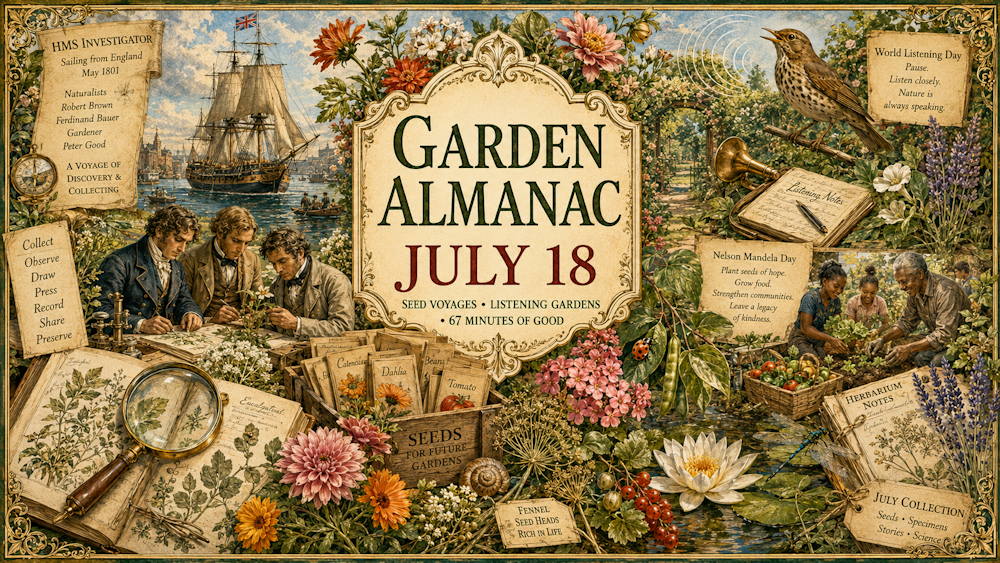
On July 18, 1801, HMS Investigator left England for Australia under the command of Matthew Flinders. Its task was to chart the coastline of what Europeans then called New Holland, but the expedition also carried an unusually ambitious scientific team: botanist Robert Brown, botanical artist Ferdinand Bauer and gardener Peter Good.
That last role is worth lingering over. Good was not merely an assistant surrounded by specimens and instruments. His work included collecting seeds and living plant material – the fragile, practical work of turning discovery into something that could be studied, grown and shared. Brown eventually documented around 3,400 Australian plant species during his years of fieldwork, many of them previously unknown to European science.
The voyage belongs to an age of exploration with a complicated colonial history, and it should not be romanticised without question. Yet it also marks an important moment in botanical knowledge: careful observation, accurate drawing, seed collection and herbarium records began to reveal the astonishing diversity of Australian flora to a wider scientific world.
For gardeners, the lesson is wonderfully close to home. Good plant knowledge starts with looking properly. Before buying, moving or removing a plant, it helps to know what it is, where it grows naturally, what insects use it and how it behaves through the seasons. A label can be useful; regular observation is better.
Garden Science – Why does recording plants matter?
A simple garden notebook can reveal patterns that memory misses:
- which perennials cope best with dry spells
- when the first pollinators visit a particular flower
- where mildew, slugs or poor drainage return each year
- which self-sown plants are genuinely welcome – and which need limiting
Over several seasons, these notes become a small but valuable map of your garden’s ecology.
World Listening Day – What Does the Garden Sound Like?
July 18 is also World Listening Day, chosen to honour the birthday of Canadian composer and educator R. Murray Schafer. Schafer’s work helped shape the field of acoustic ecology – the study of how living things, landscapes and human activity create and respond to sound.
A garden has its own soundscape. There is the low, steady work of bumblebees in flowering herbs, the wingbeat of pigeons lifting from a roof, leaves moving before rain, and the sharp alarm call that tells you a blackbird has noticed a cat. In summer, sound often reveals activity before the eye does.
Listening is more than a pleasant excuse to sit outside with a cup of tea. It can also be a useful form of wildlife observation. A garden that is loud with insects, birds and rustling vegetation is not automatically healthy, but a sudden silence can be worth noticing. Has the lawn been cut? Has a heatwave dried out the flowers? Has a hedge been heavily pruned just as young birds are using it for cover?
Try giving the garden ten quiet minutes today. Leave the phone indoors. Stand still near a flowering border, a pond or a mature shrub, and simply listen. You may hear a part of the garden’s daily life that is easy to overlook while watering, weeding or hurrying past.
Wildlife Note – Which sounds are especially worth noticing now?
- Bees working open flowers of lavender, oregano, thyme and marjoram
- Young birds making persistent contact calls from dense shrubs or hedges
- Grasshoppers and crickets in dry, sunny areas
- Frogs, damselflies or water beetles around an established pond
Avoid using broad-spectrum insecticides simply because you see a few chewed leaves. In July, many birds are still feeding young, and insects are part of the garden’s food web.
Nelson Mandela Day – A Garden Can Be an Act of Service
Nelson Mandela was born on July 18, 1918, in Mvezo, South Africa. The United Nations later declared his birthday Nelson Mandela International Day, inviting people to give 67 minutes of their time in service to others – reflecting the 67 years he devoted to public life and the struggle for justice.
The idea is not that one short act can solve every social or environmental problem. It is that useful change becomes possible when people stop waiting for someone else to begin.
Gardens offer particularly practical ways to take part. Community food gardens, school growing spaces, seed-sharing tables and small planting projects can strengthen local connections while making fresh food, shade and nature more accessible. The Nelson Mandela Foundation itself has highlighted community gardens as one way to support food security and sustainable agriculture.
A July 18 act of service could be as modest as helping a neighbour water during a holiday, dividing a healthy clump of chives or mint for someone starting a first garden, or offering surplus courgettes, beans or herbs to a local food project. The important thing is not the scale. It is the shared usefulness.
Garden Reminder – What Should You Do in the Garden in Mid-July?
In temperate Northern Hemisphere gardens, the priority is not to make every bed look immaculate. It is to help plants stay healthy through heat, harvesting and the busiest part of the growing season.
- Water deeply at the root zone in the early morning, rather than giving plants frequent light sprinkles. Deep watering encourages roots to grow down into cooler, more reliably moist soil.
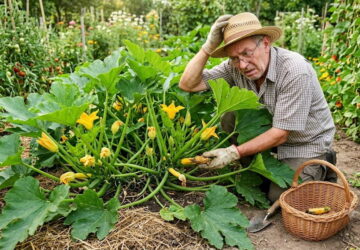
- Harvest courgettes, beans, cucumbers and herbs regularly. Leaving overgrown fruits on the plant can slow further production.
- Deadhead repeat-flowering roses and summer bedding plants, but leave some fading flowers and seed heads where they are useful to birds and insects.
- Check container plants every day in hot, windy weather. Pots can dry much faster than open ground, even after a short shower.
- Tie in tall dahlias, tomatoes and other heavy summer growers before stems bend or break in a storm.
A mulch of compost, leaf mould or untreated grass clippings around thirsty plants can reduce moisture loss. Keep it a few centimetres away from stems to avoid creating a damp collar around the base of the plant.
What to Observe Right Now – The Garden’s Mid-Summer Decisions
July is when a garden quietly shows its priorities. Some plants are investing in flowers, some in fruit, some in seed and some in survival through drought. Look closely at the differences.
Notice which flowers remain open in the hottest part of the day. Observe whether bees prefer the sunny edge of a border or the slightly cooler patch near shrubs. Look at how the leaves of hydrangeas, cucurbits and young trees respond to afternoon heat – temporary wilting may be a water-saving response, but plants that remain limp after evening cooling may need a deeper drink.
Also watch what is setting seed. Nigella, calendula, foxgloves, poppies and many annual herbs can provide a gentle supply of future plants if a few seed heads are left to mature. This is not neglect. It is a way of allowing the garden to renew some of itself.
Looking Ahead
The stories held by July 18 all begin with attention. Robert Brown and Peter Good collected and recorded plants carefully. World Listening Day asks us to notice the living sound around us. Nelson Mandela Day reminds us that even a limited amount of time can become meaningful when it is offered usefully.
A better garden does not always begin with a major redesign or another purchase. Sometimes it begins with a notebook, ten quiet minutes beside a border, a bowl of surplus beans offered to someone else, or a shared packet of seeds. Small acts of care are how knowledge, biodiversity and community take root.