
By July 19, summer has usually stopped being a promise and become a test. The garden is no longer fresh with early-season optimism. It is working hard now: roots searching deeper, leaves managing heat, flowers trying to keep pollinators fed, and gardeners learning which parts of their planting scheme were truly resilient.
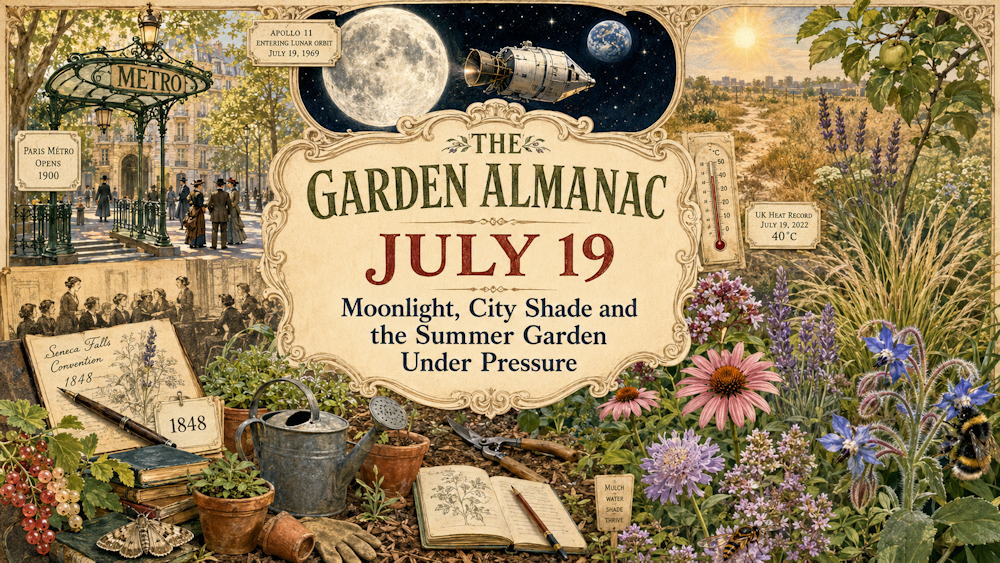
This date opens several doors at once. On July 19, 1848, the Seneca Falls Convention began in New York, a landmark moment in the history of women’s rights. On July 19, 1900, the Paris Métro opened during the Exposition Universelle. On July 19, 1969, Apollo 11 entered lunar orbit. And on July 19, 2022, the United Kingdom recorded temperatures above 40°C for the first time.
At first glance, these stories seem to belong to politics, engineering, space exploration and climate history. But look again, and July 19 becomes a surprisingly garden-minded date: a day about access, shade, perspective, heat, and the changing ways people live with the land.
July 19, 1848 – Seneca Falls and the Right to Cultivate a Life
The first women’s rights convention in the United States opened at Seneca Falls, New York, on July 19, 1848. The gathering challenged laws and customs that restricted women’s education, property rights, public voice and civic participation.
For a garden almanac, this matters because gardens have never been only decorative spaces. They have been places of food, medicine, income, teaching, experiment and independence. For many women, especially in the 18th and 19th centuries, gardens were among the few socially acceptable spaces where botanical knowledge, practical skill and economic contribution could be expressed.
Kitchen gardens, seed saving, orchard care, herb drying, poultry yards and market produce often depended on women’s labour and expertise, even when formal credit went elsewhere. The history of gardening is full of unnamed hands that selected beans, tended fruit trees, kept medicinal herbs alive, and passed growing knowledge from one generation to the next.
The lesson for today’s gardener is simple but important: gardening knowledge grows stronger when it is shared widely. A resilient garden culture depends not only on tools and techniques, but on who is invited to learn, experiment and make decisions.
Garden Inspiration – Who Gets to Garden?
A more generous garden culture can begin in very practical ways:
- Share spare seedlings with someone who is just starting out.
- Label plants clearly in community gardens and school gardens.
- Teach pruning, composting and seed saving as everyday skills, not specialist secrets.
- Choose at least a few low-cost, easy-to-propagate plants when designing shared spaces.
A garden becomes more valuable when more people can understand it, care for it and feel welcome in it.
July 19, 1900 – The Paris Métro and the Garden Above the City
The first line of the Paris Métro opened on July 19, 1900, during the World’s Fair. It was a triumph of modern urban engineering: faster movement, denser city life, and a new way of thinking about public space.
But every city that grows underground and upward must also answer a question above ground: how will people breathe, cool down, rest and remain connected to living systems?
Urban gardens are not luxuries. Street trees, pocket parks, planted courtyards, green roofs and shaded squares all help reduce heat, slow stormwater, support insects and make dense neighbourhoods more liveable. In midsummer, the difference between a bare paved street and a tree-lined one is not merely visual. It can be felt in the body.
For gardeners, the Paris Métro anniversary is a reminder that infrastructure is not only rails, stations and roads. Soil is infrastructure. Shade is infrastructure. Tree roots are infrastructure. A healthy city needs living systems as surely as it needs transport.
Seasonal Tips – How to Garden for Shade in High Summer
If July heat is becoming harder on your garden, focus first on shade and soil protection:
- Mulch around vegetables, fruit bushes and young trees to reduce evaporation and keep soil temperatures steadier.
- Use temporary shade netting for young lettuces, newly planted brassicas and container plants during heatwaves.
- Water deeply and less often rather than giving frequent shallow watering.
- Group containers together so leaves shade pots and reduce root-zone overheating.
- Avoid heavy pruning during extreme heat, because sudden exposure can scorch previously shaded leaves and stems.
A garden that is shaded, mulched and watered deeply is usually more resilient than one that is simply watered more often.
July 19, 1969 – Apollo 11 Enters Lunar Orbit
On July 19, 1969, Apollo 11 passed behind the Moon and entered lunar orbit, one day before the first human landing on the lunar surface. From that distance, Earth appeared small, blue, alive and unmistakably finite.
For gardeners, the Apollo story is not only about space. It is about perspective. A garden is the smallest practical version of planetary care: soil, water, atmosphere, sunlight, plant growth, decay, insects, fungi and human choices all meeting in one place.
The Moon is almost completely hostile to gardening. No breathable atmosphere, no liquid water on the surface, no organic soil, no pollinators, no weathered humus. Earth, by contrast, is a living garden because countless systems overlap: geology, climate, microbes, plants, animals and time.
That makes every handful of healthy soil more remarkable. Garden soil is not dirt in the casual sense. It is a living medium made from minerals, organic matter, air, water and organisms. Composting, mulching and avoiding unnecessary soil disturbance are not small gestures. They are ways of protecting the thin living skin that makes terrestrial gardening possible.
Garden Science – Why Does Mulch Help Plants Survive Heat?
Mulch works because it changes the soil’s surface environment. A layer of straw, composted bark, leaf mould or grass clippings reduces direct sun on the soil, slows evaporation and helps prevent crusting after heavy rain or irrigation.
In hot weather, bare soil can heat quickly and lose moisture from the upper root zone. Mulched soil usually stays cooler and more evenly moist, which helps roots continue absorbing water. Organic mulches also break down gradually, feeding soil organisms and improving soil structure over time.
For most ornamental beds and vegetable gardens, a mulch layer of about 5–8 cm is useful. Keep it slightly away from woody stems and crowns to reduce the risk of rot.
July 19, 2022 – When 40°C Reached the British Weather Map
On July 19, 2022, the United Kingdom recorded temperatures above 40°C for the first time, with 40.3°C measured at Coningsby in Lincolnshire according to the UK Met Office. What once seemed almost unimaginable in a temperate climate became a measured weather event.
For gardeners across Europe and beyond, this kind of record is not abstract. Heat changes the practical calendar. It affects when seeds germinate, when lawns go dormant, how fruit sets, how pests behave, and how much stress young trees can tolerate. A plant that is technically hardy in winter may still struggle if summer nights remain too warm and the soil dries too quickly.
Heat stress often appears first as wilting, scorched leaf edges, flower drop or premature fruit fall. But the deeper problem is water balance. When leaves lose water faster than roots can replace it, plants close their stomata to reduce transpiration. That protects them in the short term, but it also slows photosynthesis and growth.
The best response is not panic watering in the hottest part of the day. It is preparation: better soil organic matter, shade where needed, climate-suitable planting, fewer exposed containers, and watering that reaches the deeper root zone.
Garden Reminder – What Should You Do During a Heatwave?
During a serious hot spell, the most useful garden tasks are protective rather than ambitious:
- Water early in the morning so leaves dry quickly and roots can take up moisture before peak heat.
- Prioritise newly planted trees, shrubs, vegetables in fruit, and container plants.
- Move pots away from south-facing walls, which can radiate heat long after sunset.
- Delay feeding stressed plants, because fertiliser can push growth when the plant is trying to conserve water.
- Leave lawns longer, as taller grass shades the soil and reduces moisture loss.
A heatwave is not the moment to demand perfection from the garden. It is the moment to help plants get through with as little stress as possible.
Wildlife Note – What Are Pollinators Doing in Mid-July?
By July 19, many pollinators are working at full pace. Bees, hoverflies, butterflies and moths depend on continuous nectar and pollen sources, especially as early summer flowers fade and late-summer plants have not all reached their peak.
This is where succession planting matters. A pollinator-friendly garden should not bloom all at once and then fall silent. Lavender, oregano, thyme, scabious, echinacea, borage, catmint, verbena, single dahlias and many native wildflowers can help bridge the midsummer gap.
Do not be too quick to tidy every fading stem. Seedheads feed birds later, hollow stems can shelter insects, and some “messy” corners are often the most useful places in the garden.
What to Observe Right Now – The Garden’s July Signals
Mid-July is a good time to look closely rather than simply work harder. The garden is giving useful information.
Watch for:
- Which plants recover quickly after a hot afternoon, and which remain wilted into the evening.
- Where the soil dries first after watering or rain.
- Which flowers attract the widest range of insects.
- Whether young fruit trees show leaf scorch on the sunnier side.
- Where shade falls at midday, not just in the morning or evening.
These observations are more valuable than any generic rule. They show you where to mulch more deeply, where to add shade, where to move containers, and which plants truly suit your garden’s conditions.
Looking Ahead
July 19 brings together reform, engineering, spaceflight and climate reality. Its stories are different, but they point in the same direction: the future depends on how wisely we design the places we live in.
A good garden is not only beautiful. It is accessible, shaded, soil-conscious, wildlife-friendly and prepared for harder summers. It teaches patience, but also adaptation. It asks us to look closely at what is changing and respond with practical care.
In that sense, July 19 is a very modern garden day. It reminds us that the smallest plot can hold a larger idea: a cooler corner, a healthier soil, a shared skill, a flowering plant left for insects, and a more thoughtful relationship with the living world.