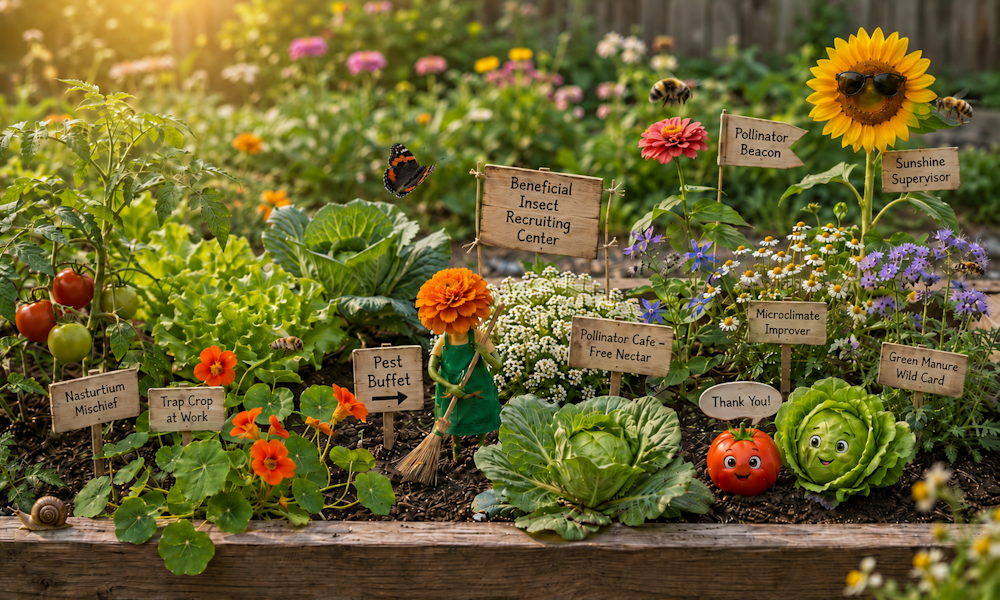

There is an old habit in vegetable gardening that deserves to be quietly retired: the idea that flowers are only for decoration, while vegetables are the “serious” part of the garden. As if one belonged to the eyes and the other to the kitchen, and the two should politely keep their distance from each other. In reality, May is one of the best times to bring flowers into the vegetable garden.
Not just because they make a row of tomatoes look more charming — although they certainly do. The real reason is that some flowers actively work in the garden. They attract beneficial insects, act as trap crops, fill bare spaces, improve the microclimate, or simply help turn a vegetable patch from a sterile little battlefield into a living, balanced system.
May is an especially good moment for this. By now, vegetable beds are usually filling up, but there are still gaps, edges, empty strips and unused corners. These are perfect places for flowers that do more than simply take up space.
Why Plant Flowers in the Vegetable Garden?
Because a vegetable garden is not just a collection of plants. It is a network of relationships.
If a bed contains only vegetables, it may be less attractive to pollinators and beneficial predatory insects than a more diverse, flower-rich planting. Flowers provide nectar and pollen, which can draw in insects that later help keep aphids, whiteflies and other pests in check.
Some flowers also improve the structure of the garden: they cover bare soil, fill gaps, create different flowering levels, or offer food to insects above and around dense vegetable foliage.
And yes, there is the emotional side too. A vegetable garden with flowers simply feels more alive. And in a garden, it matters whether you actually enjoy going out there.
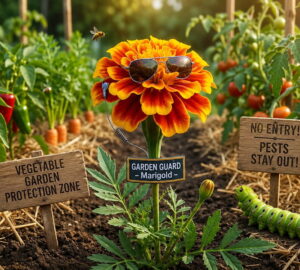
1. Marigold: The Vegetable Garden’s Familiar Little Bodyguard
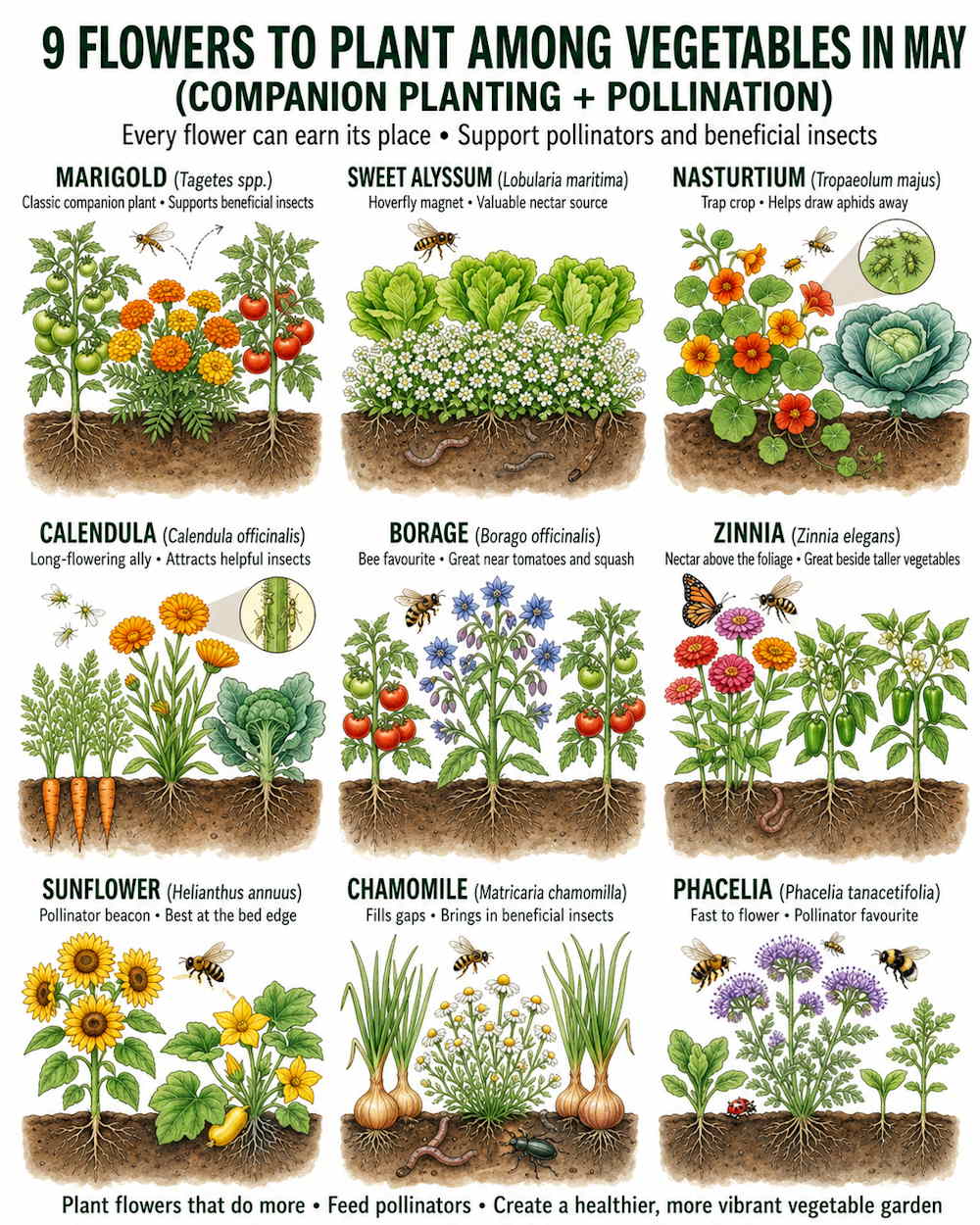
Marigold, especially French marigold (Tagetes patula) and African marigold (Tagetes erecta), is one of the best-known companion planting classics — and for good reason. It is easy to grow, loves sunshine, and fits naturally into vegetable beds.
Some of the claims made about marigolds can be a little exaggerated, but there is no doubt that they are useful plants in a kitchen garden. They are often planted near tomatoes, peppers and many other vegetables, either as edging plants or scattered between rows.
Gardeners value them because they attract beneficial insects and can help make a bed feel more balanced and diverse. And while they are doing all that, they certainly do not look like a chore.
2. Sweet Alyssum: It Does Not Fight Aphids Itself, But It Calls in Help
Sweet alyssum (Lobularia maritima) looks delicate, low and almost too pretty for a working vegetable bed. In reality, it is a very clever choice.
It grows low, helps cover the soil, and produces masses of tiny flowers that are especially attractive to hoverflies and other beneficial insects. Adult hoverflies visit flowers for nectar and pollen, while their larvae feed on aphids.
So sweet alyssum does not solve pest problems by doing the fighting itself. It helps by inviting the right guests closer to the plants that may need protection.
It works particularly well near lettuce, brassicas and other lower-growing crops, where it can form a living little carpet of flowers without taking over.
3. Nasturtium: The Beautiful Trap Crop
Nasturtium (Tropaeolum majus) is the kind of flower that is both charming and strategically useful. It trails or spreads beautifully, produces vivid blooms, and is easy to love — while often attracting some of the pests you would rather keep away from your vegetables.
That is why nasturtiums are often used as trap crops. They can be especially useful where aphids and other sap-sucking pests are a recurring problem.
Near cabbages, cucumbers or other vulnerable vegetables, nasturtium can be a smart tactical plant — as long as you accept that, from time to time, it may become the heroic insect magnet of the garden.
And that is one of its best qualities: it is beautiful, but it can also take one for the team.
4. Calendula: The All-Rounder That Asks Little and Gives Plenty Back
Calendula, also known as pot marigold (Calendula officinalis), is one of the most useful natural companions in the vegetable garden. It tolerates sun well, flowers for a long period, and attracts many beneficial insects.
It is also loved because it simply works well among vegetables. It is not fussy, not overly demanding, and usually easy to fit into a bed.
Calendula can be planted near carrots, onions, brassicas or along the edges of vegetable beds. It is one of those reliable garden characters that never needs to be the star of the show, yet somehow the whole garden feels better with it there.
5. Borage: A Bee Favourite and a Good Neighbour for Tomatoes and Squash
Borage (Borago officinalis) has a slightly wilder character than many classic edging flowers, and that is exactly part of its charm. It has presence: strong growth, blue star-shaped flowers, and a talent for drawing pollinators into the garden.
It can be a particularly good companion near tomatoes, squash, courgettes, cucumbers and other crops where pollinator activity matters.
Borage is not just useful; it is also visually striking. Even a single plant can give the vegetable garden that feeling of “something is really happening here”.
6. Zinnia: It Flowers Above Many Vegetables – and That Is Exactly the Point
Zinnia (Zinnia elegans) is especially interesting in a vegetable garden because it provides nectar above the level of many vegetable leaves.
That is not a small detail. In a dense summer vegetable bed, many low flowers can disappear under foliage. Zinnias, however, rise above the greenery and become easy targets for pollinators and other insects.
They work well near tomatoes, peppers and other taller summer vegetables, especially if you want colour, nectar and a garden that looks a little less like a military exercise.
7. Sunflower: Not Only for the Back of the Garden
Sunflowers (Helianthus annuus) are often treated as separate feature plants — something ornamental, enormous, and best placed at the far end of the garden. But used thoughtfully, they can have a place in the vegetable garden too.
The key is size and placement. You do not need to choose giant varieties that cast shade over everything. Dwarf or branching sunflowers can work beautifully along the edge of a vegetable plot, on the northern side of a bed in the Northern Hemisphere, or in a sunny corner where they will not crowd out other crops.
Their flowers provide pollen, and their presence attracts pollinators that may then visit nearby vegetables as well. A well-placed sunflower is like a beacon for insects.
8. Chamomile: Delicate-Looking but Surprisingly Useful
Chamomile, most commonly German chamomile (Matricaria chamomilla), may look too fragile for the vegetable garden at first glance. But it can be surprisingly useful as a gap-filler and a low-growing flowering companion.
It is not loud or dominant, but it attracts beneficial insects and can fit into places where a larger flower would be too much.
Chamomile can work well near onions, brassicas or in looser spaces between smaller rows. In the vegetable garden, it is not the main character. It is quiet background work — and sometimes those are the plants that give the most.
9. Phacelia: The Fast-Flowering Joker You Can Tuck Almost Anywhere
Phacelia, also known as lacy phacelia or purple tansy (Phacelia tanacetifolia), is one of the best choices if you want to create a useful flowering patch quickly in the vegetable garden.
It flowers relatively fast, attracts plenty of insects, and can work in places where other flowers might not have enough time or space to make much of a contribution.
It is excellent for open gaps, newly freed strips, temporary empty patches or edges that would otherwise remain bare. No wonder it is widely valued as a green manure and pollinator plant: it is quick, attractive and genuinely useful.
In the vegetable garden, phacelia is the type that arrives late to the party and somehow creates the atmosphere within five minutes.
Where Should You Plant Them So They Actually Work?
This is where a good idea can easily turn into overcrowding if enthusiasm takes over. Flowers are not meant to dominate the vegetable bed. Their role is to complement the vegetables intelligently.
Good places include:
- gaps between rows,
- the edges of beds,
- the ends of raised beds or growing areas,
- loosely scattered spaces among taller vegetables,
- empty strips where the soil would otherwise stay bare.
The goal is not a flower bed disguised as a vegetable garden. The goal is a mixed, living system that works better because it is more diverse.
Can Flowers Replace Spraying?
This is where it is worth staying realistic.
Flowers are not magic shields. Planting three marigolds will not make aphids pack their bags and move next door.
What flowers can do is much more interesting and much more realistic: they improve ecological balance. They bring more beneficial insects into the garden, create a more varied habitat, and reduce the chance of the vegetable bed becoming one big, vulnerable monoculture.
So no, flowers do not automatically replace plant protection. But they can do a great deal to help you reach for the sprayer less often, and with less panic.
The Real Point: In the Vegetable Garden, Flowers Are Not Decorative Mistakes – They Are Smart Companions
Planting flowers among vegetables is not just a fashionable new gardening trick. It is based on a simple observation: a garden works better when not every square inch is used in exactly the same way.
Marigold, sweet alyssum, nasturtium, calendula, borage, zinnia, sunflower, chamomile and phacelia each bring something that vegetables alone often cannot provide. They offer nectar, attract insects, fill gaps, act as trap crops, cover bare soil or simply bring more life into spaces that would otherwise be empty.
And honestly, if the same garden can give you tomatoes, pollinator activity, colour and a richer, more resilient growing environment, it is hard to find a good argument for leaving flowers out.