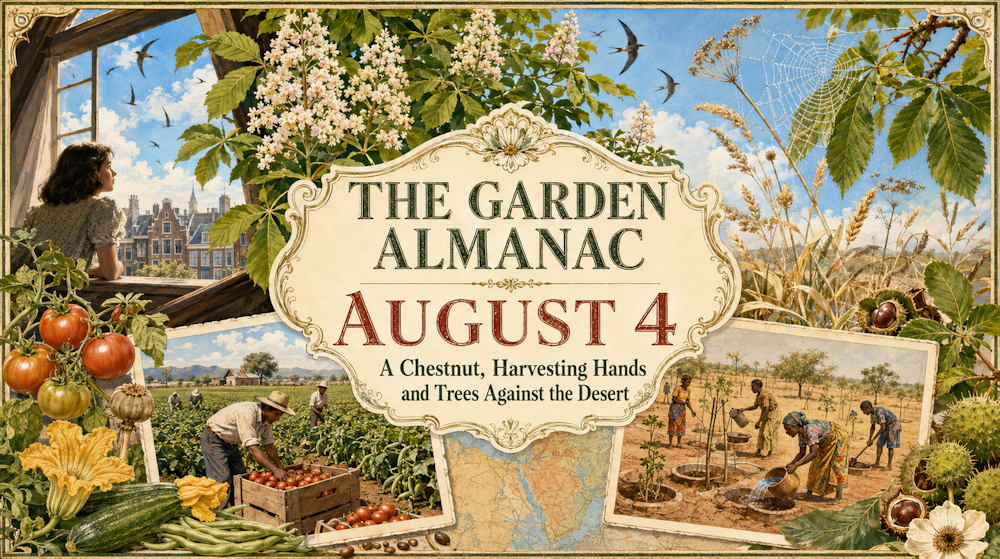

By early August, the garden has begun to tell two stories at once. Tomatoes, beans and berries may be reaching their generous peak, yet the shortening evenings and first tired leaves already hint that summer will not last forever.
August 4 opens three very different windows onto this turning season: an Amsterdam chestnut that became a symbol of freedom, a wartime agreement that revealed the human labour behind every harvest, and a West African revolution that treated tree planting as a defence against hunger and desertification. Together, they remind us that gardens and cultivated landscapes are never made by plants alone – they are shaped by memory, work, care and the choices societies make about the land.
August 4, 1944 – The Chestnut Beyond the Attic
On August 4, 1944, Anne Frank, her family and the other people hiding in the Secret Annex in Amsterdam were discovered and arrested. During more than two years in hiding, Anne had been able to see only a narrow fragment of the outdoor world through an attic window: the sky, passing birds and a white-flowering horse chestnut growing in a neighbouring courtyard. She recorded the tree several times in her diary, noticing its bare winter branches, its covering of rain and dew, and eventually its spring flowers.
The chestnut mattered because it offered more than a pleasant view. It gave Anne evidence that the living world continued beyond the sealed rooms – changing with the weather, producing leaves and welcoming birds without regard for the walls built by people. Her observations show how attentively a person may come to read a tree when contact with nature is severely limited. Buds, flowers and moving clouds become a calendar, while birds make the invisible distance beyond a window briefly imaginable.
The original tree, already more than 170 years old in its final years, eventually suffered serious decay and fell during a storm in 2010. Before that happened, chestnuts had been collected and germinated. Young descendants were planted at schools, memorial sites and other locations, allowing one courtyard tree to become a dispersed living memorial. Unlike stone monuments, these trees require continuing care: adequate soil, water during establishment, space for their roots and people willing to protect them.
There is a practical lesson here for every gardener. A mature tree cannot be replaced simply by planting a sapling after it has gone. Its shade, nesting places, stored carbon and cooling canopy have developed over decades. Inspect important trees regularly for fungal brackets, cavities, dead branches, root damage and changes in leaf density, especially after drought or construction work. When a valued tree produces viable seed, raising a successor can preserve part of its story – but protecting the old tree for as long as it remains safe is usually the greater ecological gift.
Garden Science – Why Are Mature Trees So Difficult to Replace?
A newly planted tree may absorb carbon and provide flowers, but it cannot immediately reproduce the habitat of an old one. Trunks with crevices, large crowns, deadwood and extensive root systems support fungi, insects, birds and soil organisms that young trees cannot yet accommodate. This is why good garden planning combines succession planting with careful conservation of existing mature trees.
August 4, 1942 – The Agreement Behind a Wartime Harvest
On August 4, 1942, Mexico and the United States signed the Mexican Farm Labor Agreement, beginning what became known as the Bracero Program. Wartime labour shortages had left American growers concerned that fruit and vegetable crops would remain unpicked. Mexican workers were therefore recruited on temporary contracts to plant, tend and harvest crops, while many American workers were serving in the military or employed in wartime industries.
The programme continued until 1964 and involved millions of individual contracts. It helped sustain agricultural production, but its history also includes low pay, inadequate housing, withheld wages and working conditions that often failed to match the protections promised on paper. Its legacy is therefore not simply a story of fields kept productive. It exposes a truth easily hidden by an abundant market stall: harvesting is skilled, time-sensitive physical work, and food systems depend as much on the treatment of workers as on fertile soil, irrigation and favourable weather.
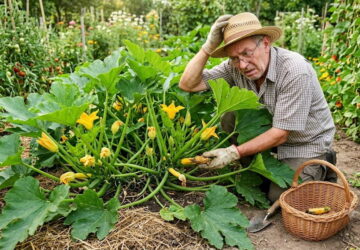
August gardens offer a smaller but recognisable version of that pressure. Courgettes become oversized almost overnight, beans toughen if left too long, and ripe tomatoes may split after heavy watering or rain. Pick little and often, preferably during the cooler morning hours, and use clean containers so that bruised or diseased produce does not spoil sound fruit. If more is ripening than a household can use, plan for freezing, drying, preserving or sharing before the surplus becomes waste.
Seasonal Tips – How to Manage an August Harvest
- Pick beans, cucumbers and courgettes regularly to encourage continued production.
- Harvest tomatoes when fully coloured but still firm, particularly if heavy rain is forecast.
- Cool leafy crops and soft fruit promptly after picking to slow moisture loss.
- Remove damaged produce from beneath plants so it does not attract wasps, slugs or disease.
- Share surplus while it is fresh rather than waiting until the whole crop ripens at once.
August 4, 1983 – When Planting Trees Became National Policy
On August 4, 1983, Thomas Sankara became the leader of Upper Volta, the West African country renamed Burkina Faso one year later. His government placed food production, land management and resistance to desertification near the centre of national policy. In a region repeatedly affected by drought, soil degradation and pressure on firewood supplies, ecological restoration was treated not as decoration but as part of economic survival.
Large tree-planting campaigns followed, accompanied by efforts to establish village nurseries, regulate uncontrolled woodcutting and reduce destructive bush fires and livestock damage. The approach connected trees directly with agriculture. In dry landscapes, well-chosen woody plants can slow wind, shade soil, contribute organic matter and help protect fields from erosion. Planting millions of seedlings, however, is only the visible beginning: survival depends on suitable species, timing, protection from grazing and several seasons of aftercare.
The same principle applies in an ordinary garden. A tree planted for climate resilience should suit the mature space available, the soil and the expected rainfall – not merely look attractive at the garden centre. In dry regions, planting is usually most successful when cooler, wetter conditions give roots time to establish. Where a tree must be planted during warm weather, create a wide watering basin, soak the full root zone deeply and cover the soil with mulch while keeping the mulch away from the trunk. A smaller number of well-sited, surviving trees achieves more than a large number planted without long-term care.
Garden Reminder – Helping Young Trees Through Late Summer
Check newly planted trees at least once a week during dry weather. Water slowly and deeply rather than sprinkling the surface, then test the soil below the mulch before watering again. Grass and weeds compete strongly with young roots, so maintain a clear mulched circle around the tree without piling material against its bark.
Wildlife Note – Who Uses a Tree in August?
A leafy summer tree may be feeding and sheltering far more wildlife than is immediately visible. Birds search its canopy for caterpillars, spiders stretch webs between twigs, and bats may use nearby flight paths after dusk. Avoid unnecessary pruning during the active season, check carefully for occupied nests, and retain safe deadwood where it does not threaten paths or buildings. Even a tree that offers little nectar in August may still function as an essential hunting ground, refuge and stepping stone through the landscape.
What to Observe Right Now – The First Signs of Seasonal Change
Early August is an excellent time to watch the garden shift from growth towards ripening and seed production.
- Look for the first fruits and nuts beginning to swell on trees and hedgerows.
- Notice which flowers still attract bees during the hottest part of the day.
- Watch swifts and swallows gathering insects overhead as the migration season approaches.
- Compare exposed soil with mulched ground after a hot afternoon – the difference in moisture and temperature can be striking.
- Listen for changes in birdsong as the intense territorial chorus of spring gives way to quieter feeding activity.
Looking Ahead
The stories attached to August 4 show that a tree may preserve memory, a harvest may reveal hidden human effort, and land restoration may become a form of collective resilience. For today’s gardener, the future begins with similarly tangible choices: protecting mature trees, reducing wasted produce, treating labour fairly and planting for survival rather than appearance alone. None of these actions is spectacular by itself. Repeated across gardens, farms and communities, however, they help create landscapes that can continue to nourish both people and wildlife.