
June 2 brings the Garden Almanac into the practical rhythm of early summer. The great spring rush of sowing and planting is beginning to settle, but the real work of care is only just taking hold.
By early June, the garden is no longer only a promise. It is growing, competing, drying, rooting, leaning, reaching, and asking to be looked after. The gardener may still dream of harvest, but the hoe, watering can and mulch are already telling the truth: nothing grows well on enthusiasm alone.
When the Hoe Begins to Speak
In early summer, the garden’s needs become more visible. Seedlings are no longer hidden. Young plants have taken their places. Beans climb, peas cling, potatoes thicken, squash begins to stretch, and weeds behave as if they were invited to every bed.
This is the season of maintenance. Not glamorous, but decisive.
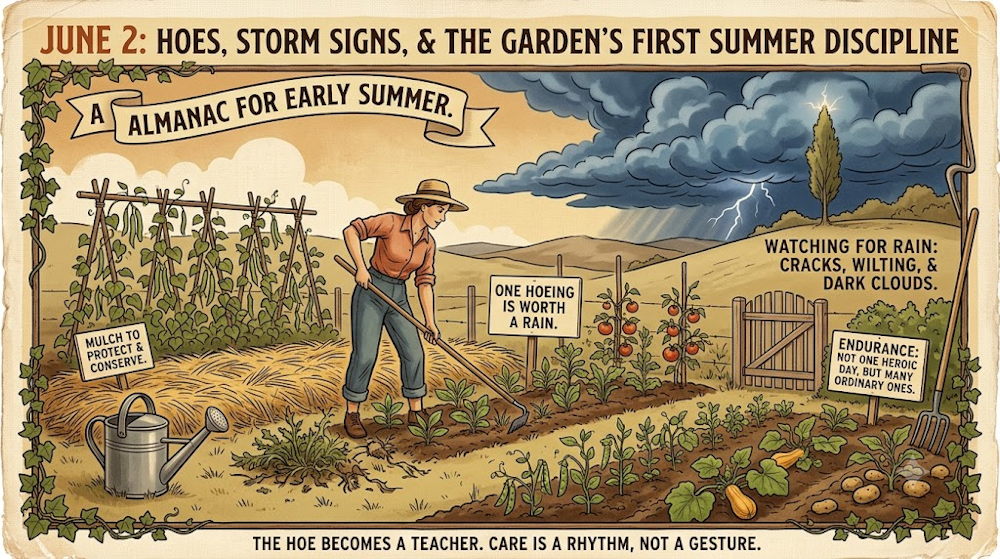
Hoeing is not only about removing weeds. It loosens the surface soil, breaks crusting, reduces competition and can help slow moisture loss. Old gardeners often said that one hoeing is worth a rain. It does not literally replace water, but the wisdom is understandable: loose, weed-free soil holds and receives moisture better than hard, crowded ground.
The hoe is one of the garden’s oldest summer tools because it answers several needs at once.
Watching for Rain
By June, water becomes a central question. Young crops are growing quickly. Fruit is forming. Leaves are expanding. Warm days pull moisture from the soil, and wind can dry a bed faster than expected.
A gardener learns to read more than the sky. Cracks in the soil, dull leaves, wilting at midday, dry mulch, seedlings that stop pushing upward — all become signs.
Watering deeply matters more than sprinkling lightly. Mulching helps protect the soil. A covered soil surface stays cooler, loses less moisture and supports a more stable root zone.
The bare earth of summer is easily tired. Covered earth endures better.
Weeds Are Messages, Too
Weeds are not always meaningless enemies. They tell us that the soil is alive, that light is reaching the surface, that seeds are waiting, that conditions are good enough for growth.
But in a vegetable bed, they can quickly become competition. They take water, nutrients and space from young crops. In early June, removing them before they seed is one of the simplest and most effective forms of care.
A weed pulled after rain comes away more easily. A small weed cut on a hot day withers quickly. A non-seeding, healthy weed may even return to the compost.
The gardener does not need to hate weeds. But the crop must be given a chance.
Storm Signs and Saint Elmo
June can also bring the first more dramatic summer storms. The garden wants rain, but it does not always want the wind, hail or sudden downpour that may come with it.
This makes early June a time for reading the weather. Old rural life depended on noticing signs: cloud shape, wind direction, animal behavior, heat in the air, the smell before rain.
June 2 is associated in some calendars with Saint Elmo, or Saint Erasmus, remembered as a patron of sailors. His name is linked with Saint Elmo’s fire, a rare electrical glow seen around pointed objects such as ship masts during stormy conditions.
The sailor watched the mast. The gardener watches the sky, the stakes, the bending tomatoes, the darkening clouds. Different landscapes, same old human need: to know when weather is coming.
Before a storm, the gardener can still act. Tie plants. Secure supports. Move pots. Check covers. Prepare rain barrels. Give the garden a better chance.
Marcellinus and Peter: Quiet Endurance
June 2 is also the feast day of Saints Marcellinus and Peter in the Roman Catholic calendar. In the Garden Almanac, their story offers a quiet note of endurance and fidelity.
Gardening has its own kind of endurance. It is less dramatic than martyrdom, of course, but it is real in daily life: returning again, watering again, weeding again, looking closely again, caring even after the first excitement of spring has passed.
A good garden is made by repeated attention.
Not one heroic day, but many ordinary ones.
The First Discipline of Summer
Early June asks for discipline, but not a harsh one. A little work often. A short visit in the evening. A weed pulled before it seeds. A bed watered before it fails. A mulch layer added before the soil bakes. A stake tied before the wind arrives.
The garden does not need panic. It needs presence.
This is the first discipline of summer: not to abandon what spring began.
What June 2 Teaches
June 2 teaches that a garden must be returned to.
Sowing begins the story, but it does not finish it. Planting is hopeful, but harvest depends on what happens between. Hoeing, watering, mulching, watching, tying, thinning and waiting are the quiet chapters that make the ending possible.
In the Garden Almanac on this day, the hoe becomes a teacher. It says: care is not a gesture. It is a rhythm.
The garden asks for rain, but it also asks for hands.