
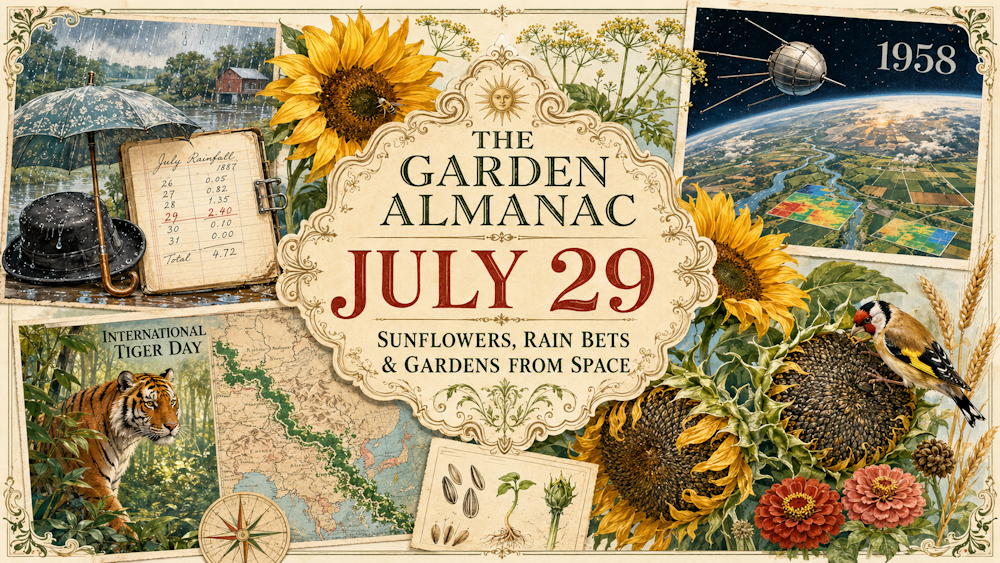

Late July is a season of abundance and strain. Sunflowers lift their heavy heads above the border, insects crowd every open flower, and ripening crops demand water just when summer heat is drawing it most quickly from the soil.
Yet July 29 is also a day of unusually wide horizons. Its stories lead from a Pennsylvania weather wager to Vincent van Gogh’s flower-filled canvases, from the creation of NASA to forests where the survival of tigers depends on keeping landscapes connected. Together, they invite us to look at the garden from several distances – close enough to see pollen on a bee, and far enough away to recognise fields, rivers and forests as parts of one living system.
Rain Day – When a Farmer’s Weather Note Became a Tradition
In Waynesburg, Pennsylvania, July 29 is known as Rain Day. The tradition traces its rainfall records back to 1874 and began with a local farmer’s observation that rain seemed to fall on his birthday every year. A pharmacist took an interest, began keeping notes and later wagered visiting salesmen that the date would bring rain – with a new hat traditionally at stake.
What started as a piece of local weather folklore eventually became an annual community festival. Rainfall on one particular day cannot prove a dependable meteorological pattern, of course, but the tradition preserves something valuable: the habit of watching, recording and comparing the weather over many years.
Gardeners have always done the same. Long before digital forecasts and soil-moisture sensors, sowing dates, harvest times and weather signs were passed between generations. A garden diary continues that tradition in a more reliable form. Notes on rainfall, first and last frosts, flowering dates, pests and harvests can reveal how one particular garden is changing – often more usefully than a general regional calendar.
Seasonal Tips – How to Water the Garden in Late July
- Water early in the morning so moisture reaches the roots before the hottest part of the day.
- Give fewer, deeper soakings rather than frequent light sprinklings, which encourage shallow rooting.
- Direct water onto the soil instead of routinely wetting the foliage, especially around tomatoes, cucumbers and other plants vulnerable to fungal disease.
- Check containers daily during hot or windy weather – small pots can dry out within hours.
- Add compost, leaf mould or another organic mulch to slow evaporation, but leave a small gap around stems to reduce the risk of rot.
- Record significant rainfall with a simple rain gauge rather than assuming that a brief shower has soaked the root zone.
A summer downpour may wet the surface while leaving the soil dry only a few centimetres below. After rain, push a finger or hand trowel into the ground before deciding whether irrigation can be postponed.
July 29, 1890 – Van Gogh’s Sunflowers Outlive Their Summer
Vincent van Gogh died in Auvers-sur-Oise on July 29, 1890. Among the works that came to define his legacy are his celebrated sunflower still lifes, painted in Arles in 1888 and 1889. He created five large canvases of sunflowers arranged in vases, exploring the flowers at different stages – from fresh, bright blooms to curling petals and ripening seed heads.
That progression is familiar to any gardener. A sunflower is not visually interesting only at its most symmetrical moment. Its rough stem, unfolding florets, fading petals and densely packed seeds are all stages in one continuous process. Van Gogh’s paintings seem to understand that a flower can become more expressive as it moves beyond conventional perfection.
In the garden, allowing at least some sunflower heads to mature extends their usefulness well beyond flowering. Bees, hoverflies, butterflies and moths visit the blooms in summer, while seed-eating birds may feed from the mature heads in autumn and winter. If seeds are wanted for sowing, protect one or two selected heads from birds and harvest them once the back turns yellow-brown and the seeds are firm.
Wildlife Note – Should You Deadhead Every Sunflower?
Not necessarily. Deadheading branching varieties can encourage further flowers, but removing every faded head also removes a future food source.
A balanced approach works well: cut some flowers to keep the display going and leave others to ripen naturally. Goldfinches and other seed-eating birds can then feed directly from the plants, while hollow or drying stems may shelter small invertebrates later in the year. Where space allows, leave the final clearing until late winter.
July 29, 1958 – The Law That Gave Gardeners a View from Space
On July 29, 1958, US President Dwight D. Eisenhower signed the National Aeronautics and Space Act, creating NASA. The new agency officially began operating that October. Although the decision belonged to the tensions and ambitions of the early Space Age, some of its most practical consequences would eventually be felt not beyond Earth, but in fields, forests and watersheds across the planet.
Earth-observing satellites now help researchers and farmers monitor drought, flooding, crop stress, vegetation change and agricultural water use. Landsat imagery, for example, can reveal differences in land-surface temperature and plant activity that are invisible from the ground. This information helps estimate evapotranspiration – the combined loss of water through evaporation from soil and transpiration from plants.
The home gardener does not need a satellite to apply the underlying lesson. Plants cool themselves by releasing water through tiny pores in their leaves, and that water must be replaced through the roots. On hot, bright or windy days, losses accelerate. A plant may wilt temporarily at midday even when the soil contains moisture, but one that remains limp into the evening or begins the morning wilted is giving a more serious warning.
Garden Science – Why Does Mulch Reduce Watering?
Mulch interrupts several routes by which water disappears from a bed:
- It shades the soil, keeping the surface cooler.
- It reduces direct evaporation caused by sun and wind.
- It limits the formation of a hard surface crust, allowing water to enter more readily.
- Organic mulch gradually improves soil structure, helping the ground hold both moisture and air.
Apply mulch to already moist, weed-free soil. A layer about 5–8 centimetres deep is useful in many ornamental and vegetable beds, but it should not be piled against trunks, crowns or soft stems.
International Tiger Day – Why Connected Landscapes Matter
July 29 is also International Tiger Day, established at the 2010 Tiger Summit in Saint Petersburg. It draws attention not only to poaching but also to habitat loss and fragmentation across the tiger’s remaining range in Asia.
A tiger needs territory, prey and access to other populations. A protected forest can become an ecological island if roads, intensive development or cleared land cut it off from neighbouring habitats. Conservation corridors help reconnect such areas, allowing animals to move, find mates and maintain healthier genetic diversity. Restored native vegetation in Nepal’s Terai Arc Landscape offers a powerful example of how connecting forest fragments can support recovery on a much larger scale.
No ordinary garden is a tiger reserve, and its contribution should not be exaggerated. Yet the same ecological principle operates locally. A hedge linked to a shrub border, a pond with safe surrounding cover or a row of gardens containing native plants is more useful to wildlife than isolated pockets separated by bare paving, sealed fences and intense night lighting. Connectivity turns individual green spaces into routes rather than dead ends.
Gardeners can help by retaining mixed hedges, planting climbers against boundaries, leaving small ground-level passages where safe, and reducing unnecessary outdoor lighting. Avoiding broad-spectrum pesticides protects the insects that sustain birds, bats and other garden wildlife. The lesson from tiger landscapes is not that every space must remain untouched – it is that living things need room to move between places where they can feed, shelter and reproduce.
What to Observe Right Now
Late July offers a chance to read the garden as carefully as that Pennsylvania pharmacist once read the rain:
- Watch which flowers attract insects at different times of day – some are busiest in morning light, while others become valuable toward evening.
- Look beneath sunflower heads for bees collecting pollen from the ring of tiny disc florets.
- Notice whether trees are shedding a few leaves during dry weather, an early sign that they are reducing water loss.
- Check where soil remains moist longest after watering – these cooler pockets can guide future planting.
- At dusk, observe whether hedges, ponds and unmown edges function as routes for moths, beetles, bats or small mammals.
These observations require no specialist equipment. Repeating them at the same time each week can reveal changes that a single walk through the garden might miss.
Looking Ahead
July 29 reminds us that useful environmental knowledge can begin with something as modest as a handwritten weather record or as ambitious as a satellite orbiting Earth. It also shows that beauty and ecological value do not end when a flower’s petals fade. By recording local conditions, using water thoughtfully and connecting small areas of habitat, gardeners can make practical decisions that reach beyond a single season. The future of greener landscapes will depend both on the widest possible view and on close attention to what is happening just outside the door.