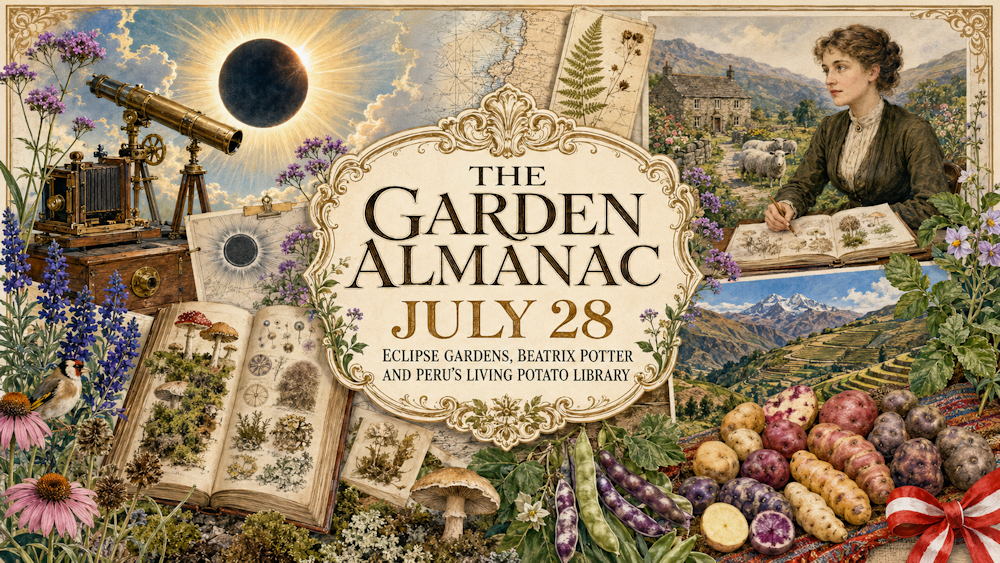

By July 28, high summer has settled deeply into northern gardens. The soil may be dry beneath the surface, bees work the remaining flowers with urgent concentration, and leaves seem to pause during the hottest hours of the afternoon. South of the equator, however, winter holds the landscape in a very different rhythm.
This date opens several unexpected windows onto the living world. It recalls the first successful photograph of a total solar eclipse, marks the birthday of a storyteller who became a serious naturalist and land conservationist, and celebrates the independence of a country whose farmers have safeguarded one of the world’s richest collections of crop diversity.
Together, these stories ask a distinctly garden-minded question: how carefully are we looking at the life around us, and what are we choosing to preserve?
July 28, 1851 – The Day an Eclipse Entered the Photograph Album
On July 28, 1851, a total solar eclipse crossed northern and eastern Europe. At the Royal Observatory in Königsberg, then part of Prussia, daguerreotypist Johann Julius Friedrich Berkowski succeeded where earlier photographers had struggled – he produced the first accurately exposed photograph of a total solar eclipse.
The image required an exposure of 84 seconds during totality. It captured not only the Moon’s dark disc but also part of the Sun’s pale corona, turning a fleeting spectacle into something that could be examined after daylight returned. Photography had begun to change natural observation from a matter of memory and description into a permanent scientific record.
A solar eclipse also offers an unusual glimpse of how strongly living things respond to light. As daylight falls abruptly, air and leaf temperatures may drop, flowers can begin to close, and some plants temporarily alter their gas exchange. Birds and insects may behave as though evening has arrived, only to resume daytime activity when the Sun reappears.
Gardeners witness quieter versions of these responses every day. Flowers open and close according to light, temperature and internal biological clocks, while leaves regulate water loss in response to heat and humidity. Watching when a plant wilts, turns its leaves or attracts its first visitors can reveal almost as much as looking at the plant itself.
Garden Science – Why Do Plants Wilt in the Afternoon?
A plant that droops during the hottest part of the day is not necessarily growing in dry soil. Leaves can lose water faster than roots are temporarily able to replace it, producing short-lived midday wilting.
Check the plant again in the evening. If it recovers as temperatures fall, the soil may still contain sufficient moisture. If it remains limp after sunset or is still wilted early the following morning, watering is more likely to be necessary. Always test the soil below the surface before reaching for the hose.
July 28, 1866 – Beatrix Potter’s Other World Was Made of Fungi
Beatrix Potter was born in London on July 28, 1866. Peter Rabbit would eventually make her famous, but long before that rebellious rabbit entered Mr McGregor’s garden, Potter was studying the natural world with remarkable patience and precision.
She kept animals, examined plants and produced hundreds of detailed illustrations of fungi, mosses and spores. Her fungal studies were not decorative exercises. She used microscopes, observed germination and attempted to understand how fungi developed and reproduced at a time when women found it extremely difficult to enter established scientific institutions.
Potter later used the proceeds from her books to buy Hill Top Farm in England’s Lake District. She became involved in farming, bred Herdwick sheep and gradually acquired land to protect it from damaging development. On her death, she left 15 farms, cottages, sheep flocks and approximately 4,000 acres of land to the National Trust.
Her life joined three forms of attention that still belong together – observing individual organisms, understanding working landscapes and protecting the places in which both wild and cultivated life can continue.
For today’s gardener, fungi provide a particularly useful lesson. The mushrooms visible above ground are usually only the fruiting bodies of a much larger network growing through soil, leaf litter or wood. Many fungi decompose dead material, release nutrients and form beneficial relationships with plant roots. A garden does not need to be stripped of every fallen twig and ageing stem to remain healthy.
Wildlife Note – How Can a Garden Support Fungi and Small Animals?
A completely tidy garden offers fewer places for decomposers and wildlife to live. Where conditions allow:
- Leave a small amount of sound deadwood in a shaded corner.
- Keep some fallen leaves beneath established shrubs.
- Avoid disturbing all bare soil around tree and shrub roots.
- Retain a few hollow stems until insects have emerged.
- Investigate unfamiliar fungi before removing them – appearance alone does not show whether they are harmful.
Diseased plant material and invasive plants still require appropriate management. The aim is not neglect, but a more selective understanding of what genuinely needs to be cleared away.
July 28, 1821 – Peru and the Crop Diversity Beneath the Soil
On July 28, Peru commemorates the proclamation of its independence in 1821. The anniversary naturally belongs to political history, but it also offers an opportunity to recognise a living inheritance that extends far beyond national borders – the extraordinary agricultural biodiversity of the Andes.
The potato was domesticated in the Andean region, and Peruvian farmers still cultivate thousands of native varieties. They differ in colour, shape, cooking quality, growing season and their ability to cope with frost, drought, disease or difficult mountain soils. Some are long and curved, some are almost black, and others reveal vivid red, purple or yellow flesh when cut.
This diversity is more than a botanical curiosity. A field containing genetically varied crops is less vulnerable than one dependent on a single uniform variety. If weather, pests or disease damage one type, another may survive. Native varieties and wild relatives also provide plant breeders with traits that can help future crops tolerate heat, water shortages and emerging diseases.
The lesson applies at garden scale. Growing more than one cultivar of an important vegetable can spread the risk of failure and reveal which plants perform best in local conditions. Gardeners can also help preserve diversity by buying seed from responsible suppliers, supporting heritage varieties and saving seed from suitable open-pollinated crops.
Potatoes themselves offer a timely late-July reminder. Check developing rows for tubers that have become exposed as soil settles or cracks. Cover them with soil or organic mulch because light causes greening and the accumulation of potentially harmful glycoalkaloids. Green potatoes should not be eaten.
Garden Reminder – What Needs Attention in the Late-July Garden?
High summer calls for observation before action. Conditions vary widely, but several checks are useful in many Northern Hemisphere gardens:
- Water early in the morning and direct water towards the soil rather than the leaves.
- Give plants a thorough watering when needed instead of repeatedly wetting only the surface.
- Check containers separately because they can dry much faster than beds.
- Harvest beans, courgettes and cucumbers regularly to encourage continued production.
- Remove only spent flowers that are not being left for seed or wildlife.
- Inspect potatoes and tomatoes for rapidly spreading dark lesions, especially after warm, humid weather.
- Mulch exposed soil, leaving a small gap around plant stems to reduce the risk of rot.
In Southern Hemisphere gardens, July may instead be a season for pruning dormant plants, improving soil and planning spring sowings. Local weather and plant condition should always take priority over the calendar.
What to Observe Right Now – The Garden’s High-Summer Signals
Late July is a good time to notice which parts of the garden remain active during heat and dryness:
- Which flowers still provide nectar during the hottest weeks?
- Where do bees, hoverflies and butterflies feed in the morning and evening?
- Which beds retain moisture longest after watering?
- Do particular plants fold, turn or droop their leaves at midday?
- Where are seed heads beginning to attract birds?
- Which vegetable varieties are coping best with current conditions?
These observations can guide next year’s planting more reliably than memory alone. A short note or photograph records not only what looked beautiful, but what remained useful and resilient.
Wildlife Note – Should Gardeners Put Out Water for Bees?
During hot, dry weather, pollinating insects benefit from safe access to water. A shallow saucer containing clean water and pebbles or rough stones provides landing places and reduces the risk of drowning.
Refresh the water frequently and scrub the container regularly. Do not add honey or sugar – ordinary clean water is sufficient, while sugary mixtures can spoil, spread disease or attract unwanted concentrations of insects.
Looking Ahead
July 28 reminds us that careful observation can outlast a moment, whether it preserves an eclipse, records a fungus or identifies a resilient crop. Modern gardens can serve the same future-minded purpose by conserving water, supporting varied forms of life and keeping useful plant diversity in cultivation. We do not need thousands of acres or a scientific observatory to contribute. A thoughtfully managed border, vegetable bed or shaded wildlife corner can become a small but valuable archive of living possibilities.