

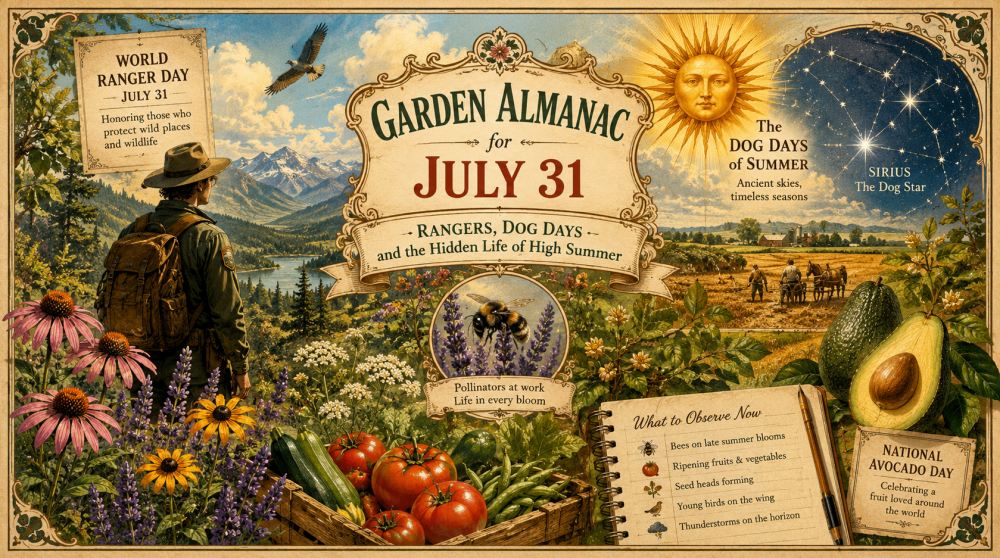

By the final days of July, the garden seems to breathe at a different pace. Borders overflow with flowers, vegetables ripen almost daily, and every sunrise reveals subtle changes that are easy to miss unless we pause to look. July 31 arrives during one of the richest moments of the gardening year – a time when abundance and careful stewardship must go hand in hand.
This date also carries stories that reach far beyond our own backyards. Around the world, July 31 is celebrated as World Ranger Day, honouring the men and women who protect forests, wetlands, mountains and wildlife under often challenging conditions. At the same time, the Northern Hemisphere is passing through the legendary Dog Days of Summer, an ancient seasonal marker associated with intense heat, dry weather and dramatic summer storms. Together, these traditions remind us that gardens are not isolated spaces – they are part of much larger natural systems.
For gardeners, July 31 is less about planting something entirely new and more about learning to observe. The garden is now revealing which plants truly thrive, which wildlife has found a home, and where thoughtful care can make the greatest difference before autumn slowly approaches.
World Ranger Day – The Guardians Behind Every Healthy Landscape
Since 2007, World Ranger Day has been observed every July 31 to honour park rangers and conservation professionals who safeguard protected landscapes and biodiversity across the globe. The day commemorates those who have lost their lives in service while celebrating the vital work of rangers in habitat restoration, fire management, wildlife protection and environmental education.
Many gardeners think of conservation as something that happens in distant national parks. In reality, every healthy landscape begins with countless smaller habitats. Pollinators move between gardens and wildflower meadows. Birds nesting in forests may forage in suburban hedges. Native insects often rely on both protected wilderness and cultivated gardens throughout their life cycles.
The work of rangers offers an inspiring lesson for home gardeners: biodiversity flourishes when habitats are connected rather than isolated. Even a modest garden can become part of a much larger ecological network by providing nectar, shelter and clean water.
Garden lesson: Instead of aiming for a perfectly tidy landscape, leave a few areas slightly wilder. Native flowering plants, unmown corners and layered planting provide valuable refuge for insects and birds throughout late summer.
Garden Reminder – What Should You Focus on at the End of July?
- Water deeply rather than frequently to encourage stronger root systems.
- Remove faded flowers from annuals and repeat-flowering perennials to extend blooming.
- Harvest beans, courgettes, cucumbers and tomatoes regularly – frequent picking encourages continued production.
- Check containers daily during hot weather, as compost dries much faster than garden soil.
- Avoid heavy fertilising of shrubs and trees, which may stimulate soft new growth before autumn.
The Dog Days of Summer – Ancient Wisdom Meets Modern Gardening
For centuries, people associated late July with the Dog Days, traditionally linked to the rising of Sirius – the brilliant “Dog Star.” Ancient Mediterranean cultures believed these weeks brought extreme heat, drought and sudden thunderstorms, observations that often matched seasonal weather patterns surprisingly well.
While modern astronomy no longer connects Sirius with Earth’s weather, the seasonal pattern remains familiar to gardeners across much of the Northern Hemisphere. Soil moisture disappears rapidly, plants experience midday stress, and even established trees can benefit from supplemental watering during prolonged dry spells.
Understanding heat stress is becoming increasingly important as many regions experience longer and more frequent summer heatwaves.
Garden lesson: Healthy soil acts as a natural reservoir. A 5–8 cm layer of organic mulch reduces evaporation, moderates soil temperature and encourages earthworms that improve soil structure over time.
Garden Science – Why Does Mulch Keep Plants Cooler?
Mulch works like natural insulation.
It shades the soil from direct sunlight, reducing surface temperatures by several degrees. Cooler soil loses moisture more slowly, allowing roots to continue absorbing water even during hot afternoons. Organic mulches such as shredded bark, compost or leaf mould gradually improve soil texture as they decompose, increasing its ability to store water for future dry periods.
This is why mulched beds often remain productive during heatwaves while bare soil quickly becomes hard and dry.
Avocados and Climate – A Reminder That Every Crop Has a Story
July 31 is also widely recognised as National Avocado Day in the United States. Although largely a food celebration, it offers an interesting opportunity to reflect on how climate shapes horticulture.
Avocados evolved in subtropical regions where frost is rare and temperatures remain relatively stable. As gardeners experiment with increasingly diverse edible plants, climate suitability becomes one of the most important considerations.
Rather than trying to grow every fashionable crop, experienced gardeners often achieve better results by selecting varieties naturally adapted to their local conditions. Climate-resilient gardening is becoming less about chasing exotic plants and more about understanding local weather, soil and water availability.
Garden lesson: Observe which fruit trees and vegetables consistently perform well in your region. Reliable harvests usually come from matching plants to local conditions rather than constantly battling them.
Wildlife Note – Late Summer Is Still Pollinator Season
Many people assume pollinators disappear after spring, yet late July remains one of the busiest periods for bees, hoverflies and butterflies.
Look closely and you may notice:
- Bumblebees visiting salvias, lavender and echinacea from early morning until evening.
- Hoverflies feeding on small, open flowers while quietly controlling aphid populations.
- Young birds learning to forage independently among shrubs and hedges.
- Dragonflies hunting above ponds and wetlands during warm afternoons.
- A shallow dish of clean water with a few stones for landing can become one of the most valuable wildlife features in the garden during hot weather.
What to Observe Right Now – The Garden Is Preparing for Autumn
Although summer still feels abundant, attentive gardeners can already spot the first hints of seasonal transition.
Watch for seed heads beginning to mature on ornamental grasses and perennials. Notice how many trees are producing their first berries or developing ripening fruit. Early morning dew may begin appearing more frequently in some regions, even while afternoons remain warm.
Perhaps most fascinating is the changing behaviour of insects. Many butterflies are laying the eggs that will produce next year’s generation, while bees increasingly collect pollen from late-flowering species that sustain colonies into autumn.
Simply spending ten quiet minutes observing these changes often teaches more about seasonal rhythms than any gardening manual.
Looking Ahead
July 31 reminds us that successful gardening depends on far more than watering cans and pruning shears. It depends on healthy ecosystems, protected landscapes and the countless people working to conserve them. World Ranger Day celebrates those guardians on a global scale, while every gardener has the opportunity to become a local steward of biodiversity.
As summer reaches its height, take time not only to harvest its rewards but also to notice the intricate connections between flowers, insects, birds and soil. The small decisions made today – planting for pollinators, conserving water, protecting wildlife and observing nature with greater care – help create gardens that remain resilient for seasons to come. In that sense, every thoughtful gardener becomes a quiet ranger of their own living landscape.