

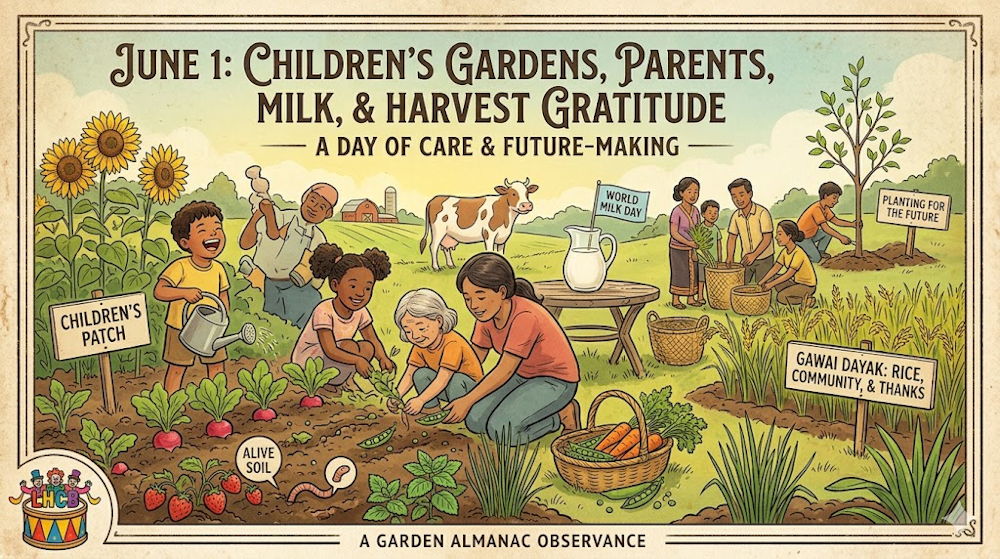

June 1 opens the Garden Almanac with children, parents, food, harvest gratitude and the quiet work of tending the future. Around the world, the date carries several observances that all circle the same human truth: care is not a single act, but a season-long, life-long practice.
In some countries, June 1 is Children’s Day. It is also the Global Day of Parents, World Milk Day, and the beginning of Gawai Dayak in Sarawak, a harvest festival rooted in gratitude, rice, community and cultural identity. These may seem like separate calendar notes, but in the garden they belong together.
Children need care. Parents need support. Food has a story before it reaches the table. Harvests depend on weather, work and community. A garden understands all of this without needing a speech.
Children’s Day and the Living Classroom
June 1 is observed as Children’s Day in many countries, and the garden is one of the oldest classrooms children can enter. It teaches without sounding like a lesson.
Seeds teach patience. Worms teach that soil is alive. Watering teaches care and consequence. Flowers teach attention. A failed row of radishes teaches that mistakes belong to learning. A strawberry eaten warm from the sun teaches more about food than a long explanation ever could.
A child given a small patch of soil receives more than a task. They receive a relationship.
Peas, beans, sunflowers, radishes, calendula, strawberries, mint and chives are all wonderful teachers for small hands. They grow visibly, smell strongly, attract insects, or offer quick rewards. They invite curiosity before they demand expertise.
Parents, Community, and Shared Care
June 1 is also the Global Day of Parents, a reminder that raising children is both intimate and communal. Parents carry an enormous part of the work, but no child grows in isolation. Families, schools, neighborhoods, parks, gardens and public spaces all shape the world children inhabit.
This is where the garden offers a useful image. A garden is not made by sowing once and walking away. It needs repeated care, changing attention, response to weather, repair after damage, and faith in what is not yet visible.
So does childhood.
A healthy garden asks for presence, not perfection. Parenting often does too.
Milk, Food, and the Household Web
June 1 is World Milk Day as well. Though milk is not a garden crop, it belongs to the larger household web of food, care and daily rhythm. Milk connects animals, pasture, fodder, water, labor, children and the kitchen table.
The lesson is simple: food has a story before it reaches us.
Children understand this deeply when they see food growing, being gathered, prepared or shared. A carrot pulled from soil, milk poured from a local farm, herbs picked from a pot, berries eaten straight from the plant — these experiences root food in reality.
A garden helps children see that food is not an object that appears from nowhere. It is the result of soil, weather, work, animals, plants and care.
Gawai Dayak and Harvest Gratitude
June 1 also marks Gawai Dayak in Sarawak, a harvest festival associated with rice, gratitude, community and cultural identity. It brings a global harvest note into the Garden Almanac.
Harvest festivals remind us that food is never only practical. It is cultural. It is communal. It carries memory, song, ritual, labor and thanks.
In one place, June 1 may be a day for children. In another, a day for parents. In another, a day for milk, food systems or harvest celebration. Together, they form one wide seasonal thought: what sustains life deserves attention.
Tree Planting and the Future We Cannot Rush
June 1 is also associated in some calendars with tree planting and national renewal. Whether marked formally or simply practiced locally, tree planting is one of the clearest acts of faith in the future.
A tree planted today does not give shade tomorrow. It asks for years. It asks someone to imagine children, birds, soil, summers and shelter beyond the immediate moment.
That is why trees fit so well beside Children’s Day and the Global Day of Parents. Both ask us to care for what will outgrow us.
A Bright Cultural Side Note
June 1 also carries a colorful modern cultural note: in 1967, The Beatles released Sgt. Pepper’s Lonely Hearts Club Band in the United Kingdom. It is not a garden event, of course, but it fits the day’s mood in a playful way. Sometimes summer arrives not only in fields and gardens, but in sound, color and imagination.
The Garden Almanac can allow a little music at the gate.
What June 1 Teaches
June 1 teaches that care is a future-making act.
A child, a garden, a harvest, a family, a community, a tree — none of these becomes strong through neglect or hurry. They grow through attention repeated over time.
In the Garden Almanac on this day, the garden becomes a meeting place for the world’s quiet forms of care: feeding, teaching, planting, parenting, harvesting and giving thanks.
The most important gardens are not always the ones with the straightest rows. Sometimes they are the places where children first learn that living things need care, and that they themselves are worthy of it.