

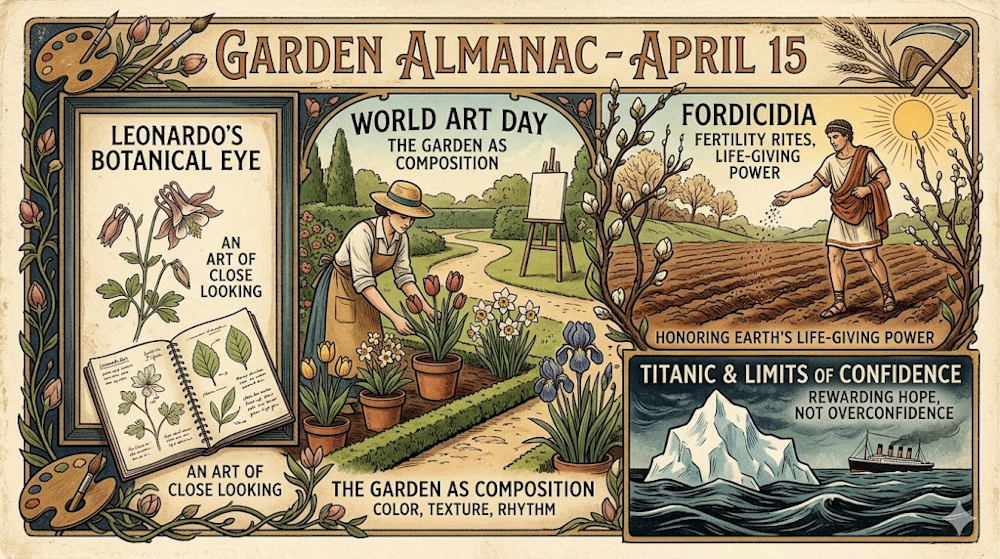

A Date Where Observation Meets Imagination. April 15 is an unusually rich almanac date. It is the birthday of Leonardo da Vinci, whose way of seeing transformed art, science, and the study of living forms. It is also World Art Day, a modern celebration of human creativity. And in the ancient Roman calendar, it was associated with Fordicidia, a fertility rite connected to the fruitfulness of the land.
That combination makes the day especially powerful in spring. It brings together three things every garden depends on: careful observation, deliberate shaping, and hope placed in the fertility of the earth.
Leonardo’s Botanical Eye
Leonardo da Vinci did not treat nature as scenery. He studied it as structure, movement, and intelligence made visible. His drawings and notes reveal a mind that looked closely at plants, water, anatomy, light, and form, always asking how things were made and how they held together.
This makes Leonardo an ideal figure for a garden almanac. Gardening is also an art of close looking. A gardener notices proportion, growth habit, angle, pattern, and sequence. One bed asks for order, another for looseness. One plant wants framing, another wants space. The beauty of a garden begins in the discipline of attention.
World Art Day and the Garden as Composition
World Art Day gives April 15 a contemporary cultural frame, but the idea reaches naturally into the garden. Gardens are not only productive spaces. They are compositions in colour, texture, height, timing, and rhythm. Even the smallest useful plot contains decisions about arrangement and emphasis.
That is why a garden can be read as a living artwork without losing its practicality. Art does not have to oppose usefulness. In the garden, the two often complete one another.
Fordicidia and the Ancient Hope for Fertility
April 15 was also the Roman festival of Fordicidia, associated with the fertility of the earth and the hope of agricultural abundance. To modern eyes, the rite may seem distant or severe, but its underlying logic remains recognisable: people sought to honour and secure the life-giving power of the land at the moment when the growing season was truly underway.
This makes April 15 a day of agricultural humility as much as artistic attention. No matter how carefully land is planned, fertility cannot be manufactured by design alone. Labour matters, but so does the unpredictable generosity of living systems.
Titanic and the Limits of Confidence
April 15 is also the date of the Titanic’s sinking in 1912, a stark reminder that brilliance, ambition, and engineering confidence do not abolish vulnerability. This may seem far from the garden, yet the lesson is not entirely unrelated.
Spring teaches a similar caution. Beauty can arrive early and still be exposed to reversal. A perfectly promising week can still be interrupted by cold, wind, rot, or error. The season rewards hope, but not overconfidence.
What To Notice In The Garden Today
April 15 is a particularly good day to notice both beauty and structure.
- Which part of the garden feels most composed today?
- Where is fertility visible not as promise, but as real momentum?
- What feature seems beautiful because it is well arranged, not merely because it is blooming?
- Where is confidence justified, and where should it be tempered?
- What in the garden today deserves a closer, more Leonardo-like gaze?
An almanac date is never just a set of anniversaries. It is a way of sharpening one’s eye.
The Meaning Of April 15
April 15 gathers together art, observation, fertility, design, and caution. Through Leonardo, World Art Day, Fordicidia, and Titanic, it becomes a date that asks how humans shape the world — and how far that shaping can truly go.
That is a fitting lesson for spring. A garden needs imagination, labour, and humility in equal measure.