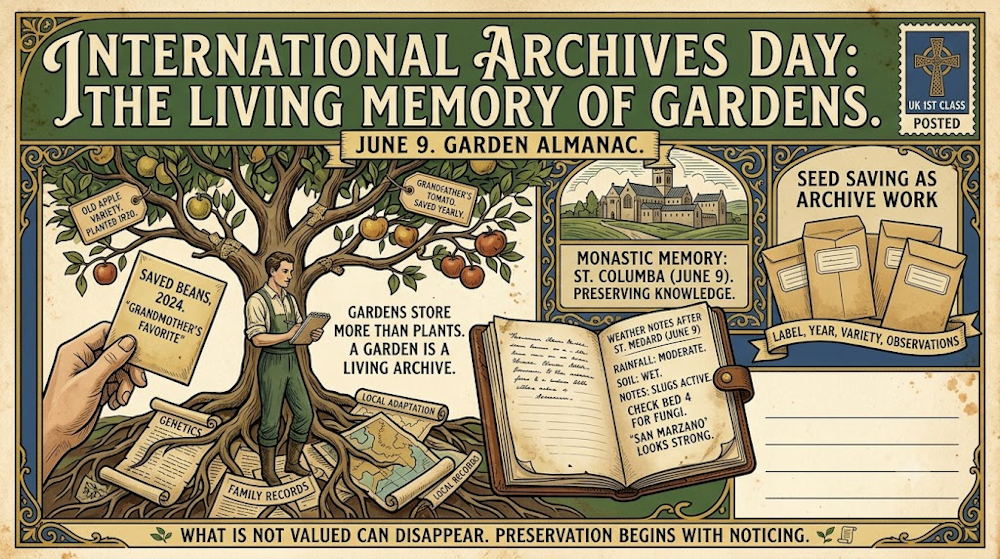

June 9 is International Archives Day, and in the Garden Almanac it becomes a day for thinking about memory in all its forms.
Archives usually bring to mind documents, manuscripts, maps, photographs and records stored carefully for the future. But gardens keep archives too. Not always in paper. Sometimes in seeds, cuttings, old fruit trees, plant names, family recipes, weather notes and the remembered wisdom of those who worked the soil before us.
A garden is a living archive. It grows, changes, forgets and remembers.
Gardens Store More Than Plants
A fruit tree can be a document. A seed packet can be a family record. A handwritten preserving recipe can hold information about varieties, seasons, taste and household care. A row of beans saved year after year may say as much about a family as any formal file.
Gardens remember through repetition. The same herb planted near the kitchen door. The same rose taken from one house to another. The same apple grafted because someone did not want its flavor to disappear. The same tomato saved because it performed well in a difficult summer.
Memory in a garden is not still. It has roots.
The Day After Saint Medard
June 9 also follows Saint Medard’s Day, one of Europe’s old weather-lore dates. If June 8 was watched for rain, June 9 becomes the first day of checking whether the pattern continues.
This makes it a good day for garden records.
Did it rain yesterday? Did the soil stay wet? Are fungal problems more likely? Are slugs more active? Did the dry spell continue? Which bed dried first? Which crop struggled? Which plant looked unexpectedly strong?
A gardener who keeps such notes builds a private archive of climate, soil and place. After a few years, those notes become more valuable than memory alone.
Seed Saving as Archive Work
Seed saving is one of the most intimate forms of preservation.
A seed saved from a healthy, useful, well-loved plant carries more than genetics. It carries a decision: this is worth growing again. It may carry local adaptation, family taste, a regional tradition or simply the memory of a good harvest.
Good seed saving asks for care. Label the seed. Write the year. Note the variety if known. Add a few words: early, sweet, drought-tolerant, poor keeper, excellent flavor, strong plant, from grandmother’s garden.
Without labels, memory fades quickly. With labels, a small envelope becomes a living record.
Garden Notebooks and Modern Records
A garden notebook does not have to be complicated. Dates, varieties, weather events, pests, first harvests, failures, successes, photographs and short observations are enough.
- When did the first aphids appear?
- Which tomato did best?
- When did the strawberries ripen?
- Which bed dried out fastest?
- Where did water collect after heavy rain?
- What should not be planted in the same place next year?
These details may seem small in the moment, but they become guidance. A garden archive helps us avoid repeating the same mistake with great confidence every spring.
Saint Columba and Monastic Memory
June 9 is also the feast day of Saint Columba, the Irish monk associated with Iona. Monasteries were often places of memory: manuscripts, learning, liturgy, healing plants, gardens and disciplined daily work were preserved through generations.
This gives the day a beautiful additional layer. The garden, like the manuscript, needs care if it is to carry knowledge forward. Both can be lost through neglect. Both can survive through patient hands.
The monastic garden is a useful image for June 9: simple, tended, useful, remembered.
Biodiversity as Living Memory
June 9 is also linked with Coral Triangle Day, which draws attention to one of the richest marine biodiversity regions on Earth. It may seem far from a household garden, but the message is related.
Living diversity is a form of memory. Species, varieties, habitats and relationships hold the history of adaptation.
In a garden, biodiversity may appear as old fruit varieties, local beans, pollinator plants, hedges, herbs, wild corners, seed saving and soil life. These are small compared with coral reefs, but the principle is the same: what is not valued can disappear.
Preservation begins with noticing.
What June 9 Teaches
June 9 teaches that gardens do not only produce. They remember.
They remember weather, hands, mistakes, flavors, names, failures, recoveries and the plants that deserved another season. But they remember best when we help them.
- Keep notes.
- Save seeds.
- Label envelopes.
- Ask older gardeners questions.
- Photograph the beds.
- Record weather after important seasonal days.
- Preserve the varieties that still matter.
In the Garden Almanac on this day, International Archives Day becomes a garden lesson: the future grows better when the past is not thrown away.