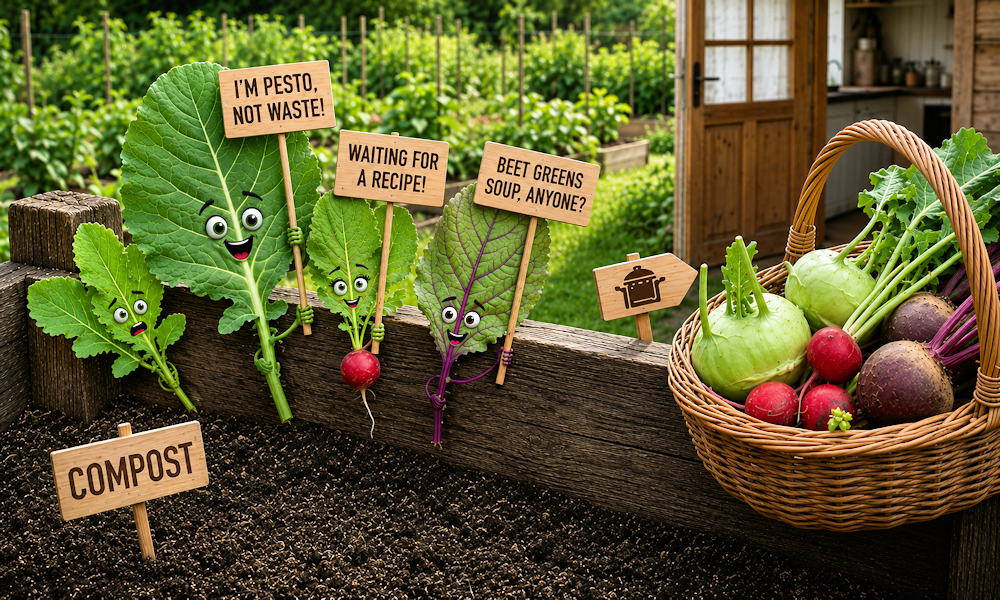

When harvesting vegetables, most gardeners focus on the part they planted them for in the first place: the crisp radish, the swollen kohlrabi stem, the sweet beetroot. The leaves are often removed without a second thought and tossed onto the compost heap.
That’s a missed opportunity.
Many vegetable greens are perfectly edible, packed with nutrients, and surprisingly versatile in the kitchen. Some can be used raw, others shine when cooked, and all of them can help you get a little more from your garden harvest before the leftovers finally make their way to the compost bin.
Radish Greens: Peppery and Full of Flavor
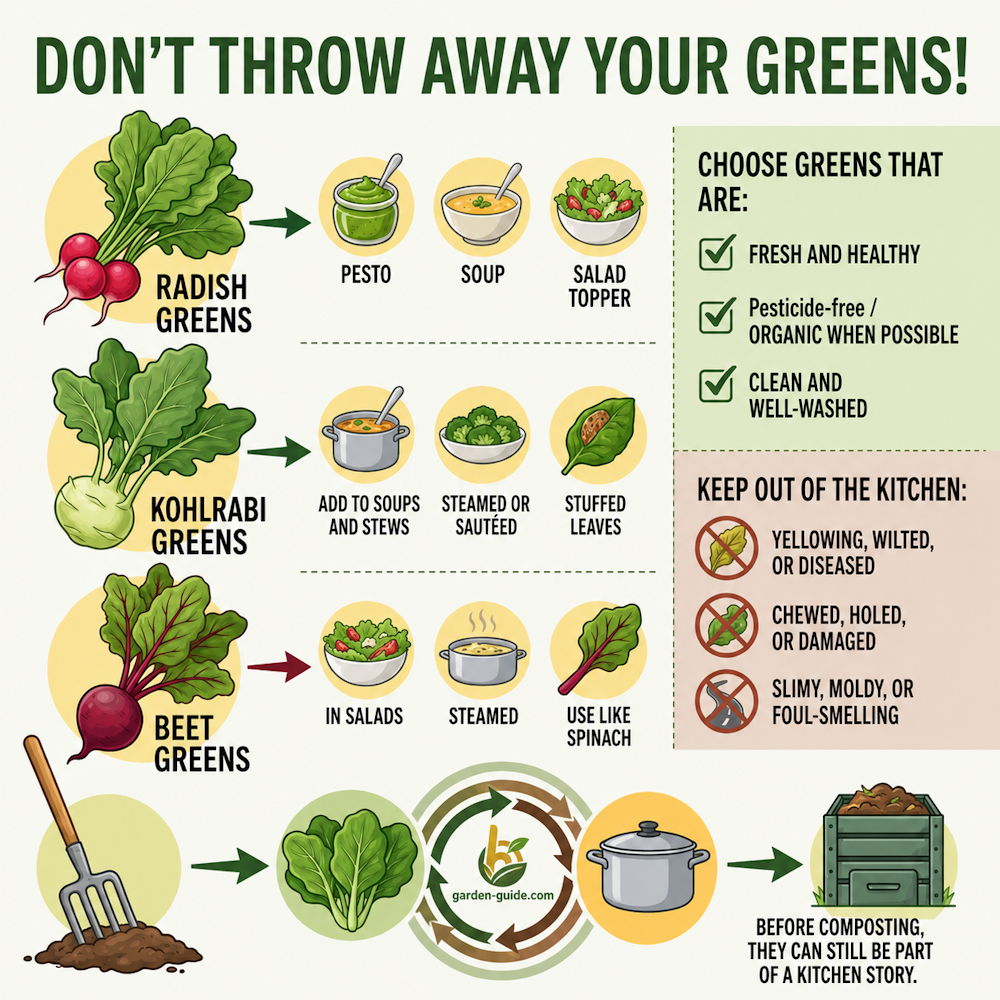
Radish leaves (Raphanus sativus) are among the most commonly overlooked edible greens. Their slightly peppery taste echoes the flavor of the radish itself, making them a natural addition to many dishes.
Young leaves can be mixed into salads, while larger ones are often better cooked. They work well in soups, stir-fries, omelets, pestos, and savory pastries. If you enjoy a little kick in your food, radish greens deserve a place in the kitchen rather than the compost pile.
Kohlrabi Leaves: The Hidden Harvest
When growing kohlrabi (Brassica oleracea Gongylodes Group), most of the attention goes to the bulb-like swollen stem. Yet the leaves are also edible and rich in valuable nutrients.
The younger leaves are tender enough for salads, while mature leaves can be steamed, sautéed, or added to soups and stews. Their mild flavor makes them easy to incorporate into everyday meals, and using them means getting more from every plant you grow.
Beet Greens: Two Vegetables in One
Beet leaves (Beta vulgaris) may be one of the vegetable garden’s best-kept secrets. Their flavor is often compared to spinach or Swiss chard, and they can be prepared in many of the same ways.
Young leaves add color and texture to salads, while larger leaves can be cooked as a side dish, stirred into pasta, added to soups, or baked into savory pies and quiches. Harvesting beets can sometimes feel like bringing home two crops instead of one.
Easy Ways to Use Vegetable Greens
Not sure where to start? Try one of these simple ideas:
- Blend them into pesto.
- Add them to soups and stews.
- Stir them into scrambled eggs or omelets.
- Sauté them with olive oil and garlic.
- Mix young leaves into salads.
- Use cooked greens in pasta dishes, quiches, or savory bakes.
Before You Eat Them, Know Where They Came From
When it comes to vegetable greens, food safety matters just as much as flavor.
If you have used any plant protection products in the garden, check the pre-harvest interval and make sure the leaves are safe to eat before harvesting them for the kitchen. Edible greens should only be consumed once any required waiting period has passed.
The same caution applies when the origin of the leaves is uncertain. If you do not know how a plant was grown or what treatments it may have received, it is better not to take chances.
This is especially true for store-bought vegetables. A bunch of radishes or beets may arrive with fresh-looking leaves attached, but those leaves were not necessarily left on the plant with human consumption in mind.
As with any leafy vegetable, wash the leaves thoroughly before use.
Which Leaves Should Stay Out of the Kitchen?
Even edible greens should be used selectively.
Avoid leaves that are:
- Yellowing
- Moldy
- Diseased
- Heavily damaged by pests
- Slimy
- Unpleasant-smelling
Not every leaf deserves a place on your plate. If it looks unhealthy, damaged, or past its prime, give it a pass.
It is also wise to avoid collecting edible greens from roadsides, polluted areas, or places frequently visited by dogs and other animals. Garden thrift is admirable, but it does not mean eating every green leaf that has not yet managed to run away.
Not Every Vegetable Leaf Is Edible
While many vegetable greens are safe and delicious, some should never end up on the plate.
Avoid eating the foliage of:
- Potato (Solanum tuberosum)
- Tomato (Solanum lycopersicum)
- Eggplant (Solanum melongena)
- Pepper (Capsicum spp.)
These members of the nightshade family contain naturally occurring compounds that make their leaves unsuitable for consumption.
When in doubt about a particular crop, always confirm that the foliage is considered edible before using it in the kitchen.
Let the Compost Wait Its Turn
Composting remains one of the smartest ways to recycle organic matter in the garden. But before those leafy tops head for the compost heap, consider whether they might have one more purpose.
The next time you harvest radishes, kohlrabi, or beets, take a closer look at the leaves before discarding them. You may discover that some of the most flavorful and useful parts of the crop have been hiding in plain sight all along.
After all, the compost bin will still be there tomorrow.