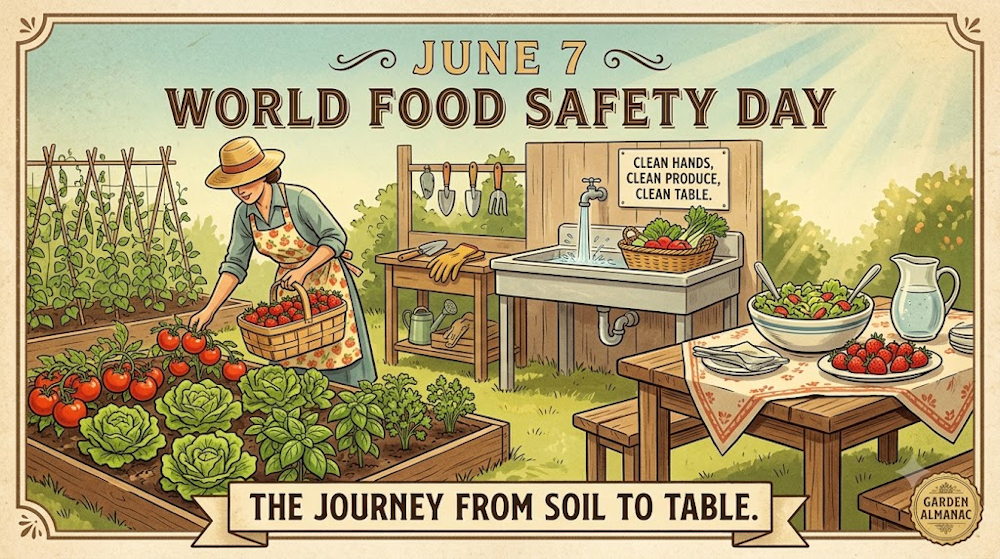

June 7 is World Food Safety Day, and in the Garden Almanac it becomes a day to follow food on its most important journey: from soil to table.
The theme of World Food Safety Day 2026, “From burden to solutions – safe food everywhere,” points to a global truth. Unsafe food is not a small inconvenience. It affects health, families, food systems and communities. But the garden brings this large issue close to home.
A tomato, strawberry, lettuce leaf, bunch of herbs or handful of peas does not stop needing care once it is harvested. In some ways, that is when a new kind of care begins.
Safe Food Begins Before the Kitchen
Food safety is often imagined as something that happens in factories, restaurants or public kitchens. But it also begins in ordinary gardens, allotments, balconies and households.
Clean hands. Clean tools. Clean baskets. Safe water. Healthy soil practices. Careful washing. Quick cooling. Thoughtful storage.
These are not glamorous tasks, but they protect the value of everything the garden has grown.
A salad picked from the garden still needs washing. Strawberries that touched soil need care. Herbs should not be tossed into a dirty container. A harvest basket should not double as a tool bucket unless it is cleaned properly.
The shortest food chain still needs attention.
The Harvest Is Not the End
Gardeners often focus on the moment of harvest: the first ripe berry, the first cucumber, the first handful of peas. But the harvest is not the end of the story.
Once picked, food changes quickly. Heat, moisture, bruising, dirt and time all matter. Leafy greens wilt. Berries soften. Herbs collapse. Cut surfaces invite spoilage. Warm kitchens speed everything up.
This is why old household wisdom valued cool storage, clean cloths, dry shelves, shaded pantries and quick preserving. Today we may use refrigerators, containers, freezers and modern food safety guidance, but the principle is the same: do not waste what the garden has given by neglecting it after harvest.
Water, Soil, and Clean Handling
A food-safe garden is not a sterile garden. Soil is alive, and living soil is a good thing. But food that comes from soil needs proper handling.
Root vegetables, lettuce, strawberries, herbs and low-growing crops can carry soil particles. Rain splash can move dirt onto leaves. Wildlife, pets, compost and irrigation practices can all affect how produce should be handled.
The point is not fear. The point is respect.
Wash produce appropriately. Keep harvest containers clean. Separate damaged or rotting items from healthy ones. Avoid leaving fresh produce in heat. Use clean water where washing is needed. Know when something is no longer safe to eat.
Food safety is care made practical.
World Caring Day and the Care Behind Food
June 7 is also associated with World Caring Day, a modern observance dedicated to recognizing people who show care, especially family caregivers. In the Garden Almanac, this connects naturally with food.
Feeding someone is one of the oldest forms of care.
A bowl of soup, a washed strawberry, a safely stored meal, herbs picked fresh, food preserved for winter — these are all quiet ways of saying: I want you to be well.
Safe food is not only a technical matter. It is an act of care.
Saint Robert and the Discipline of the Monastic Garden
June 7 is also the feast day of Saint Robert of Newminster in several Christian calendars. As a Cistercian abbot, he belongs to a tradition where work, simplicity, discipline and community life were closely linked.
The monastic garden is a useful image for this day. Such gardens were not only ornamental. They fed communities, supplied herbs, supported daily rhythm and required order.
In the Garden Almanac, Saint Robert’s day becomes a quiet reminder that food, work and care belong together. A garden needs discipline not because life should be rigid, but because life is precious.
Weather Before Medard
In parts of European folk tradition, June 8, Saint Medard’s Day, is associated with rain lore and long-weather sayings. June 7 is not Medard’s Day, but it stands at the threshold.
A gardener on June 7 watches the sky. Rain can refresh crops, but wet weather can also increase disease pressure, muddy harvests and speed spoilage if produce is left damp and warm. Dry weather brings other concerns: wilting, stress, irrigation and heat.
Food safety is connected to weather more than we often realize. Muddy leaves, warm fruit, wet herbs, humid storage and storm-damaged produce all ask for extra attention.
What June 7 Teaches
June 7 teaches that food is not safe by accident.
It becomes safer through attention at every step: growing, harvesting, washing, cooling, storing, cooking, preserving and sharing.
In the Garden Almanac on this day, World Food Safety Day moves from global campaign to garden basket. It reminds us that the work of care continues after picking.
The garden gives food.
The household protects it.
The table completes the journey.