
June 6 brings two surprisingly useful observances into the Garden Almanac: World Pest Day and World Green Roof Day. One asks us to think more carefully about pests and pest management. The other celebrates living roofs and the greening of hard urban surfaces.
World Pest Day and the Need to Look Closely
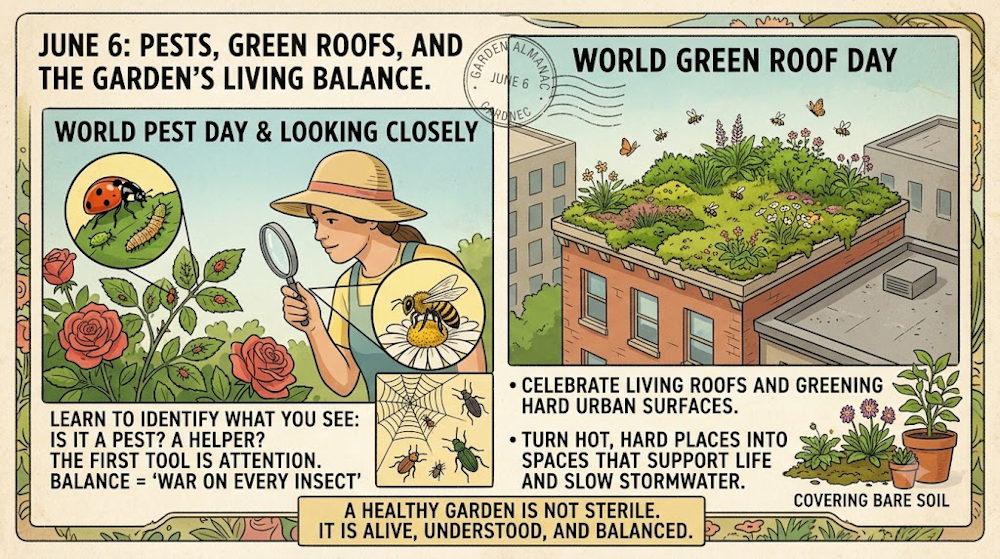
World Pest Day is observed on June 6 and was first marked in 2017 to raise awareness of the role pest management plays in protecting health, food, property and the environment.
In a garden, this does not mean declaring war on every insect.
It means learning to identify what we are seeing. Is it a pest? A predator? A pollinator? A decomposer? A temporary visitor? A sign of imbalance? A harmless part of the living system?
The first tool of good pest management is not a spray bottle. It is attention.
Not Every Insect Is an Enemy
Many garden mistakes begin with panic. A leaf curls, an insect appears, a hole is found, and the immediate reaction is to destroy everything nearby.
But gardens are full of relationships. Aphids may damage soft growth, but ladybirds, lacewing larvae and hoverfly larvae feed on them. Bees and butterflies pollinate. Spiders catch other insects. Ground beetles hunt. Worms build soil. Wasps may be alarming, but many also hunt caterpillars and other insects.
The question is not whether life is present. In a healthy garden, life should be present.
The question is whether damage is becoming serious enough to require action.
Integrated Thinking in the Garden
A balanced garden begins with observation. Check the undersides of leaves. Notice patterns of damage. Look for eggs, larvae, sticky honeydew, frass, slime trails, distorted shoots or sudden weakening.
Then ask: how much damage is there? Is the plant young and vulnerable, or strong enough to tolerate some feeding? Are beneficial insects already present? Can the problem be reduced by hand removal, water spray, barriers, pruning, crop covers or improved plant health?
Integrated thinking means starting with the least disruptive useful step. It means remembering that killing everything often removes the very allies that help bring balance back.
Old Garden Wisdom
Traditional gardens often relied on a web of helpers: birds, hens, ducks, frogs, hedgehogs, spiders, beetles, mixed planting, compost, crop rotation, hand-picking and close watching. It was not always perfect, and pests certainly caused damage, but the system was rarely based on the idea that every living thing outside the crop was an enemy.
That older wisdom has new relevance.
A garden with birds, shelter, flowers, soil life and plant diversity has more ways to recover from imbalance. A sterile garden may look controlled, but it can be surprisingly fragile.
A June Pest Walk
Early June is a good time for a deliberate pest walk.
Look at roses for aphids. Check brassicas for caterpillar eggs and holes. Look under squash and bean leaves. Watch young fruit trees for curled leaves. Notice ants, but also ask what they are tending. Look for ladybird larvae before assuming the plant has only a problem.
The point is not to become anxious. The point is to become familiar.
A gardener who sees early can respond gently. A gardener who notices late often feels forced into stronger action.
World Green Roof Day
June 6 is also World Green Roof Day, launched in 2020 to celebrate green roofs around the world. Green roofs can help cool buildings, slow stormwater, support biodiversity and bring living surfaces into towns and cities.
Not every roof can become a green roof, and proper design matters. But the idea is powerful: turn hot, hard, lifeless surfaces into places that hold water, soften heat and support life.
The same principle works at garden scale.
Cover bare soil. Plant living edges. Add pots where concrete dominates. Grow climbers for shade. Create flowering habitat for insects. Make hard places softer and more alive.
Living Surfaces Matter
A green roof is a dramatic example of a simple idea: living surfaces behave differently from dead ones.
Plants shade, cool, absorb, transpire, feed and shelter. Bare surfaces heat, shed water and often support little life. The more living layers we add — soil, roots, leaves, flowers, mosses, groundcovers, shrubs, trees — the more a space can buffer heat, water and ecological stress.
This is true on a roof.
It is true in a courtyard.
It is true in a garden bed.
The Garden Before a Weather Turn
In the Hungarian folk calendar, June 8 is Saint Medard’s Day, a famous weather-sign day. June 6 is not Medard’s Day, but it stands close enough to remind gardeners to watch the sky. Early June can bring humidity, storms, sudden rain or dry heat.
If wet weather is coming, airflow matters. Crowded plants may invite fungal disease. If dry heat is coming, mulch and deep watering become urgent. Either way, the garden asks to be read carefully.
Weather, pests and plant health are connected. A stressed plant is more vulnerable. A crowded plant dries more slowly. Bare soil swings harder between wet and dry. The living balance of the garden includes the weather, too.
What June 6 Teaches
June 6 teaches that care begins with recognition.
Recognize the pest.
Recognize the helper.
Recognize the roof that could be green.
Recognize the bare soil that needs cover.
Recognize the garden that is not empty, but alive.
World Pest Day and World Green Roof Day meet in one shared lesson: the healthiest spaces are not lifeless spaces. They are watched, understood and made more resilient with care.
In the Garden Almanac on this day, the garden does not ask us to fear every insect. It asks us to look closely enough to know who is really doing harm, who is helping, and where life needs more room.