

By the end of July, the garden has moved beyond spring’s careful beginnings. Borders are crowded, seed heads are forming, insects work from flower to flower, and every spell of heat reveals which plants have put down deep roots. It is a season of colour, but also of consequences – the results of watering, planting and soil care are now plainly visible.
July 30 opens several unexpected doors into this richly inhabited world. It is the birthday of a novelist forever associated with windblown moorland, the anniversary of the film that first brought flowers and trees to the screen in full Technicolor, and the national day of a Pacific island country whose traditional gardens offer valuable lessons in resilience.
July 30, 1818 – Emily Brontë and the Living Landscape of the Moors
Emily Brontë was born on July 30, 1818, in Thornton, Yorkshire. After her family moved to Haworth, the open Pennine moors became part of the landscape of her daily life and, eventually, part of the emotional weather of Wuthering Heights. In the novel, the moor is never simply scenery. Wind, exposed ground, stone, heather and changing skies give the story much of its force.
To a gardener, moorland can appear austere, yet it supports plants superbly adapted to demanding conditions. Heather, bilberry, cotton grass and tough moorland grasses cope with wind, acidic soils and comparatively low nutrient levels. Their restrained growth is not evidence of ecological poverty, but a response to a habitat in which the wrong kind of lushness would be difficult to sustain.
Heather can bring some of that character into a sunny garden, but choosing the correct plant matters. Calluna vulgaris and many Erica species prefer free-draining acidic soil and should not be planted blindly into alkaline ground. Where the soil is unsuitable, a container filled with ericaceous compost is often more reliable. Most heathers need only a light trim after flowering: removing the spent flower spikes encourages compact growth, while cutting deeply into old, bare wood can leave a plant unable to regenerate.
Garden Science – Why do some plants need acidic soil?
Soil pH affects the chemical availability of nutrients. Acid-loving plants are adapted to absorb what they need under low-pH conditions, but in alkaline soil elements such as iron can become difficult for them to access. The result may be yellowing leaves even when iron is physically present in the ground. Before creating a heather bed, test the soil rather than trying to change a naturally alkaline garden through repeated applications of acidifying products.
July 30, 1932 – When Flowers and Trees Burst into Colour
On July 30, 1932, Flowers and Trees, a short animated film produced by Walt Disney, was released in American cinemas. It was the first commercially released film made in the full-colour three-strip Technicolor process, and it later won the first Academy Award presented for an animated short. The film imagined a woodland waking like a theatrical company: trees stretched their branches, daisies performed morning exercises, birds supplied music and vines became harp strings.
However fanciful the story, its success demonstrated how powerfully colour could change the way an audience experienced the natural world. Gardeners understand this instinctively. Colour is not a flat collection of flower shades but something altered by light, distance, foliage and neighbouring plants. A red flower may dominate in full sun yet recede in evening shade, silver leaves can brighten a dry border, and deep green foliage gives pale flowers a clearer outline. Repetition makes a colour scheme feel deliberate, whereas isolated spots of many unrelated colours can make even a well-stocked border look restless.
A garden also becomes more convincing when it is arranged in layers, much like a woodland scene. Trees or large shrubs provide the upper structure, medium-sized shrubs and perennials occupy the middle, and ground-cover plants protect the soil below. Climbers can add another dimension without claiming much ground. The result is not only visually richer – it offers nesting places, shelter and feeding opportunities at several heights.
Wildlife Note – Is every colourful flower useful to pollinators?
A bright display does not automatically provide accessible nectar or pollen. Some highly modified double flowers offer insects very little food. For a more generous summer border, include open-centred flowers such as oregano, single dahlias, coneflowers, scabious and many members of the daisy family. Several plants of the same kind will usually create a more useful feeding patch than a single isolated specimen.
July 30, 1980 – Vanuatu and the Strength of a Diverse Island Garden
Vanuatu became independent on July 30, 1980, following decades of joint British and French administration. The Pacific nation consists of more than 80 islands, many of them volcanic, with communities that have long depended on close knowledge of soils, rainfall, coastal resources and cultivated plants. Agriculture remains closely connected to everyday life, while traditional knowledge has helped growers work in landscapes exposed to cyclones, intense rain, drought and other environmental pressures.
Traditional food gardens in Vanuatu and elsewhere in Melanesia frequently combine crops rather than separating the land into a single uniform planting. Root crops, bananas, fruit trees, coconuts, legumes and other useful species can occupy different heights and mature at different rates. These systems vary between islands and communities, but their diversity helps spread risk and makes more complete use of light, soil and growing space.
A mixed garden will not make destructive weather harmless, yet it is less likely to fail in one single way. Deep-rooted trees may continue drawing moisture after the upper soil begins to dry. Low, spreading crops reduce the amount of bare ground exposed to intense sun and pounding rain. Plants with different harvest times prevent the entire food supply from depending on one brief period, while surviving lower crops can begin producing again as damaged trees and taller plants recover.
The same principle can be scaled down for an ordinary temperate garden. It might mean growing strawberries beneath currants, allowing squash leaves to shade the edge of a sweetcorn bed, or combining a small fruit tree with herbs, flowers and low ground cover. The aim is not to crowd every centimetre, but to give each layer sufficient light, water and air while avoiding the ecological fragility of a single-species planting. Diversity is most useful when the plants complement one another rather than competing for exactly the same resources.
Garden Inspiration – What can a temperate garden learn from island agroforestry?
- Grow plants with different root depths so they do not all depend on the same layer of soil.
- Keep vulnerable soil covered with mulch, low plants or a temporary green manure.
- Spread harvests across several crops and varieties rather than relying on one.
- Retain useful perennial structure, including fruit trees, berry bushes and long-lived herbs.
- Treat diversity as practical insurance against unpredictable weather, pests and crop failure.
Garden Science – Do legumes automatically fertilise neighbouring plants?
Peas, beans, clover and other legumes can form a partnership with compatible rhizobia bacteria. Inside nodules on the roots, the bacteria convert atmospheric nitrogen into forms the plant can use. This does not mean that a growing bean plant continuously releases large quantities of nitrogen into the surrounding soil. Much of the nitrogen remains in the plant and becomes available to later crops only as roots and other residues decompose. After healthy peas or beans finish cropping, leaving their roots in the ground can therefore contribute to the bed’s longer-term fertility.
Garden Reminder – What Should You Do in the Garden at the End of July?
Late July is a time for steady care rather than dramatic intervention. Heat and rapid evaporation make the quality of watering especially important.
- Water early in the morning and soak the root zone thoroughly instead of wetting only the surface.
- Check containers daily during hot or windy weather – even drought-tolerant plants dry quickly when their roots are confined.
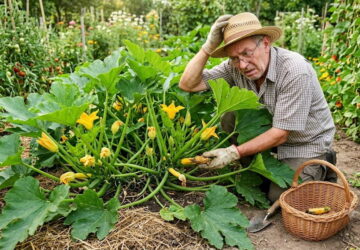
- Harvest courgettes, beans and cucumbers regularly to encourage continued production.
- Remove diseased or badly damaged foliage, but leave healthy seed heads where they can feed birds or provide winter structure.
- Sow suitable fast-growing salads and begin autumn crops such as radishes, rocket, kale or overwintering brassicas according to the local climate.
- Top up organic mulch where bare soil has appeared, keeping it away from the crowns and stems of plants.
What to Observe Right Now
Pause before reaching for the watering can and look at how the garden behaves in summer heat.
- Which plants wilt temporarily at midday but recover by evening?
- Where does soil remain moist longest – beneath foliage, mulch or open ground?
- Which flowers attract several kinds of insect rather than only an occasional visitor?
- Are berries beginning to colour, and have birds already noticed them?
- Which parts of the garden receive unexpected late-afternoon shade?
These small observations reveal more than a rigid watering schedule can. Temporary midday wilting does not always mean a plant needs immediate irrigation, while dull leaves and dry soil deeper down may indicate genuine water stress. Check the soil with a finger or trowel before deciding.
Looking Ahead
The stories attached to July 30 suggest that resilient gardens are built from both imagination and close observation. We can learn from wild moorland plants, from the layered logic of Pacific food gardens and even from an animated woodland that made audiences see familiar trees differently. The practical direction is clear – understand the soil, value diversity, use water thoughtfully and choose plants for ecological function as well as appearance. A garden designed in this way becomes more than colourful: it becomes better prepared for the seasons still to come.