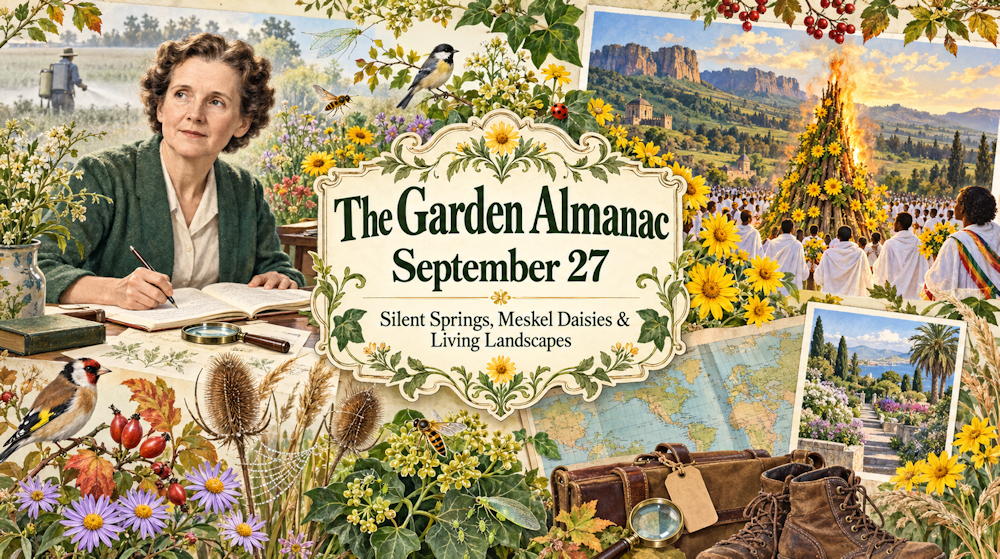

Late September is a season of thresholds. Across much of the Northern Hemisphere, flowers are surrendering their colour to seedheads, migrating birds are on the move, and gardeners are deciding what to clear, what to plant and what to leave for winter.
September 27 opens three very different doors onto that changing landscape. It marks the publication of a book that transformed our understanding of pesticides, an Ethiopian festival illuminated by bonfires and golden flowers, and a worldwide observance that asks how we travel through the landscapes we value.
September 27, 1962 – The Book That Asked Where the Birds Had Gone
Rachel Carson’s Silent Spring was published on September 27, 1962. Its title evoked an imagined spring in which birdsong had disappeared after the widespread use of persistent pesticides. Carson, a marine biologist and gifted nature writer, showed that chemicals applied to fields, roadsides and gardens did not remain neatly where they had been sprayed. They moved through soil, water and food chains, affecting insects, birds and other wildlife far beyond their intended targets.
The book appeared at a time when synthetic pesticides were often presented as straightforward instruments of progress. Carson did not argue that every pesticide should disappear, but challenged indiscriminate spraying and the assumption that humans could intervene in living systems without wider consequences. Her central insight was ecological: a garden, farm or woodland is not a collection of isolated species but a network of relationships.
That idea now sits at the heart of integrated pest management. Instead of treating every damaged leaf as an emergency, gardeners first identify the organism involved, assess whether it is causing serious harm and consider physical, cultural or biological controls. Aphids, for example, may attract hoverfly larvae, lacewings and ladybirds. Spraying too quickly can remove those natural enemies and leave the garden more vulnerable to the next infestation.
Carson’s anniversary offers a useful autumn task. Review which plants repeatedly struggled during the growing season and ask why. A plant weakened by unsuitable soil, poor drainage, drought or overcrowding is more likely to suffer from pests and disease. Moving it, improving its growing conditions or replacing it with a better-adapted species may achieve more than another round of treatment.
Garden Science – Why Can Broad-Spectrum Spraying Make Pest Problems Worse?
A broad-spectrum insecticide may kill predators and parasitoids as well as the target pest. The pest population can then recover without the natural controls that previously kept it in check.
A more measured approach is to:
- identify the pest before taking action;
- check several leaves rather than reacting to one damaged shoot;
- tolerate minor cosmetic damage on otherwise healthy plants;
- remove pests by hand or prune a localised infestation where practical;
- use barriers, traps or the least disruptive suitable treatment first;
- avoid spraying open flowers visited by pollinators.
The aim is not a garden without insects. It is a garden in which no single species is allowed to cause unacceptable damage while the wider food web remains intact.
September 27 – Meskel, Golden Flowers and the End of the Rains
In Ethiopia and Eritrea, September 27 is associated with Meskel, the Feast of the Cross, whose most striking public symbol is the Demera bonfire. Large gatherings take place around decorated structures of wood and greenery, often lit on the preceding evening. The ceremony commemorates the traditional story of Saint Helena using the direction of bonfire smoke to locate the True Cross.
Meskel also belongs unmistakably to the seasonal landscape of the Ethiopian Highlands. It arrives as the long summer rains retreat and yellow Adey Abeba, widely known as Meskel flowers, brighten fields and roadsides. The flowers are woven into the visual language of renewal, appearing around the Ethiopian New Year and the Meskel season when wet months begin to give way to clearer skies.
For gardeners elsewhere, the practical lesson lies not in copying a particular flower or ceremony, but in recognising the power of plants that mark a seasonal turning point. Native and locally adapted autumn-flowering species can provide both cultural character and vital late food for insects. When planning a border, look beyond spring and early summer: asters, ivy, late salvias and other regionally suitable flowers can keep nectar and pollen available when earlier displays have faded.
Wildlife Note – Which Autumn Flowers Help Late Pollinators?
Warm September afternoons can still bring bees, hoverflies and butterflies into the garden. To support them:
- grow several late-flowering species rather than relying on a single plant;
- choose simple, open flowers whose pollen and nectar are easy to reach;
- allow ivy to flower where it can be managed safely;
- avoid cutting every faded perennial at once;
- leave some sheltered, undisturbed ground for insects preparing to overwinter.
Observe before deadheading. A flower that appears past its best to us may still be feeding insects or beginning to produce seeds for birds.
September 27, 1970 – The Date That Put Tourism on the Calendar
September 27 became significant to international tourism when the statutes of the organisation now known as UN Tourism were adopted on this date in 1970. World Tourism Day has been observed annually on September 27 since 1980, encouraging reflection on travel’s cultural, economic and environmental influence.
Gardens are among the world’s most visited living destinations. Historic estates, botanic gardens, arboreta, community plots and restored landscapes allow travellers to encounter plants in their cultural settings. A garden visit can reveal how a region manages water, which plants belong to its traditional cuisine, how local crafts use natural materials and how climate shapes the growing year. Yet popular landscapes can also be damaged by trampling, litter, excessive water demand and the introduction of invasive organisms.
Responsible garden travel therefore begins with restraint. Stay on paths in sensitive habitats, do not collect wild seed or plant material, and never carry plants, soil, fruit or untreated wood across borders without checking the relevant regulations. Soil on muddy footwear can also transport weed seeds and microscopic pathogens, so clean boots and outdoor equipment before travelling to another natural area. Photographs, notes and ideas are the safest souvenirs.
Garden Inspiration – How to Learn More from a Garden Visit
Before leaving a public garden, choose three things to record:
- one plant that thrives in conditions similar to your own;
- one design idea based on shape, repetition or seasonal structure;
- one wildlife feature that could be adapted on a smaller scale.
Check the plant’s mature size, climate requirements and local status before buying it. A beautiful species in a garden abroad may be unsuitable, invasive or unable to survive in your own soil and weather.
Garden Reminder – What Should You Do in the Garden in Late September?
For gardeners in temperate parts of the Northern Hemisphere, this is a useful moment to combine planting with selective restraint:
- Plant daffodils and many other spring-flowering bulbs while the soil remains workable. Delay tulips until later in autumn where early planting increases the risk of disease.
- Plant hardy perennials while the ground is still warm, watering them thoroughly so roots can establish before winter.
- Collect ripe seed on a dry day and store it in labelled paper packets only after it is completely dry.
- Remove foliage showing serious fungal disease, but leave healthy hollow stems and sturdy seedheads for insects and birds.
- Move fallen leaves from paths and lawns into beds, beneath hedges or into a leaf-mould container.
- Reduce high-nitrogen feeding of tender plants, as soft new growth is easily damaged by cold weather.
In Southern Hemisphere gardens, September brings the opposite momentum. Watch for fresh growth, protect young seedlings from sudden cold spells and provide food and habitat for newly active pollinators.
What to Observe Right Now – Signs That the Season Is Turning
Late September rewards slow observation. Notice which flowers receive visitors during the warmest part of the day and which remain untouched. Watch for spiders’ webs made visible by morning dew, birds testing berries and seedheads, and the first changes in the outer leaves of deciduous trees.
Also look at the soil after rain. Water that disappears steadily suggests good structure, while persistent puddles may reveal compaction or poor drainage. This is valuable information before autumn planting: even a healthy plant will struggle if its roots spend winter in unsuitable conditions.
Keep a brief record of the first leaf colour, the last regular butterfly visit or the first cool night that checks the growth of tender plants. Repeated each year, these notes become a personal record of local phenology – the timing of seasonal events – and may reveal gradual changes that memory alone would miss.
Looking Ahead
September 27 reminds us that gardens are shaped by choices made far beyond the garden gate: which chemicals we use, which seasonal traditions we preserve and how carefully we move through other landscapes. A more resilient garden begins with identification, observation and a willingness to tolerate a little untidiness. By protecting beneficial insects, planting for the edges of the flowering season and travelling without carrying unwanted biological stowaways, gardeners can turn awareness into practical conservation. The result may not be a perfectly controlled garden, but it will be a livelier and more enduring one.