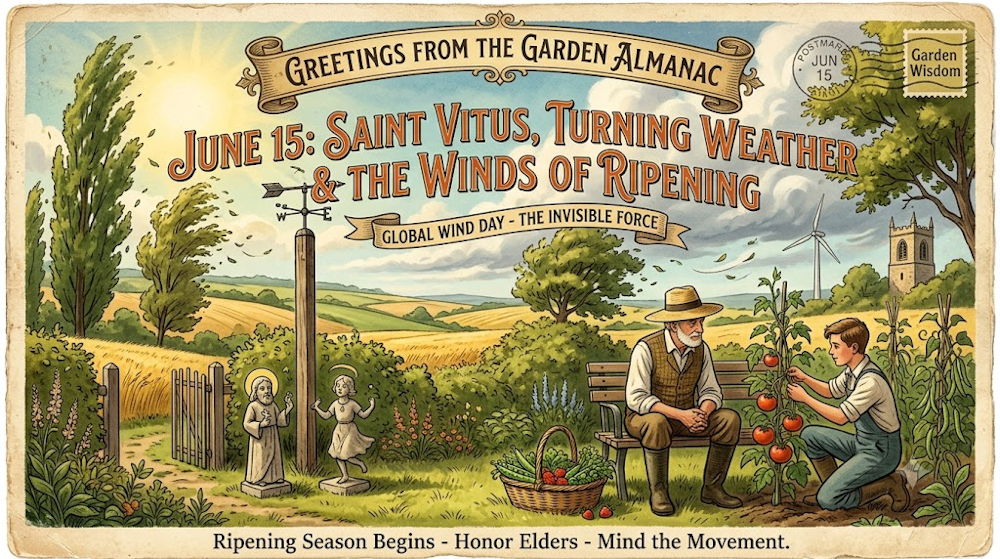

June 15 brings Saint Vitus into the Garden Almanac as a figure of movement, turning weather, ripening crops, nervous skies and the invisible force of wind.
In older European calendars, Saint Vitus’ Day was often treated as a seasonal marker. Around mid-June, growth begins to shift toward ripening. Grain changes color. Fruit swells. Vines and vegetables carry promise, but also risk. The garden is no longer simply growing. It is becoming accountable for what it has grown.
June 15 is also Global Wind Day, a modern observance that celebrates wind, wind energy and the communities shaped by this invisible force. In the garden, wind is not abstract at all. It dries, cools, pollinates, ventilates, bends, breaks and changes the mood of the day.
Saint Vitus and the Turning of the Season
Saint Vitus was one of the Fourteen Holy Helpers in medieval devotion, invoked in times of fear, illness and danger. His name became linked with Saint Vitus’ dance, a historical term associated with involuntary, uncontrolled movement.
For the Garden Almanac, that association with movement is strangely fitting. June 15 is full of movement: weather shifting, wind rising, grain turning from green to gold, fruit moving toward ripeness, gardeners moving from planting to protection.
The garden at mid-June is not still. It is in transition.
From Growth to Ripening
Early spring asks: will it sprout?
Late spring asks: will it grow?
Mid-June begins to ask: will it ripen well?
This is an important change.
Tomatoes set fruit. Beans climb. Cucumbers flower. Grapes form clusters. Berries ripen. Herbs reach cutting strength. Grain fields change color. The work of the gardener becomes less about starting life and more about guiding it toward maturity.
Ripening needs balance. Too much rain can bring disease. Too much heat can stress plants. Too little airflow can trap humidity. Too much wind can damage stems. Too little water can halt development.
Ripening is not passive. It is a delicate negotiation.
Weather Lore and Garden Attention
Saint Vitus’ Day weather lore often treated the date as a sign of the weeks ahead. A bright day suggested promise. A wet or cold day could be read as a warning for grain and crops.
Such sayings should not be treated as scientific rules. But they preserve a real agricultural instinct: mid-June weather matters.
The conditions around this time affect drying, disease, pollination, fruit quality, soil moisture and the pace of growth. A gardener does not need to believe every proverb literally to understand why people watched the sky so closely.
Weather does not simply happen above the garden. It enters the crop
Dew, Healing, and Morning Light
Some traditions connected Saint Vitus’ morning with dew gathered from fields, especially from oats, for healing purposes. Today this belongs to the world of folk belief rather than medical advice. But as an image, it is beautiful.
Dew sits at the edge between night and day. It is clean, brief, shining, and gone quickly once the sun rises. To gather dew was to gather a moment: freshness before heat, silence before work, moisture before drying.
Gardens still teach us to value such moments. The early morning garden is different from the afternoon garden. Leaves are cooler. Soil breathes differently. Flowers open quietly. Birds move before the heat begins.
Saint Vitus’ dew reminds us that not all garden wisdom comes at noon with tools in hand. Some comes at dawn, when the world has not yet hurried.
Global Wind Day
June 15 is Global Wind Day, and the connection to the garden is immediate.
Wind can be a blessing. It dries hay, moves pollen, reduces stagnant humidity, cools hot afternoons and signals weather change. It can also be destructive: breaking stems, drying pots, tearing leaves, lodging tall plants and carrying storms.
A wise gardener does not ignore wind.
Staking, tying, hedges, windbreaks, plant spacing, pruning and sheltered placement all matter. A tomato plant tied before the gust survives better than one rescued after it falls. A garden with layered planting buffers wind better than one left exposed.
Wind is invisible, but its consequences are visible everywhere.
Elders, Memory, and Garden Safety
June 15 is also World Elder Abuse Awareness Day, a serious global observance calling attention to the protection, dignity and wellbeing of older people.
In the Garden Almanac, this belongs through memory and care.
Older gardeners often carry knowledge that is not written down: when a certain tree fruits, which bed dries first, how the wind moves through the yard, which bean is worth saving, what the soil used to be like, and which mistake has already been made before.
A garden that honors elders has shade, water, safe paths, a place to sit, and time to listen.
It also recognizes that care is not sentiment. It is practical: reducing trip hazards, offering help in heat, making tools easier to use, sharing harvest, respecting experience and watching for isolation or neglect.
Gardens should be places where age is not pushed aside, but included.
The Garden in Motion
Saint Vitus, turning weather, wind, ripening crops and elder memory all meet in one idea: life is movement, and care means responding to it.
The garden changes daily in mid-June. A plant that was small last week now needs support. A fruit that was hard yesterday begins to soften. A dry bed needs water. A wet bed needs air. A calm morning may turn windy by afternoon.
The gardener’s skill is not control. It is timely response.
What June 15 Teaches
June 15 teaches that growth is only the beginning.
What sprouts must be tended.
What grows must be supported.
What ripens must be protected.
What moves must be understood.
What older hands remember must not be lost.
In the Garden Almanac on this day, Saint Vitus brings the old language of movement and turning weather, while Global Wind Day gives that movement a modern voice.
The wind changes the garden.
The season changes the work.
The gardener must change attention with it.