

Not every struggling houseplant needs more humidity. Brown leaf tips, yellowing leaves and drooping stems can have many causes – and the real secret is choosing plants that match the air, light and microclimate of your home.
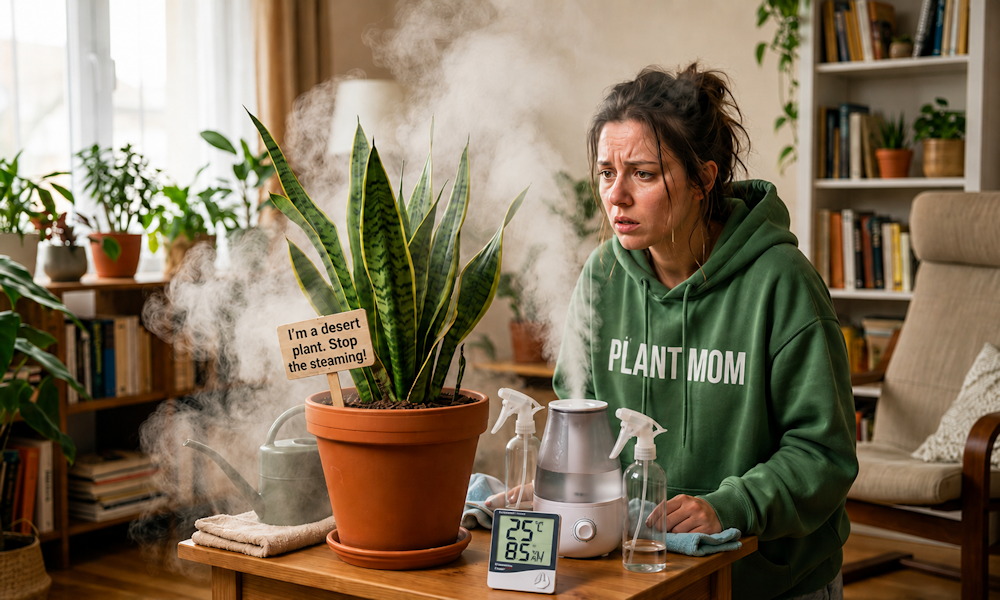
There is a persistent myth about houseplants: if a leaf turns yellow, a tip goes brown or a plant starts to wilt, it must be craving humidity. So out comes the spray bottle, the pebble tray or the little humidifier – while the real problem may be overwatering, poor light, cold drafts or simply the wrong plant in the wrong room.
Humidity does matter. But not every indoor plant wants the same kind of air. Some cope well with dry, heated homes. Others prefer moderate humidity. And some really do need a warm, moist environment to stay beautiful.
The goal is not to turn your home into a rainforest. It is to understand your indoor conditions and choose plants that can thrive in them.
Measure First, Guess Later
Humidity is difficult to judge by feel alone. What seems comfortable to us may be far too dry for a tropical foliage plant, while a succulent may consider it perfectly fine.
A simple hygrometer can be surprisingly useful. In many homes, relative humidity sits somewhere between 30 and 60%, but it can drop lower in winter when heating is on. Bathrooms, kitchens, plant-filled corners, rooms with aquariums and areas near humidifiers may all be more humid than the rest of the home.
The important thing is to notice microclimates. A sunny windowsill, the space above a radiator, a bright bathroom, a kitchen shelf and a living room corner can all offer very different growing conditions.
Low Humidity: Tough Plants for Dry Indoor Air
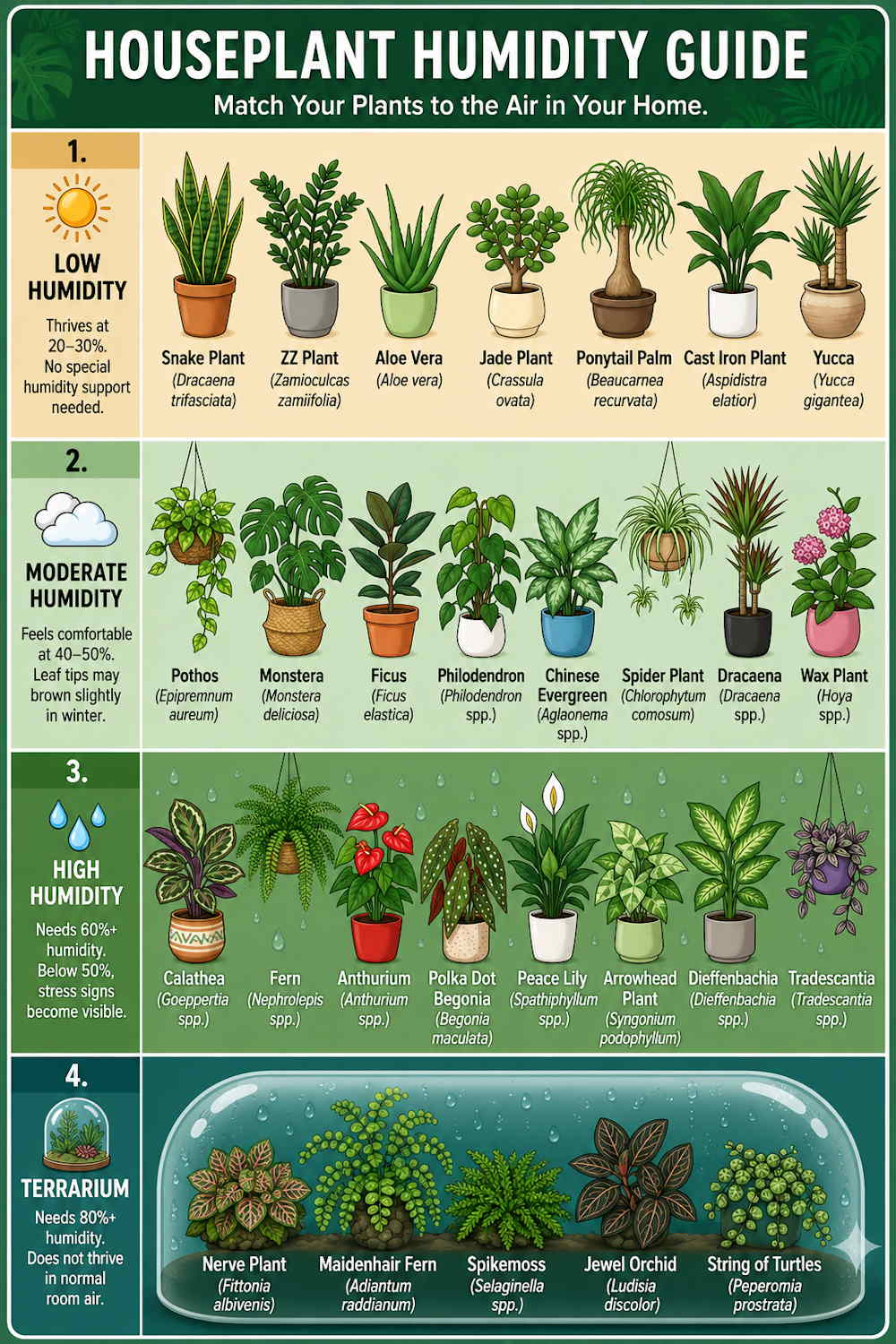
For rooms with lower humidity – around 20 to 35% – choose plants that naturally tolerate drier air. These often have thicker leaves, water-storing tissues or tougher foliage, so they are less sensitive to heated indoor conditions.
Good choices include:
- snake plant (Dracaena trifasciata, syn. Sansevieria trifasciata)
- ZZ plant (Zamioculcas zamiifolia)
- aloe vera (Aloe vera)
- jade plant (Crassula ovata)
- ponytail palm (Beaucarnea recurvata)
- cast iron plant (Aspidistra elatior)
- yucca (Yucca gigantea, syn. Yucca elephantipes)
These plants are not impossible to kill, but they are far more forgiving than humidity-loving ferns or delicate tropical foliage plants.
Snake plants and ZZ plants are especially good for beginners because they tolerate dry air and irregular care. Aloe and jade plants also prefer brighter, drier conditions, but with succulents, overwatering is usually a bigger danger than low humidity.
Yucca and ponytail palm need good light and careful watering, while cast iron plant is one of the classic indoor survivors: slow-growing, steady and remarkably tolerant of ordinary household conditions.
Moderate Humidity: The Comfort Zone for Many Houseplants
Humidity of around 40 to 55% suits many popular indoor foliage plants. This is the range where a lot of houseplants can do well, provided they also receive the right light, water and temperature.
Good options include:
- pothos (Epipremnum aureum)
- Monstera (Monstera deliciosa)
- ficus plants (Ficus spp.)
- philodendrons (Philodendron spp.)
- Chinese evergreen (Aglaonema spp.)
- spider plant (Chlorophytum comosum)
- dracaena (Dracaena spp.)
- hoya (Hoya spp.)
These plants may appreciate slightly more humidity, but most do not need terrarium-like conditions.
Pothos and philodendrons are popular because they are adaptable, fast-growing and easy to display on shelves, in hanging planters or on supports. Monstera is dramatic and rewarding, but it needs enough space and good light. Ficus can be more sensitive to drafts, sudden changes and drying out, so stable conditions matter just as much as humidity.
Chinese evergreen, spider plant and dracaena are good middle-ground plants. Hoya is often more about patience than constant misting: once it is in the right place, it can be a long-lived and rewarding houseplant.
High Humidity: Beautiful but More Demanding
Plants that prefer humidity above 60% need a little more thought. Many have striking leaves, soft foliage or tropical origins, which makes them irresistible – and sometimes difficult in dry, heated rooms.
This group may include:
- Calathea and other prayer plants (Goeppertia spp., Calathea spp., Maranta spp.)
- many indoor ferns
- Anthurium (Anthurium spp.)
- polka dot begonia (Begonia maculata)
- peace lily (Spathiphyllum spp.)
- arrowhead plant (Syngonium podophyllum)
- Dieffenbachia (Dieffenbachia spp.)
- Tradescantia (Tradescantia spp.)
Common warning signs include brown leaf edges, curled leaves, slower growth and a generally unhappy look during winter.
But higher humidity does not mean more watering. This is one of the most common houseplant mistakes. Dry air affects the leaves, while too much water damages the roots. A plant may want moisture around its foliage, but it does not want to sit in wet soil.
Humidity-loving plants often do better in a bright bathroom, a kitchen, a grouped plant corner, near a humidifier or in a more enclosed plant display. The space directly beside a radiator is usually one of the worst places for them because the air is both warm and dry.
Terrarium Plants: When Room Air Is Not Enough
Some plants need consistently high humidity – often above 70 to 80% – to stay attractive. These are not ideal candidates for an average dry living room, and growing them there often leads to frustration.
Terrarium-friendly options may include:
- some Fittonia varieties (Fittonia albivenis cultivars)
- maidenhair fern (Adiantum raddianum)
- certain Selaginella species (Selaginella spp.)
- jewel orchids (Ludisia discolor and other jewel orchids)
- string of turtles (Peperomia prostrata)
These plants usually perform best in terrariums, closed glass containers, florariums or stable, humid plant cabinets.
The key is not only high humidity, but stability. In an ordinary home, humidity rises and falls after cooking, showering, ventilation or heating. Sensitive terrarium plants often struggle with these constant changes.
Misting Is Not a Magic Solution
Misting is one of the most common reactions to dry air, but it is rarely a complete solution. It may briefly increase moisture around the leaves, but it usually does not create lasting humidity.
In cool rooms, with poor air movement or on sensitive foliage, frequent misting can even encourage leaf spots or fungal problems. That does not mean misting is always forbidden. It simply means it should not be the foundation of plant care.
Better options include grouping plants together, using a cool-mist humidifier, placing pots above – not in – water on a pebble tray, or moving humidity-loving plants to a naturally more suitable room.
And sometimes the best solution is even simpler: choose a plant that already matches the air in your home.
Brown Leaf Tips: Is Humidity Always to Blame?
No. Brown leaf tips can be caused by low humidity, but also by overwatering, underwatering, salt build-up, too much fertiliser, hard tap water, cold drafts, sunburn or root problems.
Always look at the whole situation. Is the soil wet or dry? Is the plant getting enough light? Is it near a radiator? Does it receive cold air when the room is ventilated? Has it been in the same pot for too long? What kind of water do you use?
If only the tips are brown but the plant is still growing and producing new leaves, small adjustments may be enough. If it is wilting, dropping leaves, developing spots or sitting in constantly wet soil, the first step is not a humidifier – it is checking the care routine.
How to Raise Humidity Sensibly
If you grow plants that genuinely need more humidity, a cool-mist humidifier is often the most effective option, especially in winter. Do not aim the mist directly at the leaves, and make sure there is some air movement. Air that is too wet and stagnant can cause fungal issues.
Grouping plants can also help. Several plants standing together create a slightly more humid microclimate, especially in a bright, sheltered spot away from radiators.
Pebble trays may be useful too, but only if the pot is not sitting directly in water. If the roots constantly absorb water from below, the result is not higher humidity – it is root trouble.
Bathrooms can be excellent for humidity-loving plants, but only if they have natural light. Humidity alone is not enough. A dark bathroom is rarely a plant spa; for many plants, it is simply too dark.
Choose Plants for Your Home, Not the Other Way Around
Houseplant care becomes much more enjoyable when it is not a constant rescue mission.
For a dry, sunny, heated home, snake plant, ZZ plant, aloe, jade plant, ponytail palm or yucca may be a better choice. For average indoor humidity, pothos, philodendron, spider plant, dracaena, hoya, ficus or Monstera can work well. For brighter, more humid spaces, ferns, begonias, peace lilies, arrowhead plants, Anthurium and prayer plants may be more successful.
And when it comes to terrarium plants, it helps to accept that they are not simply “a bit fussy”. They are adapted to a different kind of environment.
Humidity is not an extra luxury in houseplant care. It is basic information, just like light and watering. The smartest approach is not to treat every plant the same way, but to understand your home’s conditions, measure the air, observe your plants and choose accordingly.
Not every plant belongs in every home, and that is perfectly fine. The right match means fewer brown leaf tips, fewer rescue missions – and much happier houseplants.