
August 14 arrives at an intriguing point in the gardening year. Summer is still generous, but the garden has begun to reveal the first signs of change. Some flowers are fading into seed, vegetables are reaching their harvest peak, lawns may be slowing under heat, and the first hints of autumn are beginning to appear in the quality of the light.
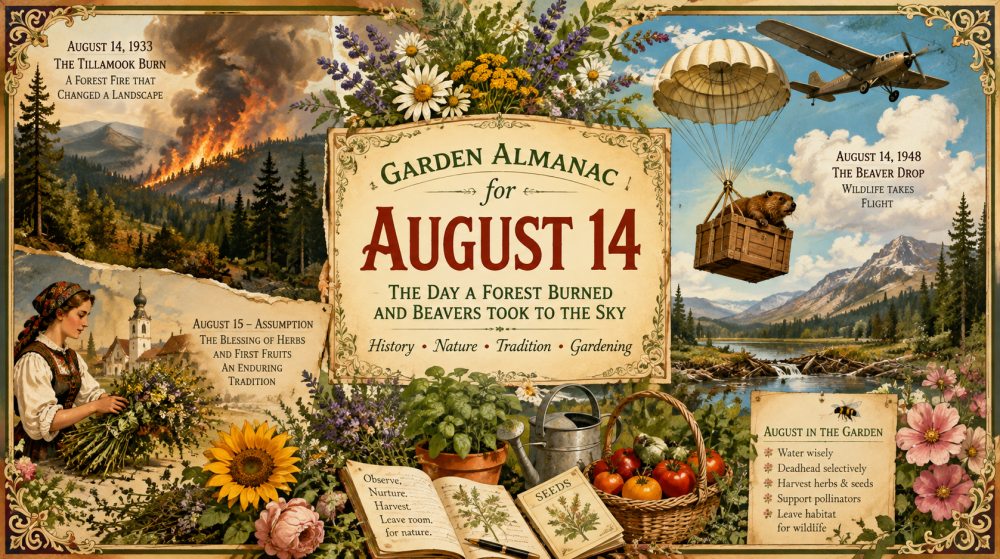
The date itself carries an unusually strong environmental story. On August 14, 1933, a fire began in Oregon’s Coast Range that would become the notorious Tillamook Burn. Fifteen years later, on the very same date, Idaho conservationists carried out one of the strangest wildlife relocation projects in American history, dropping beavers by parachute into a remote mountain basin. And just one day later comes the Feast of the Assumption, traditionally associated in parts of Europe with the gathering and blessing of herbs, flowers and first fruits.
Together, these stories make August 14 a surprisingly good date for thinking about gardens and landscapes. They ask three different questions: What happens when we lose control of a landscape? What happens when we deliberately let wildlife reshape it? And what can an old harvest tradition teach us about the plants growing around us today?
August 14, 1933 – When a Logging Fire Became a Landscape Lesson
Around noon on August 14, 1933, a fire began near Gales Creek in the northern Oregon Coast Range. The conditions were exceptionally dangerous: temperatures reached about 104°F, relative humidity was around 20 percent, and the forest was tinder-dry. The fire spread through a landscape heavily affected by logging and eventually became the first and largest of four major fires that would repeatedly devastate the region between 1933 and 1951.
The combined Tillamook fires ultimately burned about 355,000 acres. The damage was not limited to trees. Severe burning and subsequent salvage logging left some slopes exposed, contributed to erosion, and affected streams and fisheries. Yet the story did not end with destruction. From 1948 onward, Oregon undertook a huge rehabilitation effort. Over the following decades, crews and volunteers planted 72 million Douglas-fir seedlings, while aerial seeding was also used to restore difficult terrain. The damaged landscape gradually became today’s Tillamook State Forest.
That transformation is worth remembering in a garden, too. A burned, drought-stricken or otherwise damaged landscape does not necessarily need to be forced back into its previous appearance. Recovery depends on soil, water, vegetation and time working together.
Garden Science – Why bare soil is especially vulnerable
When vegetation disappears, the soil loses more than its colour. Plant roots hold soil particles together, stems slow rainfall, leaves shade the ground, and organic matter helps water infiltrate rather than simply run away.
This is one reason gardeners are encouraged to keep soil covered whenever practical. Mulch, living groundcovers and healthy plant residues can reduce evaporation and help protect the soil surface during hot weather. The RHS recommends improving soil with organic matter and using mulch as part of a water-saving strategy.
The Tillamook story therefore has a very practical garden message: resilience begins below ground. A garden with good soil structure and plenty of organic matter is better equipped to cope with heat, drought and sudden heavy rain than one dependent on frequent surface watering.
Nature Watch: A brown patch is not automatically a dead landscape.
Look closely for surviving roots, seedlings, mosses, insects and spontaneous regeneration. Recovery often begins long before a damaged area looks green again.
August 14, 1948 – The Day Beavers Came Down by Parachute
If the Tillamook story is about an ecosystem damaged by human activity, the second August 14 story is almost its comic opposite.
On August 14, 1948, the Idaho Department of Fish and Game carried out an extraordinary relocation experiment. Beavers were moved from northwestern Idaho to the remote Chamberlain Basin in central Idaho. The animals were transported by aircraft and parachuted into their new territory. The unusual operation became known as the “beaver drop”.
It sounds like a bizarre piece of wildlife history, but the underlying idea was remarkably practical. Beavers were being moved to suitable habitat where they could establish themselves and modify the landscape naturally.
Today we understand much more clearly why that can matter. Beavers are often described as ecosystem engineers because their dams and canals change water movement, create ponds and wetlands, and provide habitat for many other species. Beaver-created wetlands can support aquatic plants, insects, amphibians, birds and mammals, while slowing and storing water.
For gardeners, the important lesson is not that every garden needs a beaver. It is that wildlife can be part of landscape management rather than simply something that visits a managed landscape.
A pond edge with native vegetation, a dead tree left safely in place, a patch of long grass or a shallow area allowed to stay damp can all provide ecological functions that a perfectly tidy garden cannot.
Wildlife Note – What does a beaver actually do for a landscape?
Beavers are herbivores that browse on woody and aquatic vegetation. Their dams slow water and create more complex wetland conditions. These changes can increase habitat diversity and help retain water during dry periods, although beaver activity can also create conflicts with roads, crops, drainage systems and other infrastructure.
For a home gardener, the broader principle is simple:
- Give wildlife some room to alter the garden.
- Keep a range of habitats rather than one uniform planting style.
- Treat fallen branches, shallow water and native vegetation as potential habitat, not automatically as untidiness.
- If a garden contains a pond, allow some marginal vegetation to develop rather than keeping every edge completely bare.
- A biodiverse garden is not necessarily the one with the most plants. It is the one with the greatest variety of useful relationships.
The Eve of the Herb Harvest – Why August 14 Leads Into an Old Plant Tradition
August 14 also has a cultural connection that becomes especially interesting because it is the eve of August 15, the Feast of the Assumption.
In parts of Central and Eastern Europe, August 15 has long been associated with the gathering and blessing of herbs, flowers, fruit and other plants. In German-speaking regions, the custom is known as Kräuterweihe. Austria’s official cultural information describes the tradition as particularly strong in western parts of the country, where bouquets may contain dozens of plant species and can include garden produce as well as herbs.
The tradition developed around the time of the summer harvest, when many medicinal and aromatic plants were mature and ready to gather. Historical accounts describe people bringing bundles of herbs, flowers, grain and fruit for blessing and then keeping them at home. The practice became incorporated into Christian popular devotion, while retaining an older connection to seasonal plant gathering.
For modern gardeners, the most interesting part is the botanical knowledge hidden inside the custom. People were not simply collecting “green things”. They were paying attention to which plants were flowering, which herbs were mature, which seeds were forming and which useful species were ready to dry and store.
That is exactly the sort of seasonal awareness a good garden encourages.
August is an excellent month for observing herbs at their strongest. Lavender, rosemary, sage, thyme, mint, oregano and other aromatic plants have accumulated months of growth and can provide leaves, flowers or seed for later use. Some herbs can also be propagated from semi-ripe cuttings at this time of year.
Garden Reminder – What should you do in the garden in mid-August?
The best August garden work is often about preserving what the summer has produced while reducing unnecessary stress.
- Water deeply rather than giving established plants frequent, shallow drinks. Water early in the morning when possible, and concentrate on the root zone rather than wetting foliage.
- Give newly planted trees, shrubs and container plants priority during dry weather.
- Deadhead repeat-flowering plants such as dahlias, roses, penstemons and many bedding plants to encourage continued flowering.
- Do not deadhead everything. Sunflowers, rudbeckias, many roses and plants with ornamental seedheads can provide valuable food or shelter for wildlife.
- Collect ripe seed on a dry day and label it immediately. Store thoroughly dry seed in a cool, dry place.
- Harvest herbs regularly, but leave enough flowering plants to support pollinators and enough seedheads to provide autumn and winter food where appropriate.
- Keep ponds and other water features topped up during prolonged hot weather.
- The central August principle is water wisely, harvest thoughtfully and leave something behind for nature.
What to Observe Right Now – The Garden Is Already Turning Toward Autumn
Mid-August is an excellent time to notice transitions that are easy to miss when gardening becomes a list of chores.
Look at the same plant you watched flowering in June. Has its colour changed? Are its petals being replaced by seed capsules? Are birds beginning to investigate? Are insects visiting the flowers differently now that the abundance of midsummer is declining?
The transition from flower to seed is particularly important. A garden can look “past its best” to a human eye while becoming increasingly valuable to wildlife. The fading flowerhead may be the beginning of the next generation of plants or a food source for birds.
This is also the season when the garden’s water story becomes visible. Plants in containers may wilt long before established shrubs. Lawns can turn brown without being permanently damaged. Vegetables such as tomatoes and root crops can suffer when watering is erratic. The RHS notes that inconsistent watering can contribute to problems such as blossom-end rot in tomatoes and splitting in root vegetables.
So before reaching for the hose, check the soil. Dig down several centimetres. A wilted leaf does not always mean the whole root zone is dry.
Garden Inspiration – From Controlling Nature to Working With It
The three stories surrounding August 14 form an unlikely progression.
The Tillamook fires demonstrate how vulnerable a landscape can become when vegetation, soil and human land use interact under extreme conditions. The beaver relocation shows an early attempt to use an animal’s natural behaviour as part of landscape management. The herb-gathering tradition reminds us that people once knew their seasonal landscapes through close observation of plants and their uses.
Modern ecological gardening brings these ideas together.
Instead of asking only, “How can I make this garden look better?”, we can ask better questions. Where does water go after rain? Which plants provide food after flowering? Which areas can remain slightly wild? Which parts of the soil are exposed? Which insects depend on the plants I am removing? Where could a small pond, hedge, tree or patch of native vegetation create a much larger ecological benefit?
These questions turn a garden from a collection of plants into a functioning landscape.
Looking Ahead
August 14 is a useful reminder that landscapes are never static. Fire can transform a forest in a matter of hours. A beaver can transform a stream over years. A gardener can transform a small patch of soil through hundreds of quiet decisions.
The most resilient gardens do not try to eliminate every natural process. They learn which processes to encourage, which risks to reduce and which forms of wildness to preserve.
As summer moves toward autumn, that may mean watering less wastefully, building better soil, allowing seedheads to remain, gathering seeds and herbs at the right moment, and making space for the wildlife that turns a garden into an ecosystem.
The real garden almanac is not simply a record of dates. It is a record of relationships – between weather and soil, plants and animals, people and landscapes. And on August 14, those relationships make for an unusually good story.