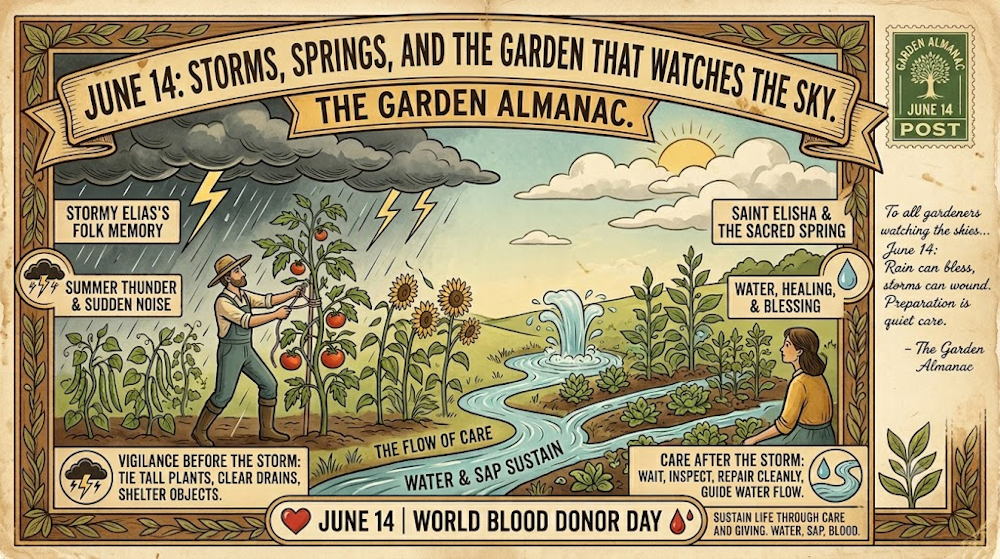

June 14 enters the Garden Almanac with storm clouds, water, old calendar memory and the practical vigilance of early summer.
In Hungarian folk memory, this date is associated in some traditions with stormy Elias, a restless weather figure linked with sudden noise in the sky, thunder and summer storms. It should not be treated as a universal national custom, but as a vivid weather-memory: one more reminder that mid-June gardens must watch the sky.
June 14 is also connected in several Christian calendars with Saint Elisha, whose stories carry strong themes of water, springs, healing and blessing. Together, stormy Elias and water-linked Elisha give this day a clear garden language: rain is needed, water is sacred, but sudden weather can also be dangerous.
The Storm Above the Garden
By mid-June, storms matter.
A shower may refresh the soil. A thunderstorm may flatten beans, break tomatoes, bruise fruit, tear leaves, wash mulch away, flood paths, damage flowers and leave humid conditions behind.
The garden is no longer a bare spring promise. It is tall, leafy, heavy with young growth and increasingly vulnerable to wind and hail. Plants need support. Soil needs protection. Water needs somewhere to go.
A storm in June is not only weather. It is a test of preparation.
Elias and the Folk Memory of Thunder
The Hungarian image of stormy Elias gives the day a memorable character. Folk weather figures often helped people make sense of sudden natural forces. Thunder, lightning, wind and rain were frightening, but giving them a name made them part of the calendar’s story.
This does not mean every thunderstorm belongs to Elias, or that the date is a guaranteed storm day. The value of the tradition is not prediction, but attention.
It reminds gardeners that early summer can change quickly. A calm morning may become a turbulent afternoon. A hot, still day may end in thunder. A sky that looks harmless at breakfast may deserve a second look by evening.
Saint Elisha and the Water of Springs
In several Christian traditions, June 14 is associated with Saint Elisha. The prophet’s stories include water, healing, drought and the blessing of springs. For a garden almanac, this gives the day a quieter counterpoint to storm lore.
Water is never simple in a garden.
Too little, and plants wilt.
Too much, and roots suffocate.
A gentle rain feeds.
A downpour damages.
A spring sustains.
A flood unsettles.
The gardener’s work is not to control water completely, but to guide, store, slow, protect and respect it.
Before the Storm
Storm preparation in a garden is ordinary work, but it can save a surprising amount.
Tie tomatoes and tall plants before wind arrives. Check beans, peas, vines, dahlias, sunflowers and young fruit trees. Secure pots, balcony boxes, row covers, insect nets and lightweight garden objects. Bring tools, seed packets and harvested produce under cover. Make sure gutters, drains, channels and water paths are clear.
A garden that has been given structure suffers less.
Support is not only for weak plants. It is for plants that are growing fast and carrying the weight of summer.
After the Storm
After heavy weather, patience matters.
Do not rush across soaked beds if the soil is saturated. Compaction can cause longer damage than the storm itself. Look first. Where is water standing? What has broken? What can be lifted gently? What should be pruned cleanly? Which fruit is damaged and should be removed before rotting?
Broken stems should be cut with clean tools. Fallen plants may be restored if roots are still sound. Damaged leaves do not always need immediate removal, but severely torn or diseased tissue should be watched carefully.
After storms, slugs, fungal problems and humid plant canopies often become more important. The real work begins after the dramatic sky has moved on.
World Blood Donor Day
June 14 is also World Blood Donor Day, a global observance dedicated to thanking voluntary blood donors and raising awareness of the need for safe blood donation.
At first, this may seem far from the garden. But the Garden Almanac can hold the connection gently.
A garden depends on circulation: water moving through soil, sap rising through stems, nutrients carried where they are needed, life quietly flowing through hidden systems. Human life, too, depends on unseen gifts moving where they are needed.
Blood donation is one of those gifts. It is not dramatic in the way thunder is dramatic, but it sustains life.
The day’s larger lesson is care through flow: water, sap, blood, generosity.
What June 14 Teaches
June 14 teaches that watching the sky is still garden work.
Old weather lore, storm preparation, water management, plant support, careful recovery after damage and human acts of giving all belong to the same pattern: life depends on attention before crisis and care after it.
In the Garden Almanac on this day, stormy Elias teaches vigilance, Saint Elisha brings the language of springs and water, and World Blood Donor Day reminds us that life is often sustained by what moves quietly beneath the surface.
Tie what needs support.
Clear the way for water.
Shelter what can be sheltered.
Wait before trampling wet soil.
Repair cleanly.
Give where life needs it.
The sky may be beyond us.
The response is not.