
By mid-August, a garden can appear settled into summer, yet the living world is already preparing for change. Birds test invisible routes across continents, seeds harden inside ripening fruits, and dry soil reveals exactly how well a garden has been cared for through the hotter weeks.
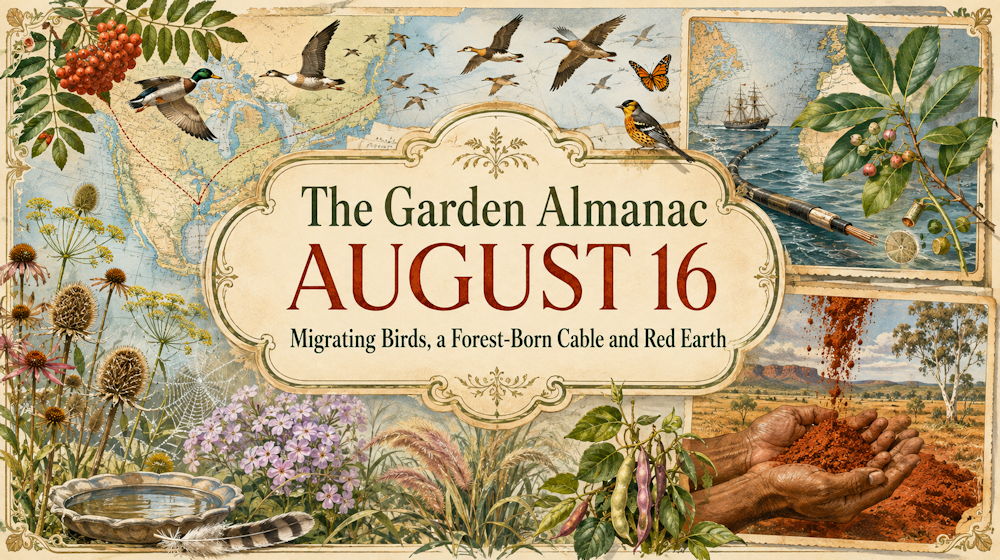
August 16 also opens three unexpected windows onto our relationship with nature: a communications revolution made possible by the latex of a tropical tree, an international agreement that recognised birds could not be protected by one country alone, and a landmark return of Australian land symbolised by a handful of earth.
August 16, 1916 – The Treaty That Followed the Birds
In the early twentieth century, North America’s migratory birds were under immense pressure. Birds were killed for food, sport and the feather trade, while rules varied from one state or province to another. Such fragmented protection made little sense for species that might nest in Canada, cross the United States and continue towards wintering grounds much farther south.
On August 16, 1916, the United States and Great Britain, acting on behalf of Canada, signed the Convention for the Protection of Migratory Birds. It introduced coordinated protection across an international border, restricted indiscriminate killing and recognised the importance of nesting grounds. Its original language reflected the values of its time, dividing birds according to their supposed usefulness to people, but the central idea was remarkably forward-looking: migration turns conservation into a shared responsibility.
That principle matters far beyond legislation. A warbler cannot survive on a protected breeding ground if it finds no food during its journey. A swallow needs insects above farms, gardens and wetlands all along its route. Conservation therefore depends not only on distant reserves, but also on countless small places where birds can feed, drink, shelter and rest.
A garden can become one of those places. Native shrubs provide caterpillars and berries, seed-bearing perennials supply late-season food, and a shallow source of clean water may be valuable during hot migration weather. Avoid cutting every fading flower head or stripping a hedge immediately after summer – a slightly untidy garden often contains precisely what travelling wildlife needs.
Wildlife Note – How Can a Garden Help Migrating Birds?
- Leave some sunflower, teasel, coneflower and ornamental grass seed heads standing.
- Grow berry-producing shrubs suited to your region rather than relying on artificial feeding alone.
- Keep cats indoors, particularly around dawn and dusk when birds are actively feeding.
- Provide shallow water with a gently sloping edge and clean it regularly in warm weather.
- Reduce pesticide use so that insect-eating birds can find natural prey.
Outdoor lights also deserve attention. Artificial illumination can disorient nocturnal migrants, especially during cloudy weather when celestial cues are obscured. Switching off unnecessary garden lighting overnight – or using shielded, low-intensity lamps directed towards the ground – makes the garden safer for birds and many nocturnal insects.
Garden Science – Why Does Migration Begin Before Summer Appears to End?
Bird migration is not triggered by cold weather alone. Changes in day length influence hormones and behaviour, while food availability, weather patterns and inherited instinct help determine when a species departs. This is why migratory restlessness may begin while gardens are still full of flowers and warm afternoons.
For gardeners, the lesson is simple: late-summer planting should support continuity rather than a single dramatic flowering peak. A succession of nectar-rich flowers, insect-friendly foliage, berries and seeds makes a garden more useful during the long transition from summer into autumn.
August 16, 1858 – The Ocean Cable Rooted in a Tropical Forest
On August 16, 1858, Queen Victoria and US President James Buchanan exchanged messages through the first transatlantic telegraph cable. Although the cable operated successfully for only a short time, it proved that communication could cross an ocean in minutes rather than waiting for a ship. Beneath that famous technological achievement lay a less familiar botanical story.
The copper wire needed an insulating material that remained stable in cold, deep seawater. The solution was gutta-percha, a natural latex obtained mainly from Southeast Asian trees in the genus Palaquium. Unlike ordinary rubber, it softened when heated, could be moulded around wire and hardened again as it cooled. A substance developed by tropical trees to seal wounds became essential to Victorian global communication.
Demand, however, encouraged destructive harvesting. Instead of carefully tapping living trees, collectors often felled them to obtain relatively small quantities of latex. Forest resources that appeared limitless were depleted rapidly – an early example of a technological breakthrough transferring its hidden environmental cost to distant ecosystems.
The gardening lesson reaches well beyond gutta-percha. Plant-derived materials are not automatically sustainable simply because they are natural. Timber, peat, coir, rubber, oils and decorative plants all carry histories of cultivation, harvest and transport. When buying garden products, durability, responsible sourcing and the possibility of reuse matter just as much as the material named on the label.
Garden Reminder – Five Useful Jobs for Mid-August
- Water deeply and less frequently, directing water towards the root zone rather than wetting foliage unnecessarily.
- Check containers daily during hot or windy weather, as small pots can dry out within hours.
- Harvest beans, courgettes and cucumbers regularly to encourage continued production.
- Remove diseased leaves, but leave healthy seed heads where they can feed birds or provide seed for next year.
- Take semi-ripe cuttings from suitable shrubs such as lavender, rosemary and many evergreen ornamentals.
Mulch is still useful in late summer, but it should be applied to already moist soil. A layer of organic material approximately 5 centimetres deep can slow evaporation and moderate soil temperature. Keep it away from stems and trunks, where permanently damp material may encourage decay.
August 16, 1975 – When Land Was Returned with a Handful of Soil
On August 16, 1975, at Daguragu in Australia’s Northern Territory, Prime Minister Gough Whitlam formally transferred leasehold title to part of the traditional lands of the Gurindji people. During the ceremony, he poured red soil into the hands of Gurindji Elder Vincent Lingiari. The gesture became one of the best-known images in the history of Australian Indigenous land rights.
The moment followed the Wave Hill walk-off, begun nine years earlier by Gurindji stockmen and their families. What started as a protest against poor pay and working conditions developed into a demand for the return of traditional land. The handback did not resolve every question of ownership or justice, but it helped reshape the national conversation about whose knowledge, labour and history belong in a landscape.
For gardeners, the image of soil passing from one hand to another carries a practical truth: land is never merely a surface to possess. It is a living system shaped by water, fire, grazing, cultivation, fungi, insects, roots and human decisions accumulated over generations. Learning how a place was managed before us – and listening to long-established local ecological knowledge – can reveal why certain plants thrive, where water moves and how disturbance changes the land.
The everyday application begins with observation. Before redesigning a garden, watch where rain gathers, which areas remain dry, where spontaneous plants return and how sun and wind move through the site. Working with those patterns usually requires fewer inputs than forcing the entire space into a uniform design.
What to Observe Right Now
In Northern Hemisphere gardens, look for the first quiet signs of seasonal change:
- earlier seed formation on annuals and perennials;
- ripening berries attracting increasing bird activity;
- morning dew lingering longer in shaded areas;
- tired foliage on plants that have completed their main growth;
- late butterflies and bees concentrating on the remaining nectar-rich flowers.
Southern Hemisphere, August belongs to the approach of spring. Swelling buds, lengthening days and renewed bird activity offer a different version of the same message – seasonal change begins before the calendar declares that a season has arrived.
Looking Ahead
The stories of August 16 remind us that gardens are connected to systems much larger than their boundaries. Birds link countries, useful materials link technology to distant forests, and soil carries both ecological memory and human history. We can respond by planting for continuity, choosing materials more carefully and learning the patterns of the land before attempting to control them. A garden managed with attention becomes more than a private refuge – it becomes one small, functioning part of a shared living world.