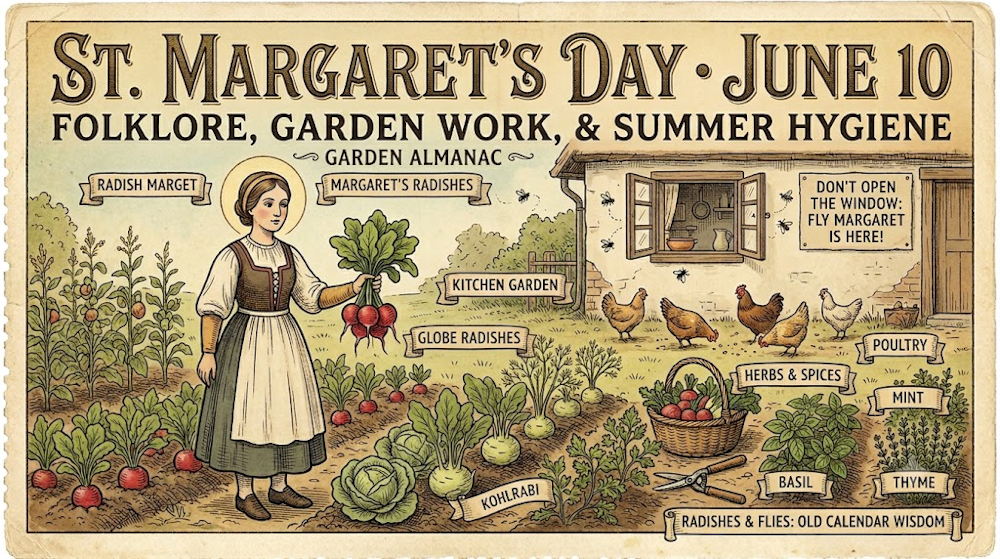

June 10 brings Saint Margaret into the Garden Almanac through a wonderfully earthy doorway: radishes, flies, kitchen gardens, summer hygiene, and the old calendar wisdom of Central Europe.
In Hungarian folk tradition, Margaret’s Day was not only a name day. It was a practical garden marker. In some places, it was associated with sowing radishes. Elsewhere, it was linked with flies, rain, poultry, cabbages, flax, and early-summer household care.
This is exactly the kind of day the Garden Almanac loves: half folklore, half garden work, with a little humor buzzing around the kitchen window.
Margaret in the Kitchen Garden
The Hungarian name “Retkes Margit,” or “Radish Margaret,” was used in some local traditions for June 10. The idea was that radishes sown around this time would remain tender.
Whether taken literally or as seasonal advice, the observation makes sense. Radishes are quick crops, but they do not enjoy stress. Heat, dryness, uneven watering and poor timing can make them tough, sharp or prone to bolting.
A radish teaches speed and precision. Sow at the right time, keep the soil evenly moist, thin properly, and harvest before the root loses its charm. Delay too long, and the garden gives you a lesson with a peppery bite.
The Folklore of Flies
Margaret’s Day was also known in some places as a fly-related day. One belief warned against opening the windows, because many flies would come in.
It sounds comic, but it carries a very real summer truth.
By June, kitchens are warmer. Fresh produce is arriving. Milk, eggs, meat, fruit, herbs, compost, animals, food scraps and storage areas all require more attention. Flies are not only irritating; they are reminders that warm weather changes household hygiene.
Old folklore often wrapped practical knowledge in memorable language. “Do not open the window on Fly Margaret’s Day” is not modern food safety advice, but it points toward the same household concern: cover food, keep things clean, cool fresh produce, and do not ignore what heat does.
Radishes, Cabbages, and Real Garden Pests
The pairing of radishes and flies is not as strange as it first appears. Radishes and cabbages both belong to the wider brassica family, and many brassicas attract specific pests. Some attack leaves, some roots, some young plants, and many are easiest to manage when noticed early.
This does not mean that an old folk saying was a scientific plant protection manual. But it does show how close observation shaped calendar wisdom.
Gardeners saw patterns. Certain crops had certain troubles at certain times. Those patterns became sayings, warnings, nicknames, and seasonal advice.
On June 10, it is worth checking brassicas closely: radishes, cabbages, kohlrabi, broccoli, kale and related crops. Look for holes, wilting, eggs, larvae, root problems and stressed young plants.
The first and best garden tool is still attention.
Herbs, Spices, and the Summer Kitchen
June 10 is also a good day to think about herbs and spices, because this date is marked in some modern calendars as National Herbs and Spices Day.
That makes a natural bridge to the summer kitchen garden. Dill, parsley, basil, mint, thyme, chives, coriander, sage and summer savory all begin to matter deeply in warm-season cooking. Herbs bring freshness, but they also connect to older household practices: drying, preserving, flavoring, soothing, masking, seasoning and making simple foods memorable.
A garden without herbs is still a garden, of course. But a kitchen garden with herbs feels awake. One sprig can change a pot. A handful of dill can announce summer. Mint can cool a drink. Basil can make tomatoes feel inevitable.
Herbs are the garden’s smallest luxuries.
Saint Margaret and the Earthy Calendar
Saint Margaret’s legends are often dramatic, including stories of danger and victory. But the Margaret of the folk calendar is far more earthy. She appears among radishes, flies, poultry, rain signs, cabbages and household warnings.
This contrast is part of her charm.
The saint belongs to sacred story. The folk-calendar Margaret belongs to the yard, the kitchen, the garden bed and the open window. One faces dragons; the other faces summer flies.
Gardeners may understand both battles.
Weather After Saint Medard
June 10 also comes shortly after Saint Medard’s Day on June 8, one of Europe’s well-known weather-lore dates. In Hungary, Medard is linked with the famous forty-days-of-rain saying. Margaret’s Day does not replace Medard, but it follows in the same early-summer weather-watching period.
If the weather is wet, gardeners should watch for fungal disease, slugs, fast-growing weeds and damp harvested produce. If the weather is dry, soil cover, careful watering and shade become more important.
Early June is a hinge in the garden. The spring rhythm has passed, but the full pressure of summer has begun.
A June 10 Garden Checklist
- Check radishes and other brassicas for stress or pest damage.
- Protect young cabbages if needed with netting or row cover.
- Keep soil evenly moist around quick crops.
- Cover food in the kitchen and do not leave fresh produce in heat.
- Watch compost, fallen fruit and animal areas where flies may gather.
- Harvest herbs cleanly and dry or store them properly.
- After wet weather, look for slugs and fungal problems.
- After dry weather, mulch and water deeply.
Margaret’s Day may come wrapped in folklore, but its lessons are practical.
What June 10 Teaches
June 10 teaches that old garden nicknames often hide real observation.
“Radish Margaret” and “Fly Margaret” may sound funny, but they point toward the same truth: the early-summer garden is changing fast. Seeds, insects, heat, food, weather, poultry, herbs and household work all become part of one system.
In the Garden Almanac on this day, Saint Margaret steps down from legend and into the kitchen garden.
She brings radishes.
She brings flies.
She brings a warning to pay attention before summer gets ahead of us.