

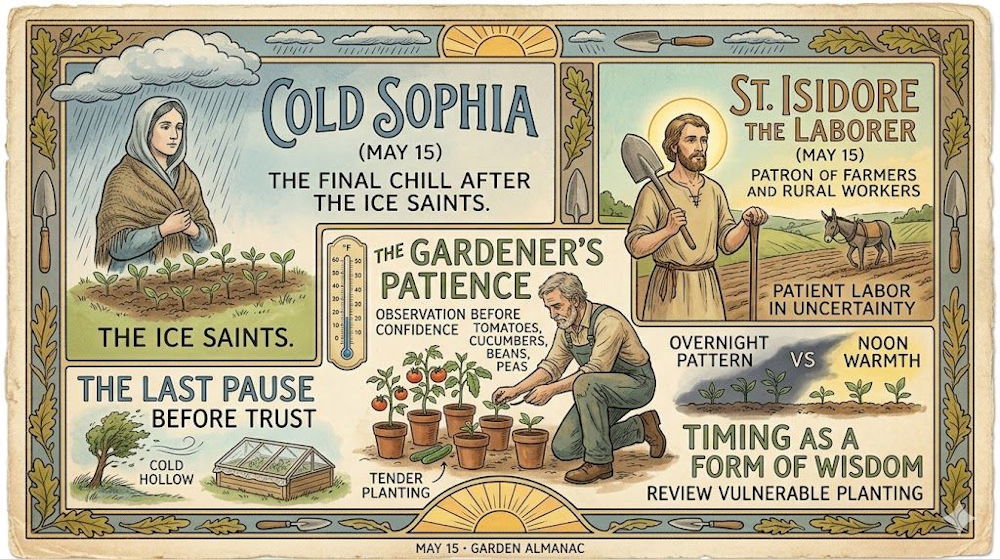

May 15 carries one of spring’s most intriguing aftertones. The better-known Ice Saints may have already passed, but in many central European traditions, Sophia still lingers as a final possibility of chill, rain, or a colder turn. In the Garden Almanac, this makes the day feel like an echo: not the main warning, but the one that arrives just when relief seems ready to settle in.
That is exactly why the date matters. Gardeners are often most vulnerable to misjudgment when they believe the difficult part is over. Sophia’s day preserves the memory that spring does not always end its tests neatly.
Sophia After the Ice Saints
Traditions around “Cold Sophia” survive because they express a real seasonal feeling. Mid-May may already look secure, yet a cool, damp, or sharply changed day can still unsettle tender growth. The danger is not always frost in the dramatic sense. Sometimes it is simply the final interruption of momentum.
This makes May 15 a useful almanac date. It reminds us that confidence should arrive one step behind observation.
Saint Isidore the Laborer
May 15 is also the feast day of Saint Isidore the Laborer, patron of farmers and rural workers. This gives the day a beautiful counterweight. Sophia represents the uncertainty of the season; Isidore represents the steady, faithful labor that continues through uncertainty.
In an international Garden Almanac, that pairing works especially well. The garden is never governed by weather alone, nor by effort alone. It depends on both the mercy of conditions and the constancy of work.
The Last Pause Before Trust
By this point in May, gardeners want to move freely. Beans, peas, cucumbers, tomatoes, vines, and all tender planting seem ready to claim the season. Yet this date suggests one final pause, especially where cold hollows, exposed sites, or damp nights still play a role.
The lesson here is not hesitation for its own sake. It is timing as a form of wisdom.
What This Day Suggests in Practice
May 15 is a good day to review the most vulnerable planting one last time, watch the overnight pattern rather than the noon warmth, and notice where the garden still behaves more like spring than early summer. It is also a fitting moment to honor the patient labor that gardening asks for – the kind that keeps working even while the weather remains uncertain.
In the Garden Almanac, this is the day when the season glances back once more at cold before finally leaning into growth.