
By July 24, high summer has become impossible to ignore. In many gardens, the early rush of spring growth has settled into a more demanding rhythm: watering, deadheading, harvesting, mulching, watching for stress, and noticing which plants are thriving while others begin to tire.
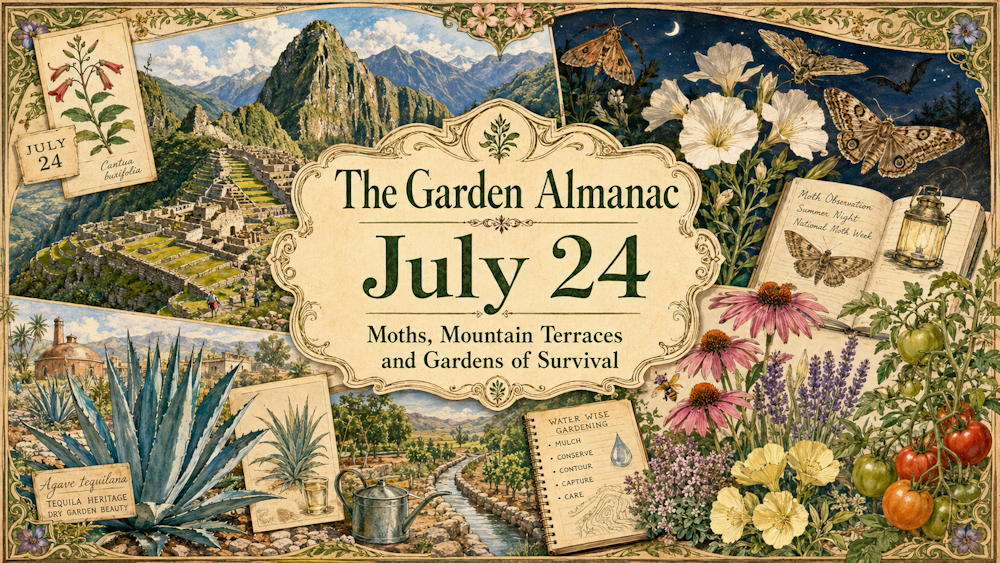
It is also a day that opens several unexpected doors. July 24 carries us from the stone terraces of the Andes to night gardens alive with moths, from dry valleys shaped by irrigation to the blue-green architecture of agave. Taken together, these stories ask a very practical gardening question: how do people, plants and landscapes endure heat, scarcity and change?
This is not a quiet date in the garden calendar. It is a reminder that some of the most beautiful landscapes are also working landscapes, and that good gardening often begins with careful observation.
July 24, 1911 – Machu Picchu and the Genius of Terraced Gardening
On July 24, 1911, Hiram Bingham reached Machu Picchu, the high Andean site that would become one of the most famous archaeological landscapes in the world. Long known to local people, the city entered global attention through this expedition, and with it came renewed fascination with Inca engineering, mountain settlement and agriculture at altitude.
For gardeners, Machu Picchu is not only a romantic ruin. It is also a lesson in how intelligently people can shape difficult land. Its terraces were not decorative steps laid across a mountainside; they were practical systems for holding soil, managing water, preventing erosion and creating usable growing space on steep slopes.
Terracing changes the relationship between rain and soil. Instead of allowing water to rush downhill, carrying nutrients with it, a terrace slows water, gives it time to soak in and protects the root zone. In mountainous regions, this can mean the difference between cultivation and collapse.
The same principle applies in smaller gardens. A sloping backyard, a bank beside a path or a raised vegetable bed on uneven ground all benefit from the same idea: slow the water, hold the soil, protect the roots. Stone edges, contour planting, mulch bands and small retaining walls can all echo ancient wisdom in a modern garden.
Garden Reminder – What Can Terraces Teach a Modern Gardener?
If your garden has a slope, even a gentle one, July is a good time to watch how water behaves during summer storms or irrigation.
- If water runs off quickly, add mulch, low edging or contour planting.
- If soil collects at the bottom of a slope, erosion is already happening.
- If plants dry out faster on raised or exposed areas, group drought-tolerant species there.
- If paths channel water, redirect runoff into planted beds rather than drains.
- On steep ground, avoid bare soil wherever possible.
A garden does not need to be ancient or dramatic to need good water design. Sometimes the most important landscape engineering begins with noticing where the first trickle of water goes.
National Moth Week – The Night Shift of the Garden
In late July, many countries take part in National Moth Week, a citizen-science celebration held during the last full week of the month. July 24 often falls right in the heart of it, making this date a perfect invitation to look beyond butterflies and notice the quieter pollinators of the night.
Moths are often underestimated because they work when people are indoors. Yet many species pollinate flowers, feed birds and bats, and serve as sensitive indicators of habitat quality. Their caterpillars are also part of the food web that supports nesting birds, especially when young birds need protein-rich prey.
A moth-friendly garden is not complicated, but it does ask for a slight shift in habits. Night-scented flowers, native plants, relaxed edges and reduced artificial light can all make a difference. Plants such as evening primrose, honeysuckle, nicotiana, jasmine, phlox and many native meadow species may draw activity after dusk.
The most useful observation a gardener can make is simple: go outside after sunset and look. A white wall, a sheet hung near a gentle light, or a flowering border on a warm evening can reveal an entire layer of garden life usually missed.
Wildlife Note – How Can You Help Moths in a Summer Garden?
Moths need more than flowers. They need shelter, larval food plants and safe night conditions.
- Leave a few quiet, less-tidy corners with leaf litter or longer grass.
- Grow some native plants that support caterpillars, not only nectar flowers.
- Reduce unnecessary outdoor lighting, especially bright white lights.
- Avoid spraying insecticides in the evening, when many insects are active.
- Let some herbs and perennials flower instead of cutting everything back at once.
A garden that supports moths often supports much more: bats, birds, beetles, lacewings and the whole living fabric that makes a garden resilient.
July 24, 1847 – Pioneer Day and the Question of Water
In Utah, July 24 is Pioneer Day, marking the arrival of Mormon pioneers in the Salt Lake Valley in 1847. The history is complex and rooted in migration, settlement, hardship and cultural identity, but from a gardening and landscape perspective, it also raises one of the central questions of dryland life: how do people grow food where water is limited?
The Salt Lake Valley is not a lush, forgiving landscape in the way many European garden traditions imagine fertility. Cultivation there required attention to irrigation, timing, soil and communal water use. The broader story of settlement in arid regions is inseparable from canals, ditches, rights, conflicts and adaptation.
For today’s gardeners, that history feels increasingly relevant. Hotter summers and less predictable rainfall mean that many gardens now face questions once associated mainly with dry regions. How much lawn is sensible? Which plants are worth watering? How can soil hold more moisture? Where should shade be created?
The lesson is not simply to water more. It is to garden more intelligently. Deep watering is usually better than frequent shallow sprinkling. Mulch protects soil from heat. Organic matter improves water retention. Shade trees, if chosen well, can reduce heat stress for both plants and people. In dry summers, a garden becomes a water budget written in leaves.
Seasonal Tips – Watering Wisely in Late July
Late July watering should support root health, not just fresh-looking foliage.
- Water early in the morning so leaves dry quickly and less moisture is lost to evaporation.
- Give vegetables and young trees deep soakings rather than brief daily sprays.
- Mulch around tomatoes, peppers, courgettes, fruit bushes and newly planted ornamentals.
- Check containers daily, especially in wind or full sun.
- Prioritize newly planted trees, food crops and stressed perennials before established drought-tolerant plants.
If a plant wilts slightly in the afternoon but recovers by morning, it may be responding normally to heat. If it stays limp overnight, the root zone needs attention.
National Tequila Day – Agave, Patience and Dry Garden Beauty
July 24 is also widely marked as National Tequila Day, and while that may sound more like a bar calendar than a garden almanac, its plant story is too good to ignore. Tequila begins with blue agave, a plant adapted to sun, heat and dry conditions with remarkable efficiency.
Agaves are not cacti, though they are often grouped with them in popular imagination. They are succulents, storing water in thick leaves and using strategies that help them survive in tough climates. Many agaves grow slowly for years before flowering, investing patiently in structure, storage and survival.
For gardeners, agave offers a useful reminder: drought-tolerant plants are not “no-care” plants. They need the right drainage, the right exposure and protection from the wrong kind of wet. In regions with cold, rainy winters, many succulents suffer less from low temperature itself than from waterlogged soil around the roots.
The agave story also points toward a wider design idea. Dry gardens do not have to look sparse or lifeless. Silver leaves, architectural rosettes, gravel mulches, aromatic herbs, ornamental grasses and drought-adapted perennials can create rich, textured plantings that use water carefully.
Garden Science – Why Do Succulents Handle Heat So Well?
Many succulents survive dry weather by storing water in leaves, stems or roots. Some also use a photosynthetic strategy that allows them to open their pores mostly at night, reducing water loss during the heat of the day.
This does not mean they enjoy every stressful condition. In gardens, the most common mistake is combining drought-adapted plants with heavy, wet soil. Good drainage is often more important than extra feeding.
For container-grown succulents, use a gritty, free-draining mix, choose pots with drainage holes and avoid leaving them standing in saucers of water after rain.
What to Observe Right Now – The Garden in Its High-Summer Test
Around July 24, the garden is honest. Spring promises have either matured into strong growth or revealed weak spots. Some plants are flowering generously; others are showing scorch, mildew, pest pressure or drought stress.
This is the perfect moment to observe before making big decisions. Which border still looks good in heat? Which plants need too much rescue? Where does the soil crack? Which flowers are still attracting bees, hoverflies, butterflies and moths?
Look especially for these high-summer clues:
- Bees visiting herbs such as thyme, oregano, mint, basil and lavender.
- Birds searching for insects among shrubs and hedges.
- Leaves curling during the hottest hours, then recovering at night.
- Bare soil heating up faster than mulched beds.
- Evening fragrance from flowers that attract night pollinators.
- Fruit trees dropping some fruit naturally during stress.
These observations are not small details. They are the garden’s midseason report.
Looking Ahead
July 24 brings together four different kinds of wisdom: the terraced patience of mountain farmers, the hidden labor of moths, the water discipline of dryland settlement and the slow strength of agave. Each story points toward the same future-facing idea: good gardening is not only about what we plant, but how well we understand the conditions around it.
A resilient garden slows water, protects soil, feeds wildlife and chooses plants with climate in mind. It leaves room for beauty, but also for function. It notices the night pollinators as well as the showy flowers, the roots as well as the blooms, the slope of the land as well as the view.
As summer deepens, July 24 invites us to garden with sharper eyes. The next step may be as simple as adding mulch, changing a watering habit, planting for moths, or looking at a dry corner not as a failure, but as the beginning of a better-adapted garden.