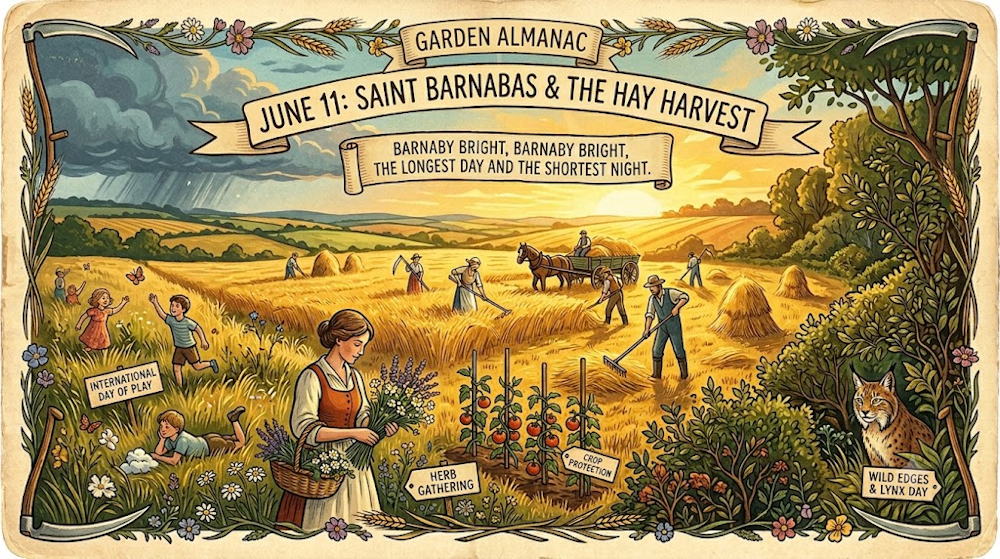

June 11 brings Saint Barnabas into the Garden Almanac with hayfields, long light, weather risk, herbs, meadows, children’s play and the living edges of the countryside.
In Hungarian folk tradition, Barnabas was remembered as “hay-cutting Barnabas,” a calendar marker for the time when meadows had to be watched closely. In English rural tradition, Saint Barnabas’ Day also carried echoes of haymaking and old midsummer light. The day belonged to grass, weather, work and brightness.
Saint Barnabas and the Season of Hay
Barnabas is known in Christian tradition as a companion of Saint Paul and as a figure of encouragement. His name is often interpreted as “son of consolation” or “son of encouragement,” which feels strangely fitting for early summer.
By June 11, the countryside is full of promise, but not yet secure. Grass may be ready for cutting. Grapes may be forming. Fruit is swelling. Herbs are at their most fragrant. Yet hail, rain, heat, pests or poor timing can still change everything.
This is the season when hope becomes work.
Haymaking is one of the clearest examples. A meadow standing in grass is not yet winter security. It must be cut at the right time, dried, turned, gathered and stored. If rain comes at the wrong moment, quality can fall quickly. If the cut is delayed too long, the feed may lose value.
Hay is sunshine stored for winter.
“Barnaby Bright” and Old Midsummer Light
In English tradition, Saint Barnabas’ Day is linked with the old saying:
“Barnaby bright, Barnaby bright,
The longest day and the shortest night.”
This belongs to the older calendar world, when Saint Barnabas’ Day fell close to what was understood as midsummer. Even after calendar reforms shifted dates, the phrase preserved a memory of long light and short nights.
For the Garden Almanac, this is a beautiful image. Barnabas stands at the bright edge of summer: a time when the day feels almost endless, grass dries in the sun, and work stretches late into the evening.
Light matters in a garden. It ripens fruit, dries hay, strengthens herbs, shapes flowering and governs the rhythm of people working outdoors.
Hay Was Winter Security
In modern imagination, hay can look picturesque. In rural life, it was practical survival.
Good hay meant feed for animals. Feed meant milk, strength, manure, transport, warmth, income and continuity. A poor hay season could echo through winter. A successful one brought relief before the cold months even arrived.
This is why haymaking was surrounded by attention and anxiety. The weather had to be read carefully. A few dry days could be a gift. A sudden storm could spoil the work.
Saint Barnabas’ Day reminds us that farming and gardening have always depended on timing. Nature gives generously, but rarely on our schedule.
Weather, Hail, and Early Summer Risk
Saint Barnabas was also invoked in some traditions against hail. That makes sense in the agricultural imagination of June.
Hail is one of the cruelest early-summer threats. It can shred leaves, bruise fruit, damage vines, flatten young crops and ruin work in minutes. Rain can be welcome, but hail is a different story: sudden, violent and often local.
The same sky that dries hay can darken into storm.
In a garden, June 11 is therefore a good day to look at vulnerability. Are tomatoes tied? Are young plants protected? Are vines too dense? Are fruit trees carrying damaged branches? Is harvested material stored before weather turns?
The bright edge of summer is beautiful, but it is not without risk.
Herbs Gathered in Dry Weather
Barnabas’ Day also fits the old practice of gathering herbs in early summer. Many aromatic and medicinal plants are strong in June, but good gathering requires judgment.
Collect only plants you know with certainty. Choose clean places away from pollution and spray drift. Wait until dew has dried. Avoid wet weather. Take modestly, leaving enough for the plant and for wildlife. Dry herbs in a shaded, airy place rather than scorching them in harsh sun.
A herb gathered well is a small act of preservation. It carries June into darker months.
The herb shelf, like the hayloft, is a memory of summer stored for later need.
The International Day of Play
June 11 is also the International Day of Play, a modern observance that brings another layer to the Garden Almanac.
Meadows and gardens are not only places of work. They are also places where children first learn the living world: the feel of grass, the sound of insects, the danger of nettles, the smell of crushed mint, the surprise of a beetle, the patience of watching clouds, the risk of mud, the shelter of a tree.
Outdoor play teaches before words do.
A child in a garden learns weather, texture, care, caution and wonder. They learn that living things are not toys, but companions in a shared place. They learn that a meadow can be both work and joy.
This belongs beautifully beside Saint Barnabas. Hayfields feed animals, but they also live in memory as places of running, hiding, lying in the sun and watching the sky.
International Lynx Day and the Wild Edge
June 11 is also marked by some conservation calendars as International Lynx Day, drawing attention to one of Europe’s most elusive wild cats and the habitats it needs.
The lynx brings a wilder note to the day. It reminds us that healthy landscapes are mosaics: meadows, woods, edges, corridors, shelter and quiet places where animals can move unseen.
A hay meadow is not separate from the wild world. It belongs to a wider pattern. Where fields meet woodland, where hedges connect places, where rough edges remain, life has more chances.
In the garden, this lesson is small but real. Not every edge must be tidied into silence. A hedge, a rough strip, a log pile, a meadow patch, a wilder corner can all become part of a living network.
The Bright Work of June
June 11 gathers many kinds of work: haymaking, herb gathering, weather watching, protecting crops, storing summer, making room for play, and remembering the wild edges beyond the cultivated plot.
It is a day of brightness, but not laziness. A day of long light, but also urgency. The meadow will not wait forever. The storm may come. The herbs must be gathered at the right moment. The child should be allowed outside while the evening is still golden.
Saint Barnabas stands in the Garden Almanac as a figure of encouragement at a demanding time of year.
What June 11 Teaches
June 11 teaches that summer’s abundance must be handled with care.
- Grass must become hay.
- Light must be used before weather changes.
- Herbs must be gathered wisely.
- Children need time outdoors.
- Wild edges need room.
- Gardens need both work and wonder.
In the Garden Almanac on this day, Saint Barnabas brings together hayfields, midsummer brightness, storm risk, stored herbs, outdoor play and the living line between cultivated and wild.
The lesson is simple: what we tend in June may sustain us long after summer has passed.