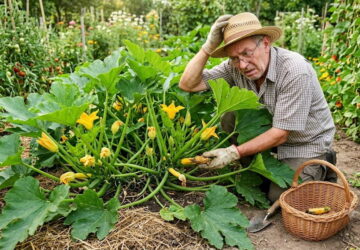

By July 21, the garden is no longer tentative. Summer has settled into the leaves, the soil has given up much of its spring moisture, and every plant seems to be making its case for either endurance or collapse. Tomatoes are swelling, herbs are flowering, lawns are tiring, and containers need more attention than their cheerful appearance suggests.
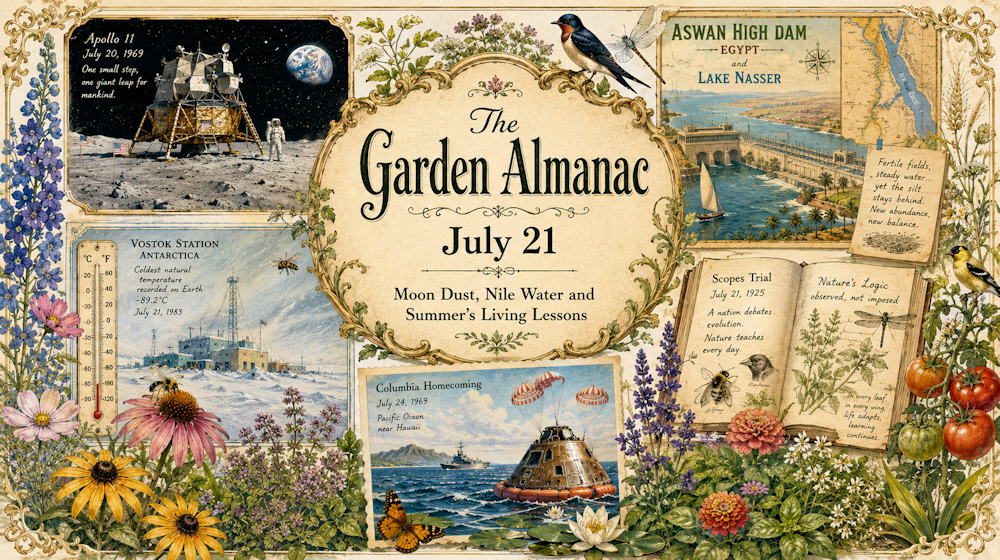
It is a good date, then, for thinking about limits. On this day, human beings first walked on the Moon. Engineers completed one of the most ambitious and controversial water-control projects in modern history. Scientists recorded the lowest officially measured air temperature on Earth. And a courtroom in Tennessee brought evolution into public argument.
At first glance, these stories seem far from the vegetable patch or flower border. But July 21 is full of garden lessons: how soil supports life, how water changes a landscape, how climate defines what can grow, and why understanding nature matters more than merely admiring it.
July 21, 1969 – First Footsteps on Another World
Neil Armstrong stepped onto the lunar surface at 10:56 p.m. EDT on July 20 in the United States, which was already July 21 in much of the world. NASA describes Apollo 11’s landing as a tense achievement: Armstrong manually guided the lunar module past boulders, and Eagle touched down with only seconds of fuel remaining before he and Buzz Aldrin explored the surface for about two and a half hours.
For gardeners, the Moon landing is more than a heroic space story. It is also a reminder of what Earth provides so quietly that we barely notice it: living soil, liquid water, breathable air, microbial partners, weathered minerals and a protective atmosphere.
Lunar dust may look like soil, but it is not soil in the garden sense. Soil is a living system. It contains mineral particles, organic matter, fungi, bacteria, roots, water and air spaces. It stores nutrients, drains excess water, shelters organisms and makes plant life possible. The Moon gave humanity a new view of Earth, but it also made the garden look miraculous.
A few years later, the Apollo program even gained a tree story of its own. During Apollo 14, astronaut Stuart Roosa carried tree seeds around the Moon. NASA notes that the seeds included loblolly pine, sycamore, sweetgum, redwood and Douglas fir; many later germinated and became “Moon Trees” planted on Earth. They did not become strange space-mutated giants. They became trees – which is perhaps the lovelier result.
The Apollo 11 story itself ended safely three days later. Armstrong, Aldrin and Collins returned to Earth on July 24, 1969, when the command module Columbia splashed down in the Pacific Ocean, southwest of Hawaii. For a garden almanac, it is a fitting place to leave the Moon story: with three explorers coming home to the only world we know where sunlight can become seeds, leaves, flowers and fruit.
Garden Science – Is Garden Soil Just “Dirt”?
No. Productive garden soil is an ecosystem.
- Mineral particles provide structure and hold some nutrients.
- Organic matter improves water retention, drainage and microbial activity.
- Fungi and bacteria help cycle nutrients into forms plants can use.
- Air spaces around roots are essential; waterlogged soil can suffocate plants.
- Mulch protects the surface from heat, crusting and erosion.
In late July, the best soil care is often quiet care: mulch bare ground, avoid digging when soil is wet or baked hard, and water deeply enough to reach the root zone.
July 21, 1970 – The Aswan High Dam and the Price of Controlling Water
On July 21, 1970, after 11 years of construction, the Aswan High Dam across the Nile was completed in Egypt. It helped control floods and droughts, expanded irrigation and generated hydroelectric power, but it also changed the river’s ecology, agriculture and communities in ways that are still debated.
This was not simply a triumph, and not simply a mistake. It was one of the 20th century’s great attempts to make water predictable – and one of its clearest reminders that rivers are not just pipes for moving water. They carry sediment, nutrients, seasonal rhythms, fish, farming traditions and whole ways of living.
The Nile had long brought more than water. Its annual floods carried nutrient-rich sediment onto fields, renewing agricultural land. After the dam altered the river’s flow, much of that sediment was held back in Lake Nasser, and farmers increasingly had to rely on artificial fertilizers. At the same time, year-round irrigation brought its own risks: higher groundwater levels, waterlogging and soil salinity in vulnerable areas.
The social and cultural costs were also significant. Large numbers of people, especially Nubian communities, were displaced by the creation of the reservoir, and archaeological sites had to be moved or were lost beneath the rising water. In modern environmental terms, the Aswan High Dam is a classic lesson in trade-offs: it brought water security and electricity, but it also disrupted a living river system.
This is a large-scale river story, but gardeners know its smaller version. Water is never just water. How it arrives, how long it stays, what it carries and where it drains all matter.
A garden that receives frequent shallow watering may still suffer drought stress because roots remain near the surface. A bed that stays constantly wet may look lush at first, then decline as roots lose oxygen. A container watered every day may still become nutrient-poor if water continually washes soluble nutrients through the potting mix.
Seasonal Tips – Watering Wisely in Late July
- Water early in the morning when evaporation is lower and leaves dry quickly.
- Give fewer, deeper waterings rather than constant surface sprinkling.
- Check containers daily; small pots can dry out in a single hot afternoon.
- Mulch vegetables and ornamentals to reduce temperature swings in the soil.
- Improve tired soil with compost, not only bottled or granular fertilizer.
- Watch for waterlogging after storms; roots need oxygen as much as moisture.
The Aswan story is a useful warning against thinking of water control as a simple victory. In gardens, too, irrigation works best when paired with soil structure, organic matter, drainage and observation.
July 21, 1983 – The Coldest Air Officially Measured on Earth
On July 21, 1983, Vostok Station in Antarctica recorded −89.2°C, widely cited as the lowest directly measured surface air temperature on Earth.
In a July garden, that number feels almost unreal. Yet it belongs to the same planet as our sun-warmed tomatoes and dry lawns. It also reminds us that plants are always negotiating temperature: not only the dramatic extremes of Antarctica, but the smaller extremes of a garden wall, a balcony, a greenhouse, a paved courtyard or a windy corner.
Microclimates decide what succeeds. A south-facing wall may ripen figs or grapes where an open bed would struggle. A shaded, damp corner may suit ferns and hostas but frustrate lavender. A paved terrace can become hot enough to stress container roots even when the air temperature seems manageable.
Garden Reminder – How to Read Your Garden’s Microclimates
Look for patterns rather than isolated problems.
- Wilting every afternoon may mean heat stress, not simply lack of water.
- Yellowing in wet soil may point to poor drainage and low root oxygen.
- Crispy leaf edges on containers often signal hot roots and irregular watering.
- Powdery mildew often appears where air movement is poor.
- Earlier flowering near walls or paths can reveal stored heat.
A thermometer tells part of the story. Leaves, roots and soil tell the rest.
July 21, 1925 – The Scopes Trial and Why Nature Education Matters
On July 21, 1925, schoolteacher John T. Scopes was convicted in Tennessee for violating a law against teaching evolution in public schools. The trial became one of the best-known public debates over science, education and the natural world.
A gardening magazine does not need to turn this into a courtroom drama. But the connection to gardens is real. Every garden is shaped by evolution: pollinator relationships, plant defenses, seed dispersal, pest resistance, drought tolerance, flower form and fruit development.
When we understand that plants and insects have long, changing relationships, we garden more intelligently. We stop seeing every caterpillar as an enemy and every weed as meaningless. We begin to notice which flowers attract solitary bees, which seedheads feed birds, which pests appear after stressed growth, and why diversity often creates resilience.
Wildlife Note – What Are Pollinators Doing in Late July?
In many temperate gardens, late July is a busy feeding period for bees, butterflies, hoverflies and other insects.
Good plants for this season often include:
- oregano, thyme, mint and other herbs allowed to flower
- echinacea, rudbeckia, salvia and verbena
- cosmos, zinnia and single-flowered dahlias
- clover or flowering lawn patches where suitable
- native late-summer perennials adapted to the region
Avoid cutting every spent flower at once. A garden with staggered bloom, seedheads and a few wilder edges offers far more support than a perfectly cleared border.
July Flowers – Larkspur, Water Lily and the Two Faces of Summer
July’s traditional birth flowers are often listed as larkspur and water lily. They make a useful pair for this date: one rising in airy spires, the other floating on still water.
Larkspur and delphinium relatives remind gardeners of vertical drama, but also of the need for decent soil, support and steady moisture in hot spells. Water lilies speak for a different kind of gardening altogether: ponds, reflective surfaces, aquatic planting and the ecological value of water in a garden.
A small pond, even without fish, can change a garden’s life. It may attract dragonflies, provide drinking water for birds and support amphibians if managed gently. The point is not to install a grand feature, but to understand that water creates habitat when it is clean, accessible and planted with care.
What to Observe Right Now
Take ten quiet minutes in the garden this week and look for summer’s signals.
- Which plants recover after evening, and which remain stressed?
- Where does the soil stay moist longest after watering?
- Are bees visiting many plant species, or only one or two?
- Which flowers are setting seed?
- Are birds feeding on insects, berries or seedheads?
- Does one corner of the garden feel noticeably hotter, cooler, drier or more sheltered?
These observations are not chores. They are the gardener’s weather report, soil test and wildlife survey in miniature.
Looking Ahead
July 21 gathers some unusually large stories: a footprint on the Moon, a dam across the Nile, a temperature record from Antarctica, and a public argument over evolution. Yet each one leads back to the same practical truth: life depends on conditions.
Gardening well means learning those conditions closely. Soil is not just a surface. Water is not just an input. Climate is not just a forecast. Biodiversity is not just decoration. Each is part of the living system that decides whether a garden merely survives or genuinely thrives.
The hopeful lesson of this date is that observation changes everything. When we look carefully, we water better, plant better, protect more wisely and make room for life beyond our own plans. A garden may be small, but it is still Earth in practice – and on July 21, that feels like more than enough.