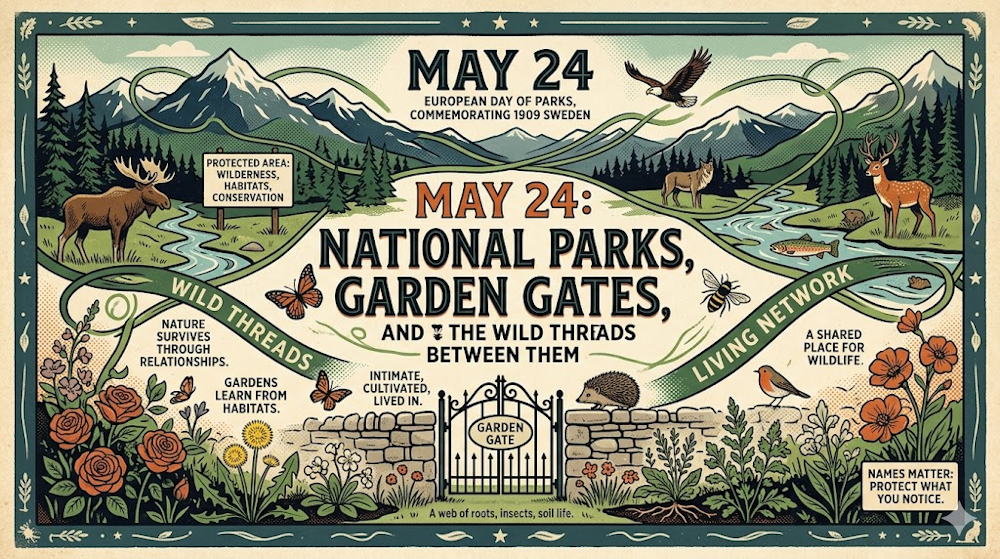

May 24 opens the Garden Almanac wide. It is the European Day of Parks, a day that remembers the creation of Europe’s first national parks in Sweden in 1909 and celebrates protected areas across the continent.
At first glance, a national park and a home garden seem to belong to different worlds. One is wide, protected, mapped and managed for conservation. The other is intimate, cultivated, pruned, planted, watered and lived in. Yet the two are connected by a simple truth: nature survives through relationships.
The Day Europe Began Protecting Parks
The European Day of Parks has been marked on May 24 since 1999. It commemorates the day in 1909 when Sweden created Europe’s first national parks. Since then, protected areas have become essential places for biodiversity, landscape memory, research, education and human renewal.
A national park protects more than scenery. It protects systems: wetlands with their birds, grasslands with their insects, forests with their soils, rivers with their banks, mountains with their fragile plant communities. It protects the relationships that make a place alive.
That same idea matters in a garden.
A healthy garden is not a collection of isolated plants. It is a web of roots, insects, fungi, birds, soil organisms, water, shelter, shade and human choices. When one part changes, other parts respond.
Connected by Nature
The great message of protected areas is connection. Parks cannot thrive as lonely islands. Wildlife needs corridors, linked habitats, safe movement and landscapes that allow species to adapt. A meadow, a hedgerow, a stream, a woodland edge, a garden and a roadside verge can all become part of a wider living network.
Gardeners are part of that network whether they think about it or not. A bee does not stop at a property line. A bird does not care where one garden ends and the next begins. A hedgehog needs gaps more than fences. A butterfly needs flowers in more than one place.
This is where the home garden becomes unexpectedly important. It may be small, but it can still be useful. A flowering herb, a water dish, a native shrub, a compost heap, a patch of unmown grass or a pesticide-free corner can help connect life across a neighborhood.
A Garden Is Not a Park, But It Can Learn From One
A garden does not need to become wild in order to become more alive. It needs variety, patience and a little tolerance.
National parks teach us to look at habitats, not just individual species. In the garden, that means asking better questions. Where can insects shelter? Where can birds feed? Where does water go after rain? What flowers are available in early spring, midsummer and autumn? Is the soil covered, fed and protected? Is every fallen leaf really waste?
These questions change the way a garden is seen. A log pile becomes habitat. A hedge becomes a nesting place. A dandelion becomes early food. A compost heap becomes a living engine. A less tidy corner becomes an invitation.
Saint Sarah and the Wetlands of the Camargue
May 24 is also associated with Saint Sarah, venerated by many Romani communities at Saintes-Maries-de-la-Mer in the Camargue of southern France. The annual pilgrimage belongs to culture and faith, but it also takes place in a remarkable landscape of wetlands, lagoons, horses, birds, salt air and open horizons.
This is a beautiful reminder that landscapes are not only ecological spaces. They are cultural spaces too. People carry stories through them. Names, songs, routes, rituals and memories become part of how a place is known.
The same is true in gardens. A plant may be kept because it feeds bees, but also because it came from a grandmother’s garden. A tree may give shade, but also hold family memory. A herb may be useful in the kitchen, but also carry the scent of childhood.
Conservation is never only about species lists. It is also about belonging.
Cyril, Methodius, and the Language of Landscape
In some Eastern Christian traditions, May 24 is linked with Saints Cyril and Methodius, remembered for their role in Slavic literacy and culture. Their presence in the calendar offers a quiet garden thought: language helps us protect what we notice.
Names matter. When people know the words for meadow, marsh, hedge, coppice, orchard, reedbed, floodplain and woodland edge, they see more than empty land. They see habitats. When gardeners learn the names of plants and pollinators, they begin to understand relationships.
A named thing becomes harder to ignore.
Small Places, Larger Care
The European Day of Parks can inspire a trip to a national park, but it can also inspire a different kind of attention at home.
Plant for pollinators. Keep soil covered. Leave seed heads for birds. Let some herbs flower. Add water safely for insects and birds. Avoid unnecessary chemicals. Keep a small wild corner. Make fences passable for small animals where possible. Choose plants that feed more than the eye.
None of these gestures replaces protected areas. But together, they help weave a more generous landscape.
What May 24 Teaches
May 24 teaches that nature protection is both large and small. It is Sweden’s first national parks in 1909, Europe’s protected landscapes, wetlands, mountains and forests. It is also the quiet decision to leave a flowering strip in the garden for another week.
The national park may be far away. Its lesson is close.
A garden becomes richer when it stops being only a possession and becomes a shared place. Shared with birds, bees, beetles, fungi, worms, flowers, rainwater, shade and the many lives that do not ask for ownership, only space.
In the Garden Almanac on this day, the park gate and the garden gate open toward the same idea: protected nature begins with attention.