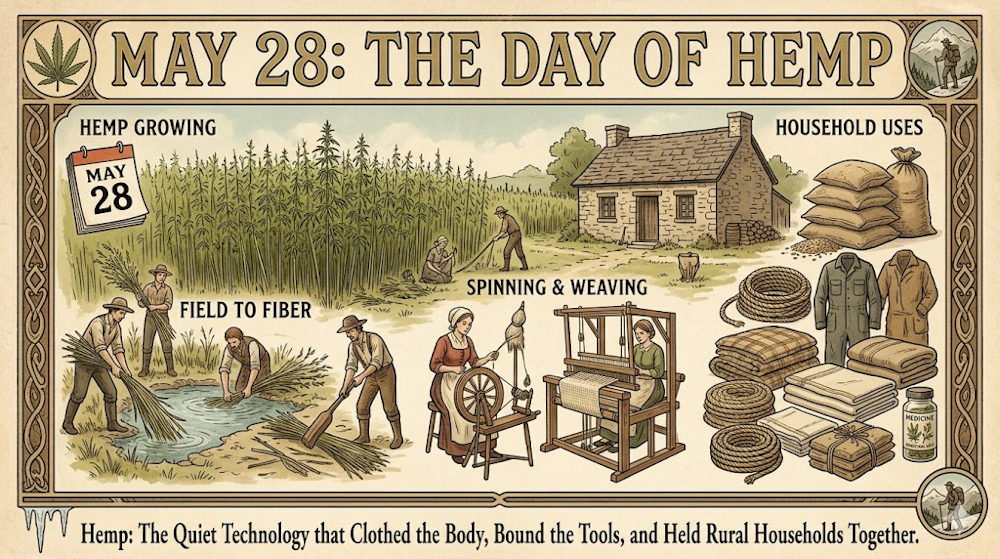

May 28 brings hemp into the Garden Almanac, not as a modern controversy, but as an old household plant. In rural life, hemp was once one of the quiet technologies that held daily life together. It became cloth, sacks, rope, workwear, bedding, bundles, tools and sometimes even folk medicine.
A date in the calendar could decide more than a sowing task. It could decide the future of household cloth.
The Day When Hemp Was Too Late
In some folk calendars, May 28 was remembered as a day when hemp should no longer be sown. The belief was that hemp planted after this point would not grow properly and would not produce a satisfactory crop.
This was not only about whether the seed would germinate. Hemp grown for fiber needed long, straight, strong stems. The quality of the future cloth began with the timing of the sowing, the condition of the soil and the strength of the plant.
A late sowing could mean weak growth. Weak growth could mean poorer fiber. Poorer fiber could mean less useful thread, cloth, rope and household material.
In that sense, the rule carried practical memory inside a folk warning.
Hemp as Household Security
Hemp was once an essential fiber plant across many rural households. It was not grown for novelty. It was grown because people needed it.
From hemp came cloth for clothing, bedding, table linen, sacks, bundles, work garments, ropes and cords. The plant connected the field to the loom, the loom to the household, and the household to daily survival.
A piece of homespun hemp cloth was never just cloth. It was soil, seed, weather, pulling, retting, drying, breaking, combing, spinning and weaving. It was the work of seasons held in the hand.
From Field to Fiber
Hemp demanded a long chain of labor. After sowing and growing came pulling, often done by hand. Then the stems were retted so that the fibers could separate. They were dried, broken, scutched, hackled, spun and woven.
Each step required skill. Too little retting, and the fibers would not separate well. Too much, and the material could weaken. Breaking and combing required strength and rhythm. Spinning and weaving required patience and trained hands.
The finished cloth carried the memory of all this work.
This is why the sowing date mattered. The plant’s future did not end in the field. It continued into clothing, bedding, storage, transport and domestic life.
Folk Beliefs Around Long Stems
Hemp attracted many beliefs because its success mattered. People wanted tall, strong stems and good fiber, so they watched signs and built rituals around the crop.
In folk belief, long icicles in late winter could promise long hemp later in the year. The image is beautiful: winter’s frozen length becoming a sign of summer’s green length.
Other customs surrounded the act of sowing itself. Some traditions claimed that silence, special vessels or unusual behavior during sowing could help secure long fiber. Such beliefs may seem strange now, but they reveal a deep anxiety and hope around a crop that was too important to leave entirely to chance.
Hemp Seed in Folk Medicine
Hemp also appeared in folk healing. In some village traditions, hemp seed was used as a remedy against intestinal worms, especially for children. Similar practices could be extended to animals, including horses, sometimes mixed with other substances believed to strengthen the effect.
These practices should be read as folk medical history, not modern medical advice. But they show how rural households thought about plants: not as single-purpose items, but as many-sided resources.
A useful plant could feed, clothe, bind, heal, protect, store and symbolize.
Rain on the Forbidden Sowing Day
May 28 also carried weather lore. Rain on this day could be seen as a promise of abundance. This creates a lovely tension: hemp should not be sown now, but rain might still bless the wider season.
For rural people, rain was never simply bad weather. It could interrupt work, but it could also save crops. By late May, gardens, fields, orchards and meadows all needed moisture. A well-timed rain could become hope falling from the sky.
The calendar did not only tell people what to do. It taught them how to read the weather as a sign.
Saint Bernard and the Materials of Survival
May 28 is also associated in Christian calendars with Saint Bernard of Menthon, remembered in connection with Alpine passes, travelers and mountain refuges. At first this seems far from hemp fields, but there is a quiet link.
Old travel and rural work depended on durable materials: sacks, ropes, rough cloth, packs, covers and work garments. Plant fibers helped people carry, tie, cover, repair and endure.
Hemp was one of the materials that made practical life possible.
A mountain shelter and a strong hemp sack may seem unrelated, but both belong to the same old world of survival through useful, lasting things.
What May 28 Teaches
May 28 teaches that plants once stood at the center of household self-reliance in ways modern life can easily forget. Hemp was not just a crop. It was future cloth. It was workwear. It was bedding. It was rope. It was storage. It was labor transformed into material.
The folk warning not to sow hemp after this day reminds us that timing mattered because everything was connected. Field, weather, fiber, work, household and memory all depended on one another.
In the Garden Almanac on this day, hemp becomes a reminder of an older material wisdom: what grows from the soil may one day clothe the body, carry the harvest, bind the tools and hold a household together.