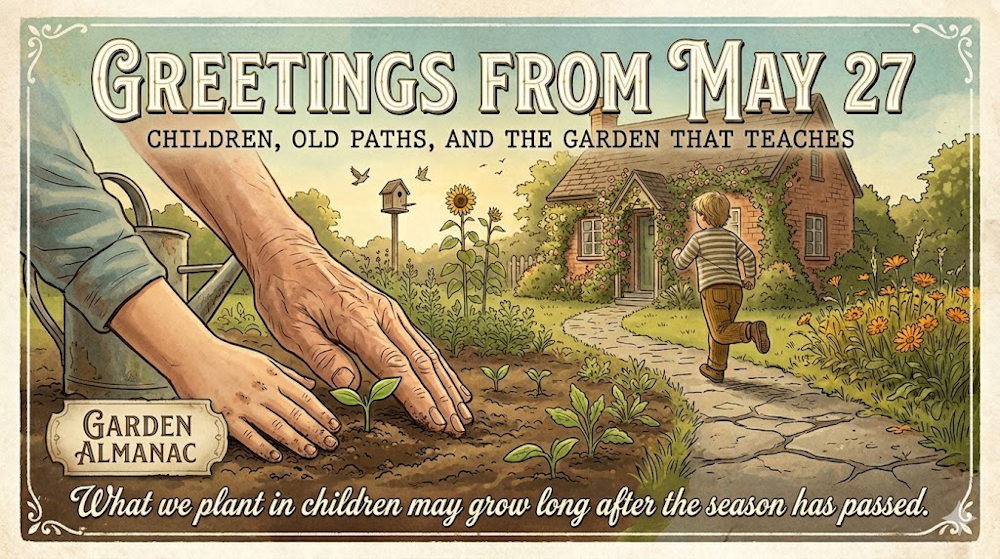

May 27 is a quieter day in the Garden Almanac. It is not centered on one plant, one harvest custom or one dramatic piece of weather lore. Instead, it gathers several threads into a gentle lesson: gardens teach, land remembers, and what we plant in children may grow long after the season has passed.
By late May, the garden is full of instruction. Seedlings show patience. Compost shows transformation. Birds show return. Roots show commitment. Weeds show persistence with frankly unnecessary confidence. The garden does not lecture, but it teaches constantly.
Augustine of Canterbury and New Roots
May 27 is the feast day of Augustine of Canterbury in several Christian calendars. Augustine travelled from Rome and became an important figure in the early Christian history of England. In the Garden Almanac, the most useful image is not institutional history, but the journey itself: arrival, adaptation, teaching and new roots.
Gardens understand this kind of story. A plant is moved from one place to another. At first, it may droop, hesitate or look offended by the entire idea. Then, if soil, water, light and care are right, it begins again. It sends out roots. It becomes part of the place.
New roots are never instant. They require trust and time.
The same is true of people, ideas and traditions. What arrives from elsewhere may need patience before it belongs. A garden is one of the gentlest places to learn that belonging is not always immediate, but it can grow.
Children’s Day and the Living Classroom
May 27 is Children’s Day in Nigeria, a day associated with children’s rights, care, education and celebration. In the Garden Almanac, it becomes a reminder that gardens are among the oldest classrooms humans have.
A child in a garden learns with the whole body. Soil under fingernails. Water in a small can. Seeds dropped too close together. Radishes pulled too early. Peas eaten before anyone else gets a chance. Worms discovered with equal parts horror and fascination.
These are not small lessons. They teach cause and effect, patience, responsibility, curiosity and care.
A seed does not grow faster because a child is impatient. A plant does not survive if forgotten. A worm is not an enemy. A puddle may contain a whole world. The garden teaches without needing a blackboard.
Show, Do Not Only Forbid
Many adults begin a child’s garden education with the word “don’t.” Don’t step there. Don’t pull that. Don’t pick it yet. Don’t dig that up. Sometimes the warning is necessary. But if the garden becomes only a place of prohibition, children learn that it belongs to adults.
A better garden gives them a place inside it.
A pot of their own. A row of peas. A sunflower. A few beans. A patch of calendula. A strawberry plant to check every morning with dramatic seriousness. Large seeds are easier for small hands. Fast growers give encouragement. Flowers bring insects and questions.
A child-friendly garden does not need to be perfect. It needs permission: permission to look closely, to make small mistakes, to care for something living, and to feel that the garden is not only to be protected from them, but shared with them.
Land, Memory, and Responsibility
May 27 is also the beginning of National Reconciliation Week in Australia, which runs through June 3. It is a serious time of reflection on shared histories, cultures and responsibilities, especially in relation to Aboriginal and Torres Strait Islander peoples.
The Garden Almanac approaches this with humility. The garden lesson here is simple but important: land is never empty background. Every place has memory. Every landscape has stories, names, uses, losses, paths and relationships that may not be visible at first glance.
A garden, too, has layers. Perhaps there was once an orchard where the lawn now grows. Perhaps an old well is hidden under a cover. Perhaps a tree was planted by someone long gone. Perhaps a plant survives because a neighbor shared it decades ago.
To care for land well, we must first stop treating it as blank space.
The Garden as Relationship
It is easy to speak of “my garden,” “my soil,” “my tree,” “my harvest.” Ownership is part of everyday life. But a garden is also a relationship.
It connects us to weather, insects, birds, water, neighbors, ancestors, children and future caretakers. It asks not only what we want from it, but what kind of attention we bring to it.
The question “What do I want from this garden?” is useful. But another question may be even better: “What has been entrusted to me here?”
That question changes the work. Pruning becomes care. Planting becomes promise. Leaving a wild corner becomes hospitality. Teaching a child becomes continuity.
What Children Remember
A child may forget the exact name of a plant, but remember the feeling of pulling the first carrot. They may forget the instructions, but remember being trusted with a watering can. They may forget which insect was which, but remember that someone knelt down and looked with them.
Garden memories do not always grow visibly at once. They are like seeds underground. Later, they may become respect for food, gentleness toward living things, curiosity about soil, or simply the desire to grow something again.
What we plant in a child can outlive the season.
What May 27 Teaches
May 27 teaches that gardens are not only productive spaces. They are places where belonging, patience and memory take root.
Augustine’s journey speaks of new roots. Children’s Day speaks of care and learning. Reconciliation Week reminds us that land carries history and responsibility. The garden brings all of this into reach.
In the Garden Almanac on this day, a seed in a child’s hand is more than a seed. It is a lesson in time, trust and connection.
What grows from it may not be only a plant.