

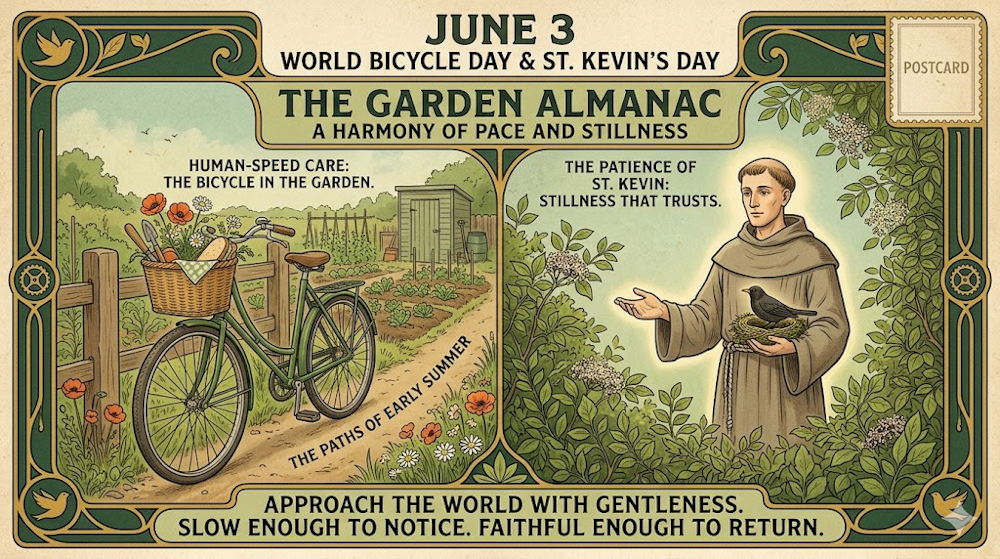

June 3 brings together one of the most grounded modern observances and one of the gentlest legends in the Christian calendar. World Bicycle Day invites us to think about simple, sustainable movement. St Kevin of Glendalough invites us to think about stillness, patience, and a closeness to nature so deep that even a bird could trust it.
Together, they make an ideal Garden Almanac day.
World Bicycle Day and the Pace of Attention
A bicycle changes more than transport. It changes scale.
It moves faster than walking, yet slowly enough to keep us connected to the world we pass through. On a bicycle, the landscape is not a blur. We still notice hedgerows, scent in the air, shifting light, rain clouds building, wildflowers at the roadside, and the subtle changes that mark early summer.
That makes the bicycle especially meaningful in garden life. Whether someone is cycling to an allotment, a community garden, a small orchard, a village plot or a market, the bicycle keeps the body inside the weather and inside the season. It does not separate the traveller from the land.
In early June, this matters. Gardens change quickly now. Soil dries faster. Plants begin to climb, spread and fruit. A short visit in the morning or evening can make all the difference, and a bicycle is perfectly suited to that kind of regular return.
Small Journeys, Everyday Care
The bicycle has long been more than a machine of leisure. In many rural and peri-urban places, it has been a tool of daily life: carrying tools, produce, baskets, cut flowers, milk, seedlings, bread, children, and all the small necessities that connect households to the land around them.
That practical history makes World Bicycle Day feel very much at home in the Garden Almanac. Gardens thrive on repeated small journeys. A quick ride to water seedlings. Another to tie tomatoes. Another to pick herbs, check pests, harvest peas, or carry home strawberries and lettuce.
Care does not always arrive dramatically. Sometimes it rolls in quietly on two wheels.
St Kevin and the Bird in the Hand
St Kevin of Glendalough is remembered through one of the most beautiful nature legends in Christian tradition. According to the story, he stood in prayer so still and for so long that a blackbird built a nest in his outstretched hand. Kevin did not move until the eggs had hatched and the young birds had flown.
Whether read as legend, symbol or spiritual teaching, the image is unforgettable.
It speaks of a form of attention that is not possessive. Kevin does not capture the bird, tame it, or interrupt it. He simply remains present long enough for life to feel safe beside him.
This has much to say to gardeners.
A living garden is not made only by planting. It is also made by restraint: leaving a nesting hedge undisturbed, keeping water out for birds, allowing corners of habitat to remain slightly wild, delaying a harsh cutback, or noticing that the garden is shared space rather than a stage set.
Early June and Bird-Friendly Gardens
By early June, many birds are still nesting, feeding chicks or sheltering in dense growth. This is a good moment in the gardening year to be especially careful with hedges, shrubs and climbers. A neat-looking trim can destroy a nest. A little patience can protect a whole hidden family.
Bird-friendly gardening begins with simple things: fresh water, layered planting, shrubs for shelter, some insects for food, and a willingness to leave parts of the garden a little less controlled.
This does not mean abandoning the garden. It means understanding that order is not the only form of care.
St Kevin’s legend belongs beautifully here. It reminds us that the natural world responds not only to effort, but to gentleness.
Roads, Faith, and Quiet Endurance
June 3 is also associated in some traditions with missionaries and martyrs, including figures such as Peter Sanz and the Ugandan martyrs remembered with St Charles Lwanga and companions. These observances widen the day beyond transport and birds, placing it in the larger frame of courage, fidelity and journey.
The Garden Almanac does not need to turn this into a history lesson to feel the echo. There are practical journeys, spiritual journeys, communal journeys and seasonal journeys. A bicycle ride to a garden may be humble, but it still belongs to that deeper truth: we are shaped by the roads we return to.
The Garden at Human Speed
Modern life often teaches us to move quickly and notice little. Gardens teach the opposite. They reward repeated return, close looking and patient timing.
A bicycle belongs naturally to that lesson. It is a human-speed vehicle in a season that needs human-speed attention. And St Kevin belongs to it as well, because his story honors a form of stillness that does not force life to perform.
June 3 therefore becomes a day about approach: how we move toward the world, and how the world answers back when we do so with enough humility.
What June 3 Teaches
June 3 teaches that closeness to nature is often a matter of pace.
Slow enough to notice.
Gentle enough not to disturb.
Faithful enough to return.
In the Garden Almanac, World Bicycle Day and St Kevin’s feast meet in that shared wisdom. One invites us to travel simply. The other invites us to remain quietly. Both suggest that the living world becomes more legible when we stop trying to rush past it.
Sometimes the best way to reach a garden is by bicycle.
And sometimes the best way to understand it is to stand still long enough for a bird to trust your hand.