

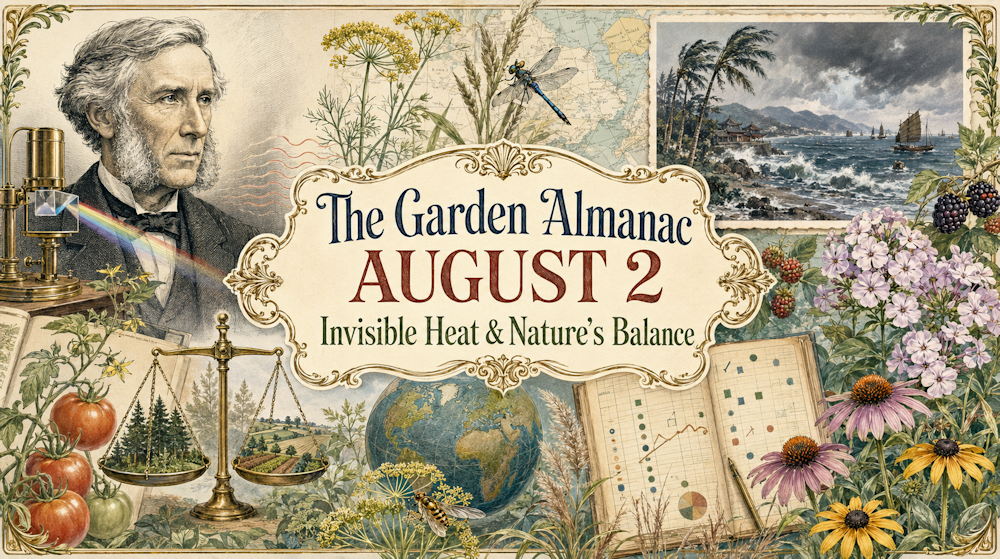

By August 2, the high-summer garden often appears to have reached its fullest expression. Tomatoes colour in the sun, seed heads rise above fading flowers, insects move busily between blooms, and every dry afternoon seems to ask for another watering can. Yet beneath this abundance, invisible forces are shaping what happens next.
This date connects three very different stories: the birth of a scientist who helped reveal how the atmosphere holds heat, a modern measure of humanity’s demand on nature, and one of the deadliest typhoons in recorded history. Together, they turn August 2 into a day for looking beyond the surface of the garden – towards the air above it, the resources that sustain it and the weather it may have to withstand.
August 2, 1820 – John Tyndall and the Heat We Cannot See
Irish physicist John Tyndall was born on August 2, 1820, in Leighlinbridge, County Carlow. After early work in land surveying and railway planning, he became one of the nineteenth century’s most gifted experimental scientists. His interests ranged from glaciers and mountain air to dust, light and the behaviour of gases.
In 1859, Tyndall began investigating how different gases interact with radiant heat. Eunice Newton Foote had already demonstrated in 1856 that carbon dioxide and water vapour warmed more strongly than ordinary air when exposed to sunlight. Tyndall’s more sensitive apparatus later showed how gases including water vapour, carbon dioxide and methane absorb infrared radiation – the invisible heat emitted by the warmed Earth.
This discovery helps explain something every gardener observes during summer. A garden’s temperature is determined not only by the reading at the nearest weather station, but also by moisture, shade, soil cover, wind and the materials surrounding it. Bare soil, stone paving and dark walls absorb solar energy during the day and release it later as heat, while trees and other plants cool their surroundings through shade and transpiration.
Gardeners can use these differences deliberately. A south-facing wall may help peaches, figs or grapes ripen in a cool region, but the same stored heat can scorch leafy vegetables or newly planted perennials during a hot spell. Adding trees, climbers, hedges and planted ground cover creates a more varied garden climate, giving plants and wildlife cooler places to retreat when temperatures rise.
Garden Science – Why Does a Garden Stay Hot After Sunset?
Soil, brick, concrete and stone absorb energy in daylight and release it slowly after the sun goes down. Built-up areas therefore remain warmer overnight than well-vegetated surroundings. Plants moderate this effect by shading surfaces and releasing water vapour through their leaves, although transpiration slows when soil becomes very dry.
August 2, 2017 – The Day Humanity Used Up Nature’s Annual Budget
August 2 became Earth Overshoot Day in 2017 – the calculated date on which humanity’s demand for ecological resources and services exceeded what the planet could regenerate during that year. The same date was announced again in 2023. Historical dates can change slightly when improved data and accounting methods are applied, but the central message remains clear: forests, fisheries, productive land and the atmosphere’s capacity to absorb carbon are being used faster than natural systems can renew them.
A garden cannot solve global ecological overshoot, but it makes the idea unusually easy to understand. Soil fertility declines when organic matter is continually removed and never returned. Stored rainwater disappears if it is used faster than the tank can refill. Flowers cannot support pollinators if they are cut or cleared before producing enough nectar, pollen and seed. Every healthy garden depends on cycles of renewal rather than a constant flow of outside resources.
The most useful response is not to stop gardening, but to make the garden more regenerative. Composting keeps nutrients on site, rainwater storage reduces demand for treated water, and long-lived plants require less repeated cultivation than short-lived bedding displays. Dividing established perennials, saving suitable seed and allowing autumn leaves to decompose beneath shrubs can also turn materials already present in the garden into next season’s fertility and habitat.
Garden Reminder – How Can You Use Fewer Resources in August?
- Water early in the morning and direct it towards the root zone rather than wetting the entire surface.
- Apply a 5–8 cm layer of organic mulch to moist, weed-free soil, keeping it clear of stems and trunks.
- Add disease-free plant material to the compost instead of sending it away as waste.
- Leave some seed heads for birds and overwintering insects.
- Replace struggling, frequently watered plants with species suited to the garden’s soil and climate.
August 2, 1922 – The Typhoon That Overwhelmed Shantou
Late on August 2, 1922, a powerful typhoon approached the coast of southern China near Shantou, then widely known as Swatow. Light wind and rain earlier in the day gave way to violent conditions as the atmospheric pressure fell. A storm surge reported at more than 3.5 metres swept into low-lying coastal communities, destroying settlements and carrying vessels far inland. Estimates vary, but the disaster killed tens of thousands of people and remains among the deadliest tropical cyclones on record.
The tragedy was shaped not only by the storm’s strength but also by exposure. Low ground, coastal settlement, limited warning systems and buildings unable to resist wind and water greatly increased the losses. Modern forecasting has improved enormously, yet gardens and cultivated landscapes still face the same physical forces: saturated soil, uprooting winds, saltwater intrusion, erosion and sudden flooding.
For gardeners, storm resilience begins with recognising how water and wind move through a site. Avoid planting large trees where failure could endanger a house, inspect mature specimens for weak unions or damaged roots, and do not leave climbing plants attached to unstable supports. Permeable paths, rain gardens, shallow swales and planted depressions can slow runoff, while mixed hedges filter wind more safely than solid barriers, which may create damaging turbulence behind them.
Wildlife Note – What Happens to Garden Animals During Storms?
Dense shrubs, hollow stems, mature trees and undisturbed ground vegetation provide shelter from heavy rain and strong wind. After a storm, check ponds for overflowing debris and refill shallow water dishes, but leave intact piles of leaves and twigs in place – insects, amphibians and small mammals may still be sheltering inside them.
Preparing the August Garden for Heat, Drought and Heavy Rain
Weather resilience is rarely created by a single dramatic intervention. It develops through diversity: plants of different heights, roots reaching different soil depths, ground that remains covered and several places where rainwater can soak in. A garden containing trees, shrubs, herbaceous perennials and low ground cover is generally better equipped to moderate heat and intercept intense rainfall than one dominated by paving and short-mown lawn.
Soil condition is especially important. Compacted ground sheds water quickly during a cloudburst yet can remain inaccessible to roots during drought. Adding organic matter at the surface, avoiding unnecessary digging and keeping permanent paths for foot traffic help preserve pore spaces through which air and water can move. Never cultivate waterlogged soil, as working it while saturated can destroy its structure.
Containers need separate attention because their small volume heats and dries rapidly. Grouping pots reduces exposure, and moving vulnerable plants into afternoon shade can prevent both leaf scorch and root damage. Make sure drainage holes remain open before heavy rain arrives – a drought-stressed plant can still be killed by waterlogging if its container suddenly fills during a storm.
What to Observe Right Now – Signs of a Changing Summer
Early August often reveals which parts of a garden are most resilient. Instead of looking only at flowers, notice how the whole site behaves.
- Which bed loses moisture first after watering?
- Where does shade remain during the hottest part of the afternoon?
- Do rainwater and loose soil collect at the bottom of paths?
- Which plants continue flowering without frequent irrigation?
- Are birds and insects concentrating in one cooler, more sheltered corner?
These observations form a practical map for autumn improvements. The hottest boundary may need a climber or small tree, a persistently dry bed may suit drought-tolerant planting, and a low point that briefly collects rain could become a planted basin rather than a drainage problem.
Looking Ahead
The stories attached to August 2 remind us that no garden is separated from the atmosphere, the wider use of natural resources or the movement of extreme weather. Tyndall’s invisible heat can be moderated locally with shade and vegetation, ecological demand can be reduced by keeping water and nutrients in circulation, and storm damage can be limited by healthy soil and thoughtful planting. Each improvement may appear small, but together they create gardens that consume less, shelter more life and recover more readily from change.