

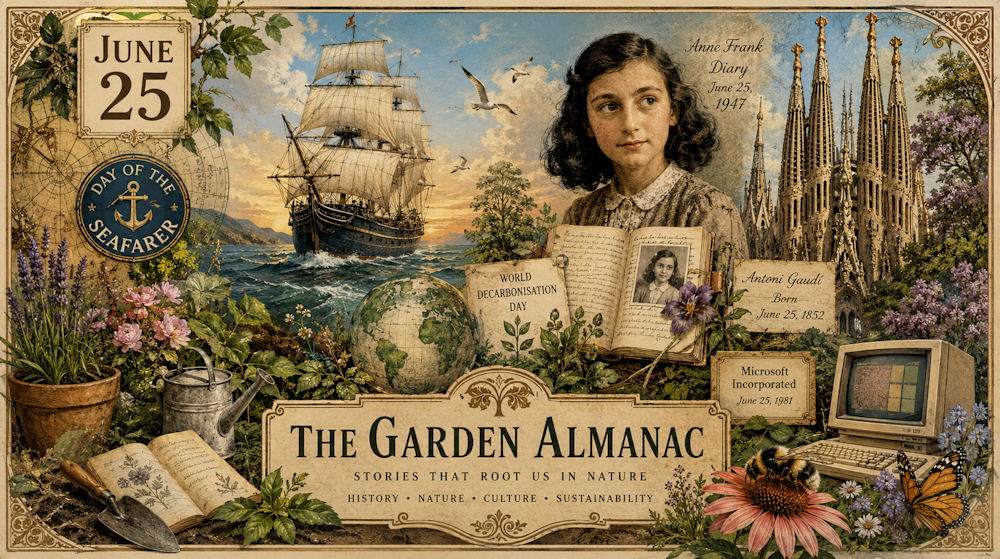

Late June is a time of fullness in the garden. Borders are dense with growth, trees cast deeper shade, and the first signs of midsummer abundance are everywhere – flowers, insects, ripening fruit and the long, warm evenings that make people linger outdoors.
June 25 brings together several very different stories, yet all of them circle around one essential idea: how people find their place within larger systems. The sea, the city, the written word and the built environment all appear in today’s almanac, each offering a different lesson for gardeners and nature lovers.
It is a day for thinking about connection – between land and ocean, memory and landscape, design and living forms, technology and sustainability. In the garden, those connections are never abstract. They are visible in every bee visiting a flower, every seed carried by wind, and every small decision that helps a place become more alive.
June 25 – Day of the Seafarer and the Garden’s Link to the Sea
June 25 is marked internationally as the Day of the Seafarer, a reminder of the people whose work keeps global maritime trade moving. At first glance, this may seem far removed from the world of gardens. Yet few gardens are truly separate from the sea.
The ocean shapes weather, moderates climate, feeds clouds and influences the movement of goods, seeds, tools and food across the world. Many garden plants have travelled by ship. So have spices, fruit trees, ornamental bulbs, timber, fibres and the materials used in greenhouses, pots and irrigation systems.
For a gardener, the Day of the Seafarer can become a quiet reminder that even the smallest garden is part of a much larger environmental and human network. The compost in a raised bed, the coir in a seed tray, the bamboo cane supporting tomatoes, or the terracotta pot on a patio may all carry traces of long journeys.
Garden Reminder
Late June is a good time to look at the hidden footprint of your garden:
- choose durable tools and pots that last for years
- reuse plant labels, trays and containers where possible
- buy peat-free or locally produced growing media when available
- support nurseries that are transparent about sourcing
- reduce unnecessary plastic in seasonal planting
A beautiful garden does not need to be disconnected from responsibility. Often, the most satisfying choices are the ones that last.
June 25, 1947 – Anne Frank’s Diary and the Garden as a Place of Memory
On June 25, 1947, Anne Frank’s diary was first published in Dutch as Het Achterhuis, later known in English as The Diary of a Young Girl. It is not a gardening anniversary in the usual sense, but it belongs in a garden almanac because it reminds us how deeply people need light, air, seasons and living things.
Anne wrote from hiding, cut off from ordinary freedom. The outside world – trees, sky, birds, weather, chestnut leaves moving in the wind – became more than scenery. It became a sign of life continuing beyond fear and confinement.
Gardens often hold this kind of meaning. They are not only places where plants grow. They are places where people remember, recover, mourn, hope and begin again. A tree planted after loss, a flowerbed kept by a grandparent, a bench beneath a favourite shrub – these are quiet forms of memory rooted in living soil.
Nature Watch
Today, take a few minutes to notice one ordinary natural detail with full attention:
- the movement of leaves in warm air
- the sound of insects around flowering herbs
- the shape of clouds before evening
- the smell of soil after watering
- the shade beneath a tree at midday
Small observations can become powerful anchors. A garden teaches us that memory is not always a monument. Sometimes it is a living thing that changes with the seasons.
Antoni Gaudí – When Architecture Learns from Plants
Antoni Gaudí was born on June 25, 1852. The Catalan architect is best known for his extraordinary buildings in Barcelona, especially the Sagrada Família, but his work also offers a fascinating lesson for gardeners: nature is not only decorative. It is structural.
Gaudí looked closely at the forms of trees, bones, shells, honeycombs, grasses and minerals. His architecture often feels as though it has grown rather than simply been built. Columns branch like trunks, surfaces ripple like stone shaped by water, and ornament seems to emerge from the natural world.
This is a useful idea for anyone designing a garden. The best gardens rarely feel imposed on a place. They respond to light, slope, wind, soil, movement and existing plants. A path can curve because people naturally walk that way. A seating area can sit where evening shade already falls. A planting scheme can echo the wild edges beyond the fence.
Garden Inspiration
Borrow a little Gaudí thinking in the garden:
- repeat natural shapes rather than forcing rigid symmetry everywhere
- use curves where they make movement feel more inviting
- let climbers soften walls, pergolas and fences
- combine texture, colour and structure instead of relying only on flowers
- observe how plants solve practical problems – shade, support, water capture, resilience
Nature is full of design intelligence. Gardeners do not need to copy it exactly, but they can learn from its patience, efficiency and beauty.
World Decarbonisation Day – A Practical Climate Reminder
June 25 is also listed in environmental calendars as World Decarbonisation Day. Whether marked widely or quietly, the idea behind it is highly relevant to gardeners: reducing carbon emissions is not only a matter for governments, industries and transport systems. It also touches the way we care for land.
Gardens can be small climate allies. Soil stores carbon when it is protected and fed with organic matter. Trees cool houses and streets. Hedges shelter wildlife and reduce wind. Perennial planting reduces repeated disturbance. Composting turns waste into fertility. Even a modest garden can become part of a more resilient local landscape.
This does not mean every gardener must aim for perfection. It means that practical, repeated choices matter.
Seasonal Tasks
In late June, climate-conscious gardening can be simple and useful:
- mulch bare soil before the hottest weeks arrive
- water deeply but less often to encourage stronger roots
- keep lawns slightly longer during heat
- plant for pollinators with long-flowering herbs and perennials
- compost green waste instead of sending it away
- add shade with trees, shrubs, climbers or pergolas
The most sustainable garden is often not the neatest one, but the one that protects life, soil and water through the season.
Microsoft Incorporated – From Digital Tools to Garden Knowledge
On June 25, 1981, Microsoft was incorporated, a milestone in the rise of personal computing. At first, this may seem like the least garden-like story of the day. Yet the digital revolution changed the way gardeners learn, plan and share.
Today, plant identification, weather alerts, seed catalogues, irrigation systems, garden journals and community advice all travel through digital tools. A gardener can compare varieties, track rainfall, design a bed, learn pruning techniques or identify a pest with a few taps.
But the garden still asks for something technology cannot replace: direct attention. No app can fully tell you how your own soil feels, when a plant looks thirsty, or how bees move through your border on a warm afternoon.
Seasonal Tip
Use digital tools as support, not as a substitute for observation. A good late-June garden habit is to keep a simple garden note:
- what is flowering now
- which plants are coping well with heat
- where the soil dries fastest
- which insects or birds you notice
- what you would change next year
The best garden knowledge is often both old and new – part record, part observation, part lived experience.
Looking Ahead
June 25 is a surprisingly rich date for a garden almanac. It speaks of seafarers and global connection, of a diary that preserved a young voice, of architecture inspired by natural forms, of carbon-conscious choices, and of digital tools that changed how knowledge moves.
For gardeners, the message is practical and hopeful. A garden is never isolated. It is connected to climate, trade, memory, design, technology and the living world beyond its boundaries.
Looking ahead, the most meaningful gardens will not simply be decorative spaces. They will be thoughtful, resilient places – rich in plants, attentive to soil, welcoming to wildlife, and shaped by people who understand that beauty and responsibility can grow together.
On June 25, that may be the most useful lesson of all: every garden, however small, can become a better answer to the world around it.