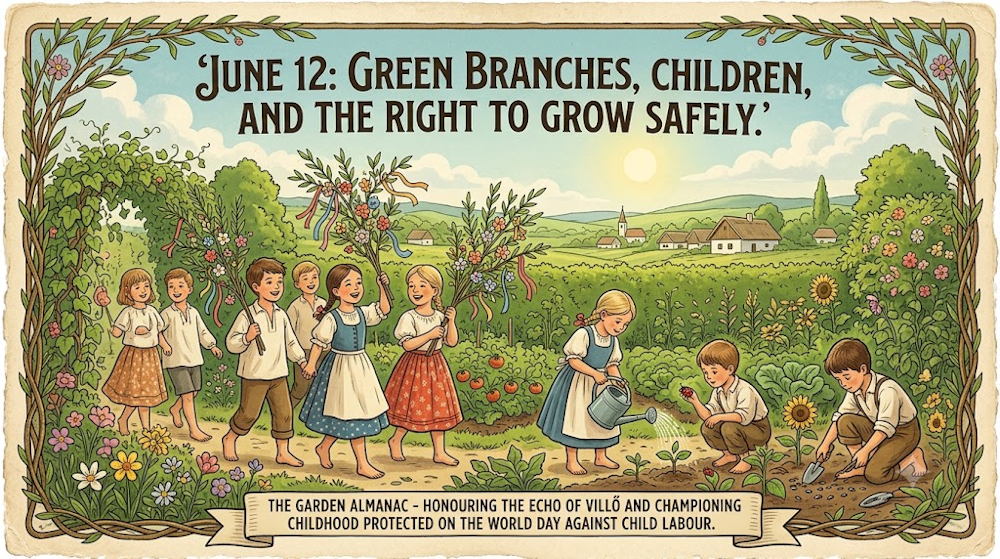

June 12 brings a tender but serious combination into the Garden Almanac: green branches, old spring customs, children, protection, and the right to grow in safety.
In Hungary, June 12 is the name day of Villő, a name that carries the memory of the villő, a decorated green branch used in a Palm Sunday spring custom. The custom itself did not belong to June 12. It belonged to spring. But the name day offers a beautiful opportunity to remember the old language of green branches, renewal, blessing and new life.
June 12 is also the World Day Against Child Labour, a global reminder that children should not be robbed of school, play, safety and childhood by exploitative work.
Together, these two threads create a powerful garden lesson: new life must not only be welcomed. It must be protected.
Green Branches and the Old Language of Spring
The villő was a decorated green branch, often associated with willow, carried from house to house by girls after the symbolic driving out of winter. The old spring custom belonged to the same world as many green-branch traditions: bringing freshness, fertility, blessing and renewal into the community.
A green branch was never just a decoration. It was a sign.
It said that winter had been pushed away, that the sap was rising, that houses and gardens were ready to receive new life. It carried hope from one household to another.
Willow made sense in this role. It greens early, bends easily, grows near water and responds quickly to spring. It is a plant of movement, moisture and renewal.
Villő: A Name That Carries a Branch
Because June 12 is Villő’s name day, the Garden Almanac can pause here, even though the folk custom itself belonged to Palm Sunday.
This distinction matters. We should not move the old custom into June by mistake. Instead, we can see the name day as an echo. The green branch of spring reaches into early summer as memory.
By June 12, the promise of spring is no longer symbolic. It is visible everywhere: thick hedges, strong shoots, climbing beans, vines needing tying, fruit swelling on branches, herbs ready for cutting, compost warming, and gardens entering their full summer work.
The green branch that once wished for growth has become the garden that must now be tended.
Children, Houses, and Blessings
In the old villő custom, children and young people carried the green branch, sang, offered blessings, and received eggs or gifts from households.
The image is simple and beautiful: children moving through the village with a branch of new life.
But June 12 also asks us to think carefully about children and work. There is a deep difference between children taking part in safe, joyful seasonal customs and children being forced into labour that harms their health, education or freedom.
A child helping to plant beans with a grandparent is one thing.
A child being denied school and safety through exploitative labour is another.
The garden can teach care, patience, responsibility and wonder. It must never become a place where childhood is consumed.
World Day Against Child Labour
The World Day Against Child Labour is observed on June 12 to draw attention to the need to end child labour and protect children’s rights. It reminds us that millions of children around the world are still burdened by work that is too heavy, too dangerous, too early or too costly to their future.
This belongs in the Garden Almanac because gardens and farms have always involved work. Food does not grow without labour. But ethical labour matters. Safe work matters. Childhood matters.
Children may learn from gardens. They may play in them, taste from them, water seedlings, gather herbs, ask questions, muddy their shoes, chase butterflies, plant sunflower seeds and discover that worms are not monsters.
That is not child labour. That is childhood rooted in life.
The difference is dignity, safety, freedom and choice.
The Garden as a Place to Grow Safely
A good garden for children is not only tidy or productive. It is safe enough to explore and alive enough to wonder at.
There is soil to touch, shade to rest in, flowers to smell, insects to watch, fruit to taste, water to handle carefully, tools to learn with supervision, and seasons to notice. A child in a garden learns before textbooks: wet and dry, soft and sharp, safe and unsafe, patience and reward.
This is one of the quiet powers of gardens. They can teach responsibility without stealing childhood. They can give work in the form of participation, not exploitation.
A child can carry a watering can and feel proud.
A child can plant a seed and wait.
A child can learn that living things need care.
That is a right kind of garden work.
Saint Onuphrius and the Bare Minimum of Shelter
June 12 is also associated in several Christian traditions with Saint Onuphrius, the desert hermit often remembered through images of solitude, poverty and survival in a harsh landscape.
His story adds a quieter layer to the day. A human being stripped down to the bare minimum still needs food, water, shelter, dignity and some form of protection.
Placed beside the World Day Against Child Labour, this becomes especially meaningful. No child should be reduced to mere survival. Children need more than endurance. They need safety, learning, play, affection and a future.
A garden can remind us of that too. A seedling does not thrive by simply surviving. It needs the right conditions to grow well.
Willow, Shelter, and the Ethics of Growth
The willow branch of the Villő custom and the global call to protect children meet in one shared idea: life needs shelter.
A willow needs water.
A seedling needs soil.
A child needs safety.
A garden needs care.
A community needs rituals that welcome new life, but also responsibilities that protect it.
Green branches are beautiful, but their meaning is incomplete if the life they symbolize is not protected afterwards.
This is true in gardens. It is true in households. It is true in societies.
What June 12 Teaches
June 12 teaches that new life should be welcomed with joy and protected with seriousness.
The old Villő branch carried blessings from house to house. The World Day Against Child Labour carries a different but related message across the world: children must be allowed to grow safely.
In the Garden Almanac on this day, green branches, children, gardens and justice belong together.
A branch can announce spring.
A garden can teach care.
A child can learn from soil.
But childhood must never be spent up like a resource.
The right garden for a child is not a place of exploitation. It is a place of play, learning, wonder, safety and gentle responsibility.
New life is not enough.
It must be guarded.