
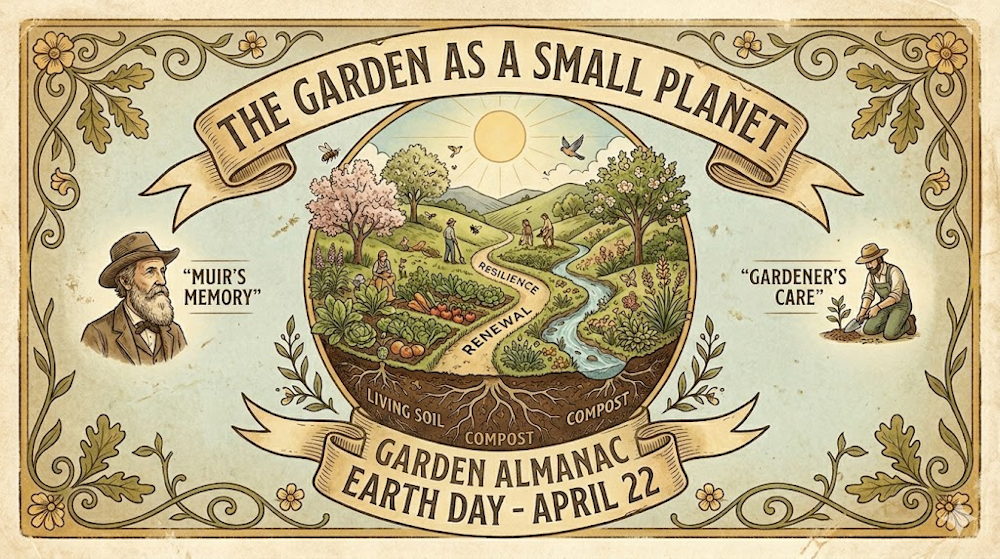

April 22 belongs to those modern dates that have already become larger than their original event. Around the world, it is recognized as Earth Day, yet in a garden almanac it feels even more intimate than global. The garden is one of the few places where environmental reality stops being abstract. Soil health, pollinators, water, waste, shade, heat, resilience, and renewal all become visible there.
That is why this day fits so naturally into the Garden Almanac. It is not attached to a single blossom or sowing custom, but to a way of seeing. April 22 asks the gardener to remember that every small cultivated space is part of a much larger living system.
Earth Day and the Garden Scale of Responsibility
Earth Day began as a civic call to attention, but gardeners understand its message almost instinctively. A garden teaches cause and effect quickly. Overfeed the soil, and balance shifts. Ignore biodiversity, and life thins out. Waste water, and stress shows. Make room for pollinators, compost, shade, and layered planting, and the whole place starts to behave differently.
In that sense, Earth Day is not only about the planet in the grandest sense. It is also about the ethics of tending. What do we take? What do we restore? What kind of abundance are we trying to create?
John Muir on This Day
April 22 is also associated in the Christian calendar with John Muir, whose name sits beautifully beside Earth Day. Muir became one of the best-known voices for protecting wild landscapes, and his memory carries a kind of moral clarity that suits this date. He reminds us that love of nature is incomplete if it never matures into protection.
In a garden, that same lesson appears in miniature. It is not enough to enjoy bloom, fruit, shelter, or birdsong. To care for a place fully also means protecting the conditions that make it alive: living soil, insect life, plant diversity, water, patience, and room for other species.
Older Wisdom Beneath a Modern Day
Although Earth Day is modern, the instinct behind it is much older. Farmers and gardeners have long known that land cannot be exhausted forever without consequence. Soil must be fed. Water must be respected. Variety matters. Extraction always has a price.
That older wisdom gives April 22 unusual depth in the almanac. The day may be contemporary in name, but its deepest lesson is ancient: the earth is not only something beneath us, but something we belong to.
What This Day Suggests in Practice
April 22 is a good day to look at the garden with wider eyes. Check where water is wasted. Notice whether there is food for pollinators. Ask whether the soil is being covered or left exposed. Think about compost, mulch, tree planting, mixed borders, native-friendly corners, and the kinds of changes that make a garden more alive rather than merely more controlled.
This is not a day for guilt as much as for alignment. The best Earth Day gesture in a garden is often not dramatic at all. It is the quiet decision to work with living systems instead of against them.
A Date That Keeps Growing
Some dates in the almanac are held up by tradition. Others gain weight because the modern world gives them new urgency. April 22 is one of those. In the garden, it is no longer just Earth Day as a public event. It is a reminder that every patch of tended ground is a conversation with the future.