

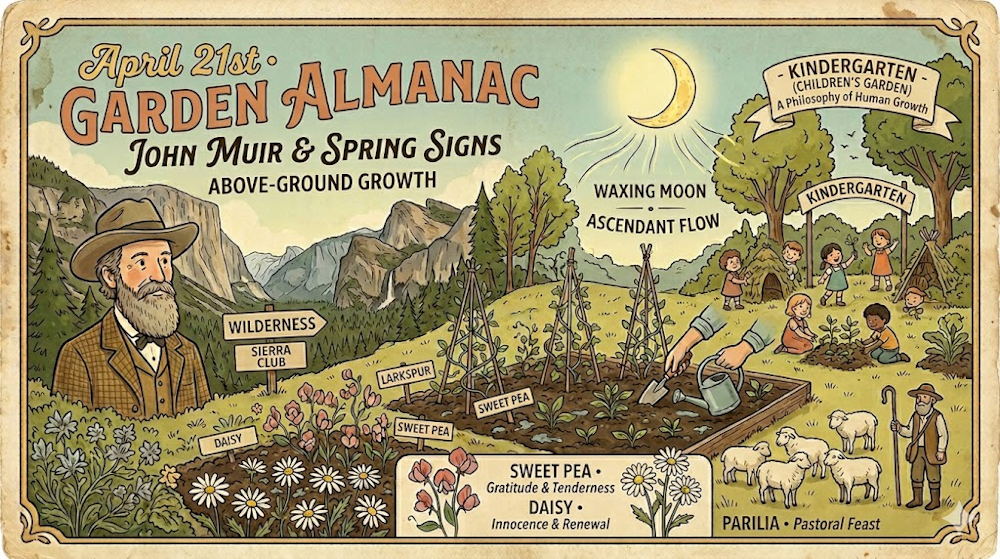

April 21 is one of those spring dates that feels quietly decisive. The season is no longer tentative, but it is not fully settled either. The garden is pushing upward with confidence, while the gardener still needs a little restraint. That balance makes this day especially fitting for an almanac entry: it is about motion, but also about attention.
For April 21, the strongest international thread is the birth of John Muir in 1838. But there is another beautiful strand in the background as well: Friedrich Froebel, whose educational idea of the kindergarten—literally a “children’s garden”—turned the image of cultivation into a philosophy of human growth. Muir was not a gardener in the narrow sense, but he was one of the great interpreters of living landscapes. His work helped shape the protection of forests and wild places, including Yosemite and Sequoia. On this day, his memory gives the garden calendar a wider horizon: the idea that to care for a garden well, one must also learn how to notice, value, and protect the larger natural world around it.
John Muir and the Discipline of Wonder
John Muir was born on April 21, 1838, in Dunbar, Scotland, and became one of the most influential voices for forest conservation in the United States. He was instrumental in the establishment of Yosemite and Sequoia National Parks and helped found the Sierra Club. In a garden almanac, that matters because Muir represents a habit gardeners understand deeply: careful looking.
A thriving garden does not come from constant interference. It comes from observation first, action second. Muir’s legacy fits April 21 beautifully because this is a time when leaves are expanding, root systems are settling, and patterns are becoming visible. The day invites the gardener to notice before correcting, and to protect before extracting.
Froebel and the Garden as a Model of Growth
April 21 is also associated with Friedrich Froebel, born in 1782, the educator who gave the world the word kindergarten. That phrase matters deeply in an almanac context because it imagines development in horticultural terms: not as force, but as tended growth. Children, in Froebel’s view, were to be nurtured as living beings in a garden, not processed as if they were products.
Gardeners understand this instinctively. You cannot hurry healthy growth by command. You can only create conditions in which it unfolds well. That makes Froebel unexpectedly relevant to April 21: the whole season is asking the same question—what needs intervention, and what simply needs room?
April Flowers and the Softer Language of Spring
April’s traditional flowers are the daisy and the sweet pea. Their symbolism—innocence, gratitude, tenderness, and renewal—matches the emotional tone of late April remarkably well. By this point in the season, the garden is no longer only a plan. It has become a presence.
That is why this date works so well as a flower-marked day in the almanac. The daisy suggests cheerful resilience. The sweet pea suggests fragrance, delicacy, and relationship. Together they remind us that gardens are not only productive spaces. They are also places of mood, memory, and seasonal character.
The Waxing Moon and Above-Ground Growth
Around April 21, the Moon often falls into the waxing part of its cycle Traditional moon-gardening systems often read this as a favorable period for plants grown for their leaves, stems, flowers, and other above-ground parts. Whether one follows lunar gardening literally or symbolically, the image is useful: the season is gathering upward force.
This is a good day to tend young growth, support emerging stems, and make small, thoughtful interventions that help the garden rise well rather than simply grow fast.
What This Day Suggests in Practice
April 21 is well suited to checking early structure in borders and beds, giving attention to leaf growth, sowing or tending ornamental climbers and annuals, and observing which parts of the garden are truly awake and which are still lagging behind. In an older Mediterranean seasonal imagination, the date also resonates with Parilia, the Roman spring festival of purification for herds, stalls, and pastoral life—a reminder that this part of the year has long been associated with clearing, tending, and beginning again. It is not a frantic day in the almanac. It is a clarifying one.
John Muir gives it a larger ecological conscience. The daisy and sweet pea give it springtime grace. The waxing moon gives it momentum. Altogether, on this day, the garden feels less like a task list and more like a living text that is becoming easier to read.