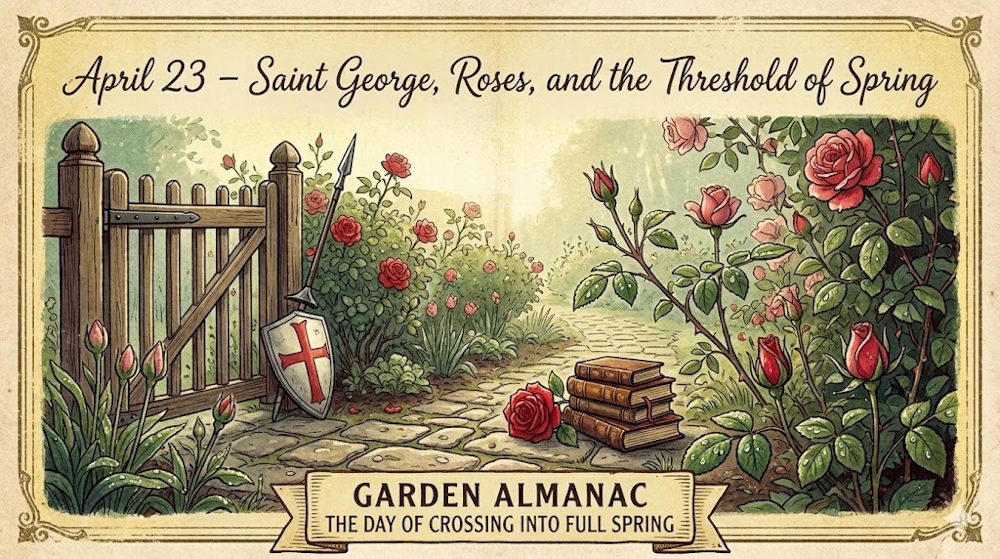

April 23 is one of those dates where folklore, season, and symbolism meet so naturally that the day almost seems to write itself. Across much of Europe, Saint George’s Day has long marked a true turning point in spring: a time of livestock going out, fields waking fully, and the year stepping into a more confident phase. In a garden almanac, this makes the date feel less like a commemoration and more like a threshold.
The day carries several strands that suit the Garden Almanac beautifully. There is Saint George’s old association with spring courage and protection. There is the pastoral tradition of seasonal turning-out, which belongs to the wider European rhythm of spring movement. And in Catalonia, there is Sant Jordi, where April 23 fills the streets with books and roses – perhaps one of the loveliest ways a calendar date has ever linked culture and flowers.
Saint George and the Threshold of Spring
Saint George’s Day has often been treated as a marker of real spring, not merely early promise. In pastoral tradition, it is tied to movement, renewal, and the opening of the outdoor season. That makes perfect sense in the garden. By this point, growth is no longer theoretical. Shoots are strengthening, beds are clarifying, and the season is beginning to reveal its direction.
A threshold day in the almanac is not simply about action. It is about reading the signs properly. April 23 invites the gardener to notice moisture, tenderness, momentum, and risk all at once.
Dew, Protection, and Living Energy
Many Saint George traditions place special meaning on dawn, dew, and the protective force of the season. Dew was often seen not merely as moisture, but as a sign of vitality, blessing, or fertility. For an almanac, that image remains powerful.
Gardeners know how much can be learned in the early morning. Dew reveals temperature, exposure, airflow, and the balance between tenderness and resilience. On a date like April 23, the dawn garden can feel almost diagnostic. It shows what is thriving, what is vulnerable, and what kind of spring is truly settling in.
Sant Jordi and the Rose in the Street
In Catalonia, April 23 becomes Sant Jordi, one of the most distinctive cultural spring celebrations in Europe. Books and roses fill the streets, turning the date into a festival of affection, language, and beauty. For a garden almanac, this is an irresistible detail. It ties one of spring’s most beloved flowers to a living civic ritual rather than to ornament alone.
The rose matters here not only as a symbol of love, but as a reminder that flowers are part of culture as much as cultivation. They move between the garden and the street, between growing and giving.
World Book Day and the Garden of Thought
April 23 is also recognized internationally as World Book Day. In the Garden Almanac, that offers a gentler secondary echo. A garden, like a book, asks to be read closely. It rewards return visits. It changes with the reader’s patience.
This gives the day an unusual richness: Saint George gives it its spring threshold, the dawn dew gives it atmosphere, the rose gives it beauty, and the book gives it reflection.
What This Day Suggests in Practice
April 23 is a good day to walk the garden early, pay attention to moisture, support young stems, assess what is truly taking hold, and notice where the season is still delicate. It is also a lovely moment to think about flowers not only as planting material, but as carriers of meaning.
This is not a date for rushing the garden into summer. It is a date for recognizing that spring has crossed an invisible line and is now fully asking for partnership.